Can you wear white after Labor Day if your destination is Earth orbit?
The Vast Astronaut Flight Suit showcases the company's "focus on human-centric design." The crew of Vast's Haven-1, planned as the world's first commercial space station, will wear this suit for events, training, and their mission in Earth orbit. Credit: Vast
After more than 25 years of US astronauts wearing off-the-rack clothes while living in Earth orbit, a company working to launch the world’s first commercial space station has adopted a more custom approach to its crew attire.
Vast has revealed its astronaut flight suit, a two-piece outfit designed to be worn both on and off the planet. The company also certified a custom-Swiss wristwatch for use aboard its upcoming Haven-1 space station.
“Over the last two decades on the International Space Station, astronauts have moved away from wearing flight suits every day,” Drew Feustel, Vast’s lead astronaut and former NASA mission specialist who spent 225 days in space, said in a statement. “The environment has become safer and more like how we work on Earth.”
Feustel contributed to the design of the Vast Astronaut Flight Suit.
“We wanted to honor the tradition and history of aviation in human spaceflight and flight suits themselves,” he said.
From used to use-driven
The origin of US astronauts adopting a uniform flight suit dates to the original Mercury pilots and an iconic photo showing them standing in front of an F-106 jet while wearing a hodgepodge of colors and military garments.
“When we were selected as astronauts in 1959, little effort was made to create a standard flying suit for us. Our classic photo in front of the F-106 jet shows how we had scrounged around to get flight equipment from the various armed services,” Mercury astronaut Gordon Cooper once said. “The dark blue NASA flight suit was mainly a result of the publication of that one photograph.”
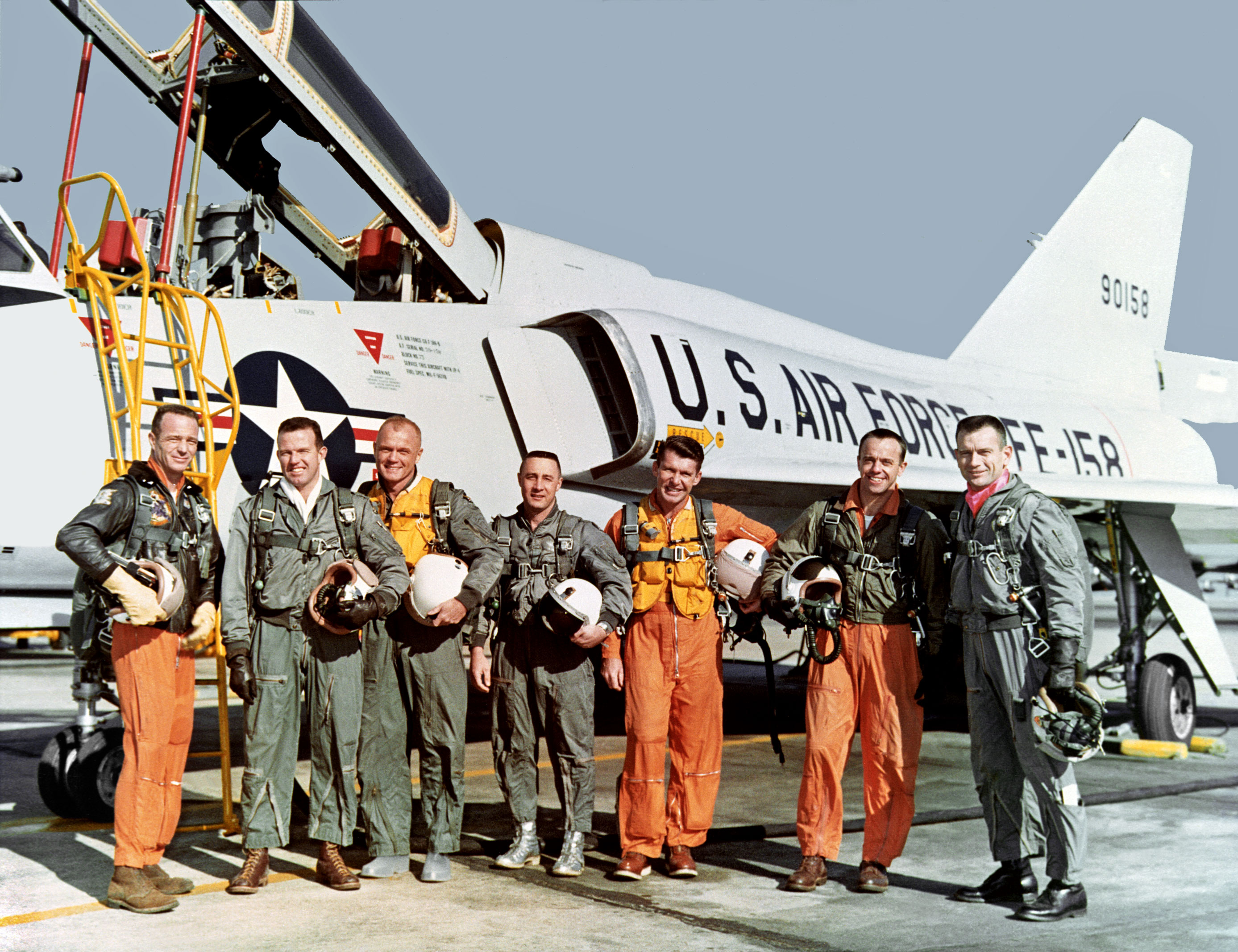
Astronaut flight suits originated after this 1961 photograph of the Mercury 7, which is said to have inspired NASA to adopt a uniform look for its then-burgeoning corps.
Credit: NASA
Astronaut flight suits originated after this 1961 photograph of the Mercury 7, which is said to have inspired NASA to adopt a uniform look for its then-burgeoning corps. Credit: NASA
At first, NASA’s blue flight suits were used only on the ground and on board aircraft. The Mercury and Gemini spacecraft were too cramped to change clothing, so on those early missions, the crew members remained in their pressure suits. Apollo was the first time that NASA astronauts could doff their bulky spacesuits for a shirt-sleeve-type environment. Their in-flight wear included a jacket and trousers made out of a fire-resistant glass fiber.
The same was true for life on the first US space station, Skylab. Instead of Beta Cloth, though, the crew’s outerwear was made out of polybenzimidazole (PBI), a less-itchy, fire-resistant golden-brown fabric.
The space shuttle initially saw the return to coveralls and two-piece flight suits that were worn throughout the entire mission. Crew members could also switch into matching powder-blue shorts and shed their pleated jackets for just polo shirts. This approach turned out to be too casual, though, and after Challenger and its seven-person crew were lost in 1986, NASA returned to using pressure suits for launch and landing.
The International Space Station, at least on the US operating side, adopted the later shuttle-era style of polo or rugby shirts coupled with slacks. On the winged orbiters, the dark blue legwear was custom to the program and covered in Velcro. On the ISS, NASA sought a commercial solution: Cabela’s hiker pants.
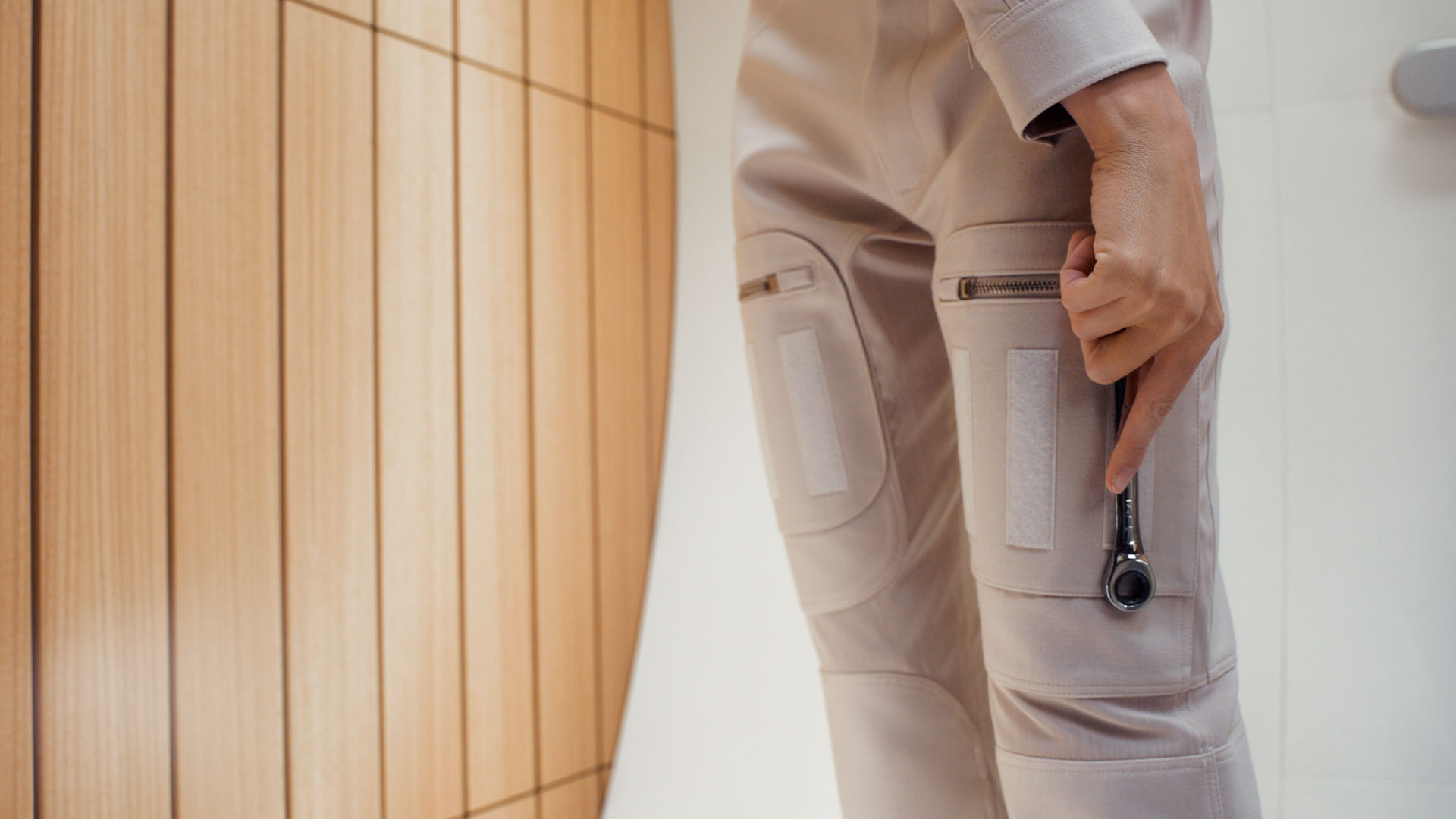
The Vast Astronaut Flight Suit has pockets and hook-and-fastener (Velcro) attach points to keep crew members’ tools handy.
Credit: Vast
The Vast Astronaut Flight Suit has pockets and hook-and-fastener (Velcro) attach points to keep crew members’ tools handy. Credit: Vast
Vast stepped back from off-the-shelf solutions to meet its “human-centric approach to design.” Over the next year, the suit will continue to undergo iterative testing and refinement, including material validation for safety, durability, and compatibility with the station’s environment.
Specifically suited
The Vast Astronaut Flight Suit was developed with the company’s clients in mind, from its fit to its features.
Worn as either a one- or two-piece garment by zipping (or unzipping) the jacket from the pants, the flight suit will be tailored to each crew member while also offering increased comfort and mobility through back vents and shoulder gussets. The suit also has pockets and hook-and-loop fasteners (Velcro) so tools can be easily stowed and retrieved.
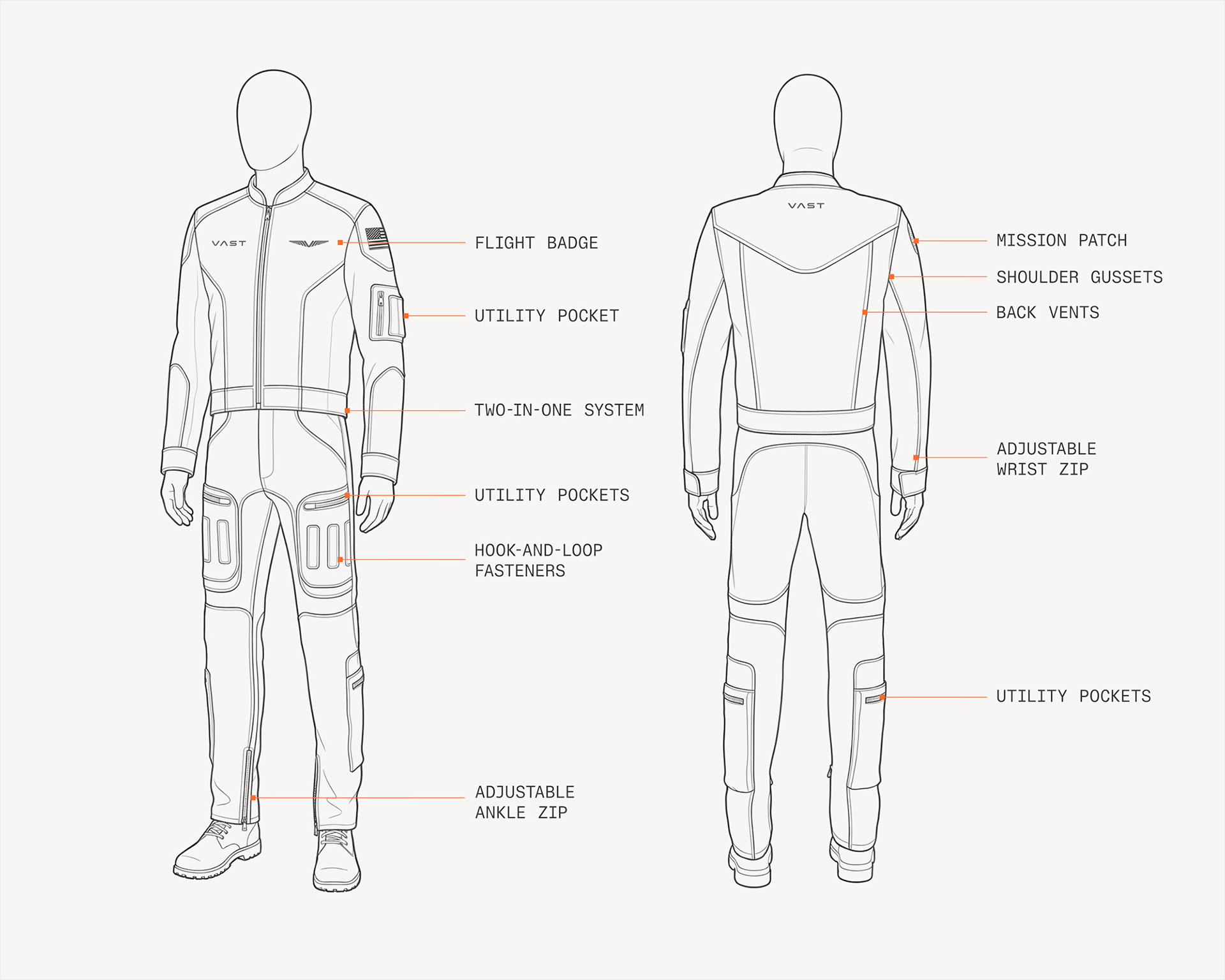
With utility in mind, Vast sought to create a highly functional flight suit optimized for both training on Earth and daily use aboard Haven-1 in orbit.
Credit: Vast
With utility in mind, Vast sought to create a highly functional flight suit optimized for both training on Earth and daily use aboard Haven-1 in orbit. Credit: Vast
“In microgravity, you need your hands free and your tools always within reach,” said former NASA astronaut Megan McArthur, who is also advising Vast. “You’re constantly moving through small spaces and positioning your body in ways we don’t experience on Earth.”
Despite its clean white color and uniform design, the suit also provides for points of personal customization. Each crew’s suits will sport their own mission patch, and it has a place for each crew member’s flight badge, “wings” that they will individually earn from Vast “by launching, living on orbit and performing mission operations in space,” according to the company.
Separate from the flight suit but along similar lines, Vast also recently certified the Pilot’s Venturer Vertical Drive for use in space. Designed by IWC Schaffhausen, a Swiss luxury watchmaker, the timepiece was engineered to meet the challenges specific to human spaceflight, including replacing the watch’s crown with a more glove-friendly rotating bezel. Under a partnership with IWC, Vast tested the Pilot’s Venturer Vertical Drive to make sure it could withstand the vibrations and pressure changes associated with a launch, as well as be compatible with the Haven-1 on board environment.
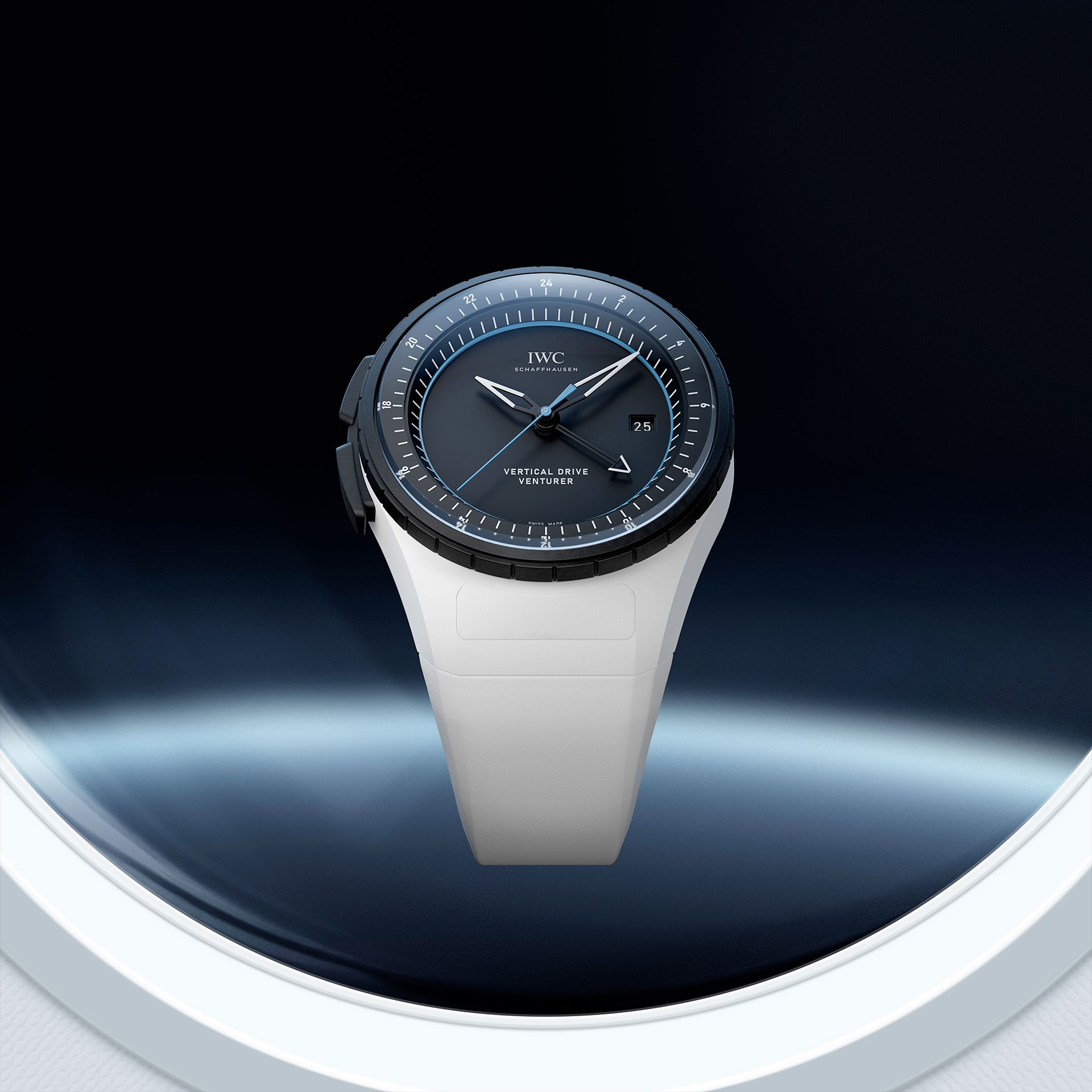
IWC Schaffhausen partnered with Vast to certify its Pilot’s Venturer Vertical Drive, a wristwatch designed for space.
Credit: IWC Schaffhausen
IWC Schaffhausen partnered with Vast to certify its Pilot’s Venturer Vertical Drive, a wristwatch designed for space. Credit: IWC Schaffhausen
(IWC Schaffhausen is offering the Pilot’s Venturer Vertical Drive to anyone for $28,200.)
“It’s something astronauts can actually use,” said Feustel. “This is the flight suit for the commercial, crewed spaceflight era, and it’s really just the beginning.”
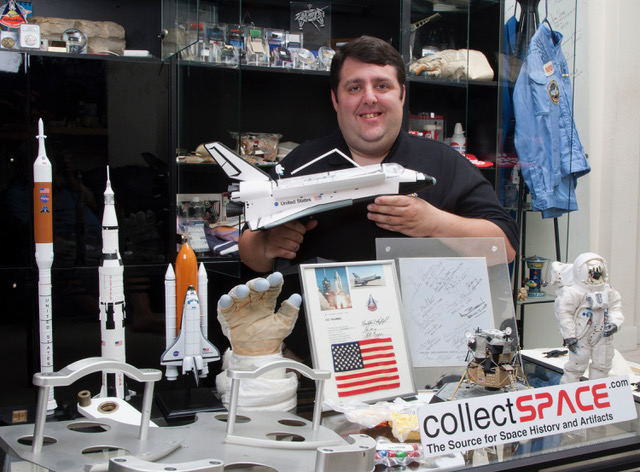
Robert Pearlman is a space historian, journalist and the founder and editor of collectSPACE, a daily news publication and online community focused on where space exploration intersects with pop culture. He is also a contributing writer for Space.com and co-author of "Space Stations: The Art, Science, and Reality of Working in Space” published by Smithsonian Books in 2018. He is on the leadership board for For All Moonkind and is a member of the American Astronautical Society's history committee.