Decision space
“If the spacecraft is ready to go, that’s going to give it a priority.”
A United Launch Alliance Vulcan rocket, powered by four solid-fueled boosters, lifts off from Cape Canaveral Space Force Station, Florida. Credit: United Launch Alliance
The US Space Force is still dealing with the near-term implications of the second grounding of United Launch Alliance’s Vulcan rocket in less than two years. The experience is likely to influence how the Pentagon buys launch services in the future, a three-star general said Tuesday.
The Vulcan rocket is one of the two primary launch vehicles the Space Force uses to put satellites into orbit, alongside SpaceX’s Falcon 9. Despite a backlog of nearly 70 launches, ULA’s Vulcan has flown just four times since debuting in January 2024.
On two of those flights, the Vulcan launcher suffered anomalies with one of its solid rocket boosters. One of the booster’s exhaust nozzles blew off in the first incident in October 2024. The same problem appeared to occur again during a Vulcan launch in February of this year. The rocket continued flying after both incidents, ultimately reaching each mission’s targeted orbit.
But the nozzle malfunctions suggest something is seriously amiss at ULA and its booster supplier, Northrop Grumman. The Vulcan rocket is many months from returning to flight for the US military. One industry source told Ars that the Space Force may not fly another mission on Vulcan before the end of the year.
Reputational harm
Lt. Gen. Philip Garrant, head of the Space Force’s Space Systems Command, said the Vulcan rocket’s reliability woes are top of mind among the military’s space leadership. On Tuesday, Garrant told Ars the experience with Vulcan “absolutely will shape” the military’s thinking the next time the Pentagon buys launch services.
“From my role, as essentially the person who accepts the risk of launching the rocket, it certainly shapes my decision space,” Garrant said.
Roughly half of the Space Force’s major launches planned over the next four years are assigned to the Vulcan rocket. ULA, a 50-50 joint venture between Boeing and Lockheed Martin, was the Pentagon’s No. 1 launch provider for nearly 20 years after the company’s creation in 2006, building a strong reputation for reliability with its Atlas V and Delta IV rockets. No ULA mission has failed to put its payload into orbit, and the company enjoyed near-perfect performance before the two close calls with Vulcan, the replacement for the Atlas and Delta rocket families.
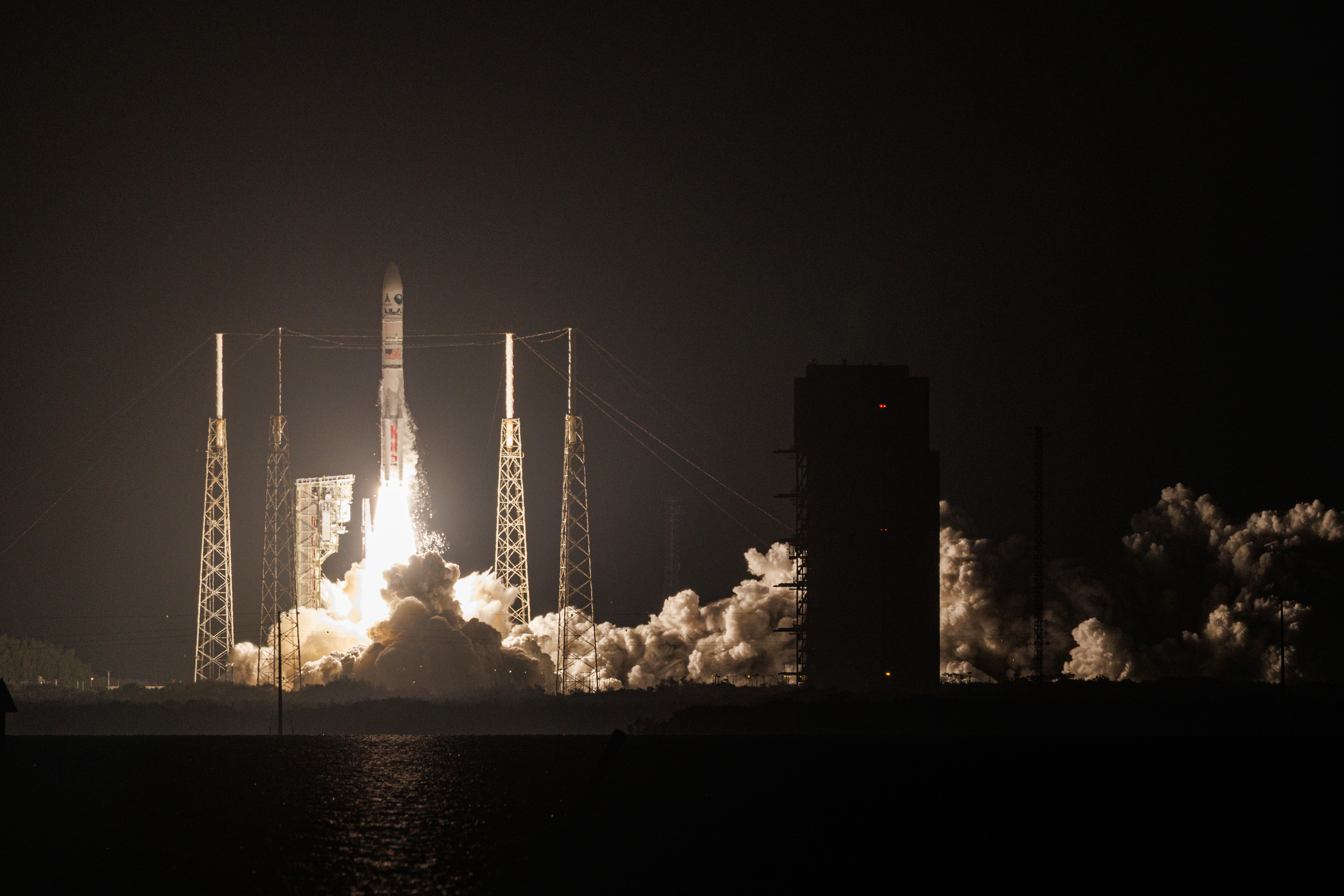
ULA’s Vulcan rocket lifts off on a mission for the US Space Force.
Credit: United Launch Alliance
ULA’s Vulcan rocket lifts off on a mission for the US Space Force. Credit: United Launch Alliance
ULA’s position as the Pentagon’s preferred launch provider changed last year, when SpaceX won the lion’s share of military launch contracts in a multiyear procurement stretching from 2025 through 2029. SpaceX’s reusable rockets are less expensive, and sometimes fly more times in a week than ULA’s expendable rockets fly in a year. The Space Force also last year added Blue Origin as a contractor in its roster of launch providers for the military’s National Security Space Launch (NSSL) missions. Blue Origin’s New Glenn rocket needs to launch successfully two more times before becoming certified for the Space Force’s most important NSSL missions.
Last year’s NSSL contracts set aside some of the military’s lower-priority, risk-tolerant payloads to launch on rockets that the Space Force has not yet certified. These missions usually launch experiments or groups of small satellites, adding capacity to the military’s low-Earth orbit constellations. The Space Force did this to give companies with new rockets a chance to compete.
“I can look out there and find providers to get to capability on orbit when it’s ready,” said Col. Eric Zarybnisky, portfolio acquisition executive for Space Access at Space Systems Command. The military’s experience with Vulcan “really drives home the importance of having multiple providers and not just having a singular provider flying assets to space,” he said Tuesday in a media briefing at the Space Foundation’s Space Symposium.
Shuffling the deck
Space Systems Command has moved four launches of new GPS navigation satellites from ULA to SpaceX in the past two years. The next GPS payload, previously assigned to Vulcan, will instead launch next week on a Falcon 9 rocket. This satellite was already at the launch site in Florida to prepare for a Vulcan launch this spring when ULA encountered the booster malfunction in February. Military officials made a quick swap to the Falcon 9, which flies from the launch pad next to ULA’s Vulcan launch complex at Cape Canaveral Space Force Station, Florida.
Zarybnisky said the military is “working through a significant number” of potential additional rocket swaps from Vulcan to another launch vehicle. “I really take in two factors as we’re working through how we do swaps,” he said. “One is the availability of the spacecraft. If the spacecraft is ready to go, that’s going to give it a priority.”
“It’s also talking to the warfighter, talking to Combat Forces Command, talking to the Headquarters, and understanding their priorities, that’s how we decide which missions we’re going to swap,” Zarybnisky said. “As far as the maximum number, I will say there are definitely missions that need Vulcan. We need Vulcan flying for this nation, but I continue to push my team… How do we get capability on orbit as fast as possible?”
Officials are also looking at modifying payload packages to make them light enough to launch on a Vulcan rocket without any solid rocket boosters. Garrant said this is an option for rideshare missions for the Space Development Agency, a Space Force unit deploying a fleet of missile-tracking and data-relay satellites. Each launch for the Space Development Agency carries multiple satellites—21 spacecraft in the case of a SpaceX launch last year. Removing a few satellites from a launch could make the payload stack light enough to reach orbit without needing the extra boost from strap-on motors.
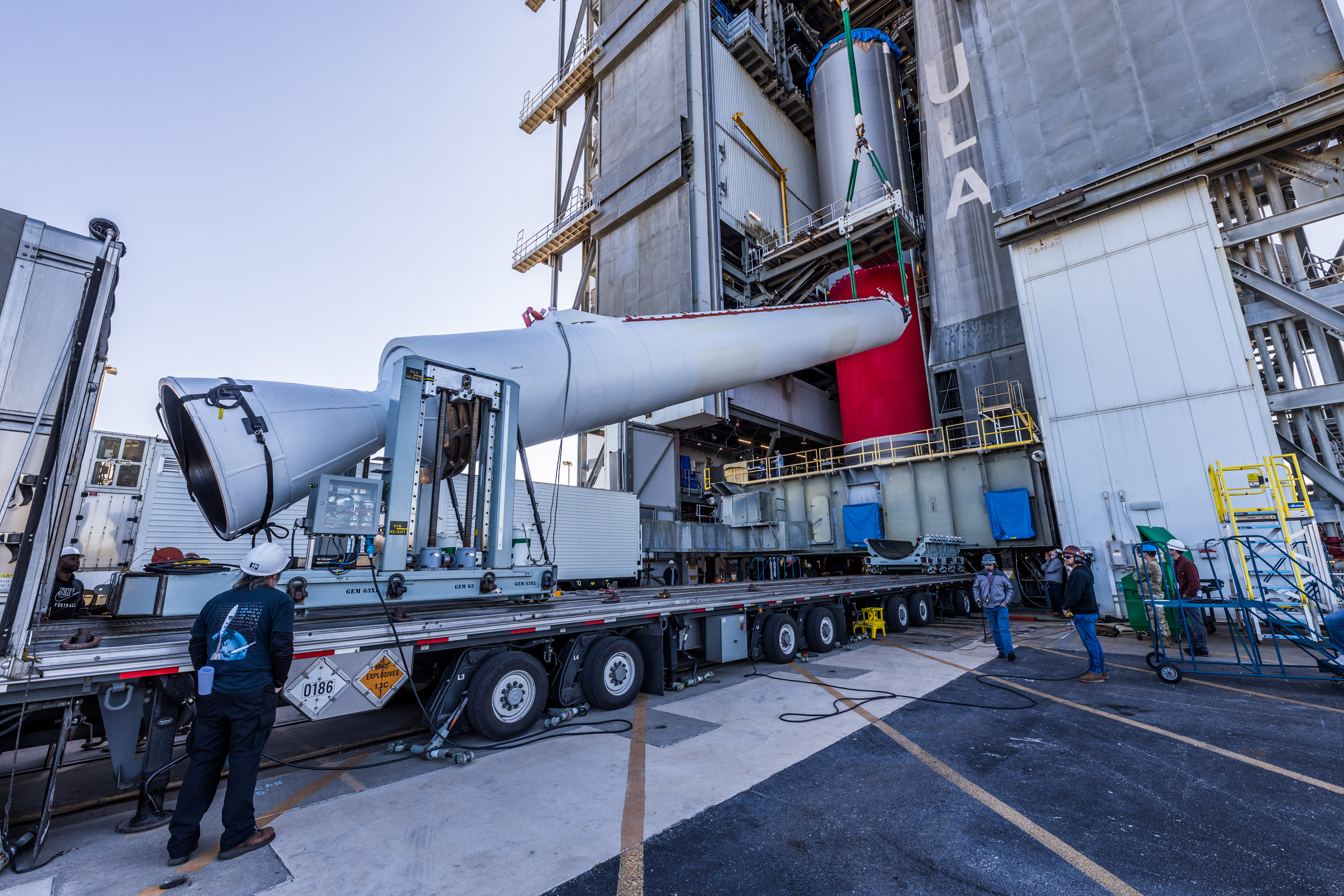
Technicians prepare to mate a Northrop Grumman-built solid rocket motor to the core stage of ULA’s Vulcan rocket.
Credit: United Launch Alliance
Technicians prepare to mate a Northrop Grumman-built solid rocket motor to the core stage of ULA’s Vulcan rocket. Credit: United Launch Alliance
Other national security missions awaiting launch on Vulcan rockets this year include the first in a new generation of Space Force missile-warning satellites in geosynchronous orbit. The Pentagon considers these satellites, each costing several billion dollars, as critical strategic assets. Another Vulcan launch this year was supposed to deliver the next set of Silent Barker space surveillance satellites to geosynchronous orbit for the Space Force and the National Reconnaissance Office. The launch of a new wide-band geosynchronous communications satellite is also affected by the Vulcan grounding.
These spacecraft are more bespoke than GPS satellites, which the Space Force can easily interchange between Vulcan and Falcon 9 without modification. They would also require a launch on SpaceX’s Falcon Heavy, so it wouldn’t be as easy to find an immediate slot in SpaceX’s launch schedule.
Finding root cause
In the meantime, engineers at ULA and Northrop Grumman continue their investigation into the cause of Vulcan’s boosters losing their nozzles. Northrop is planning a test-firing of a new nozzle design in Utah later this month, and Garrant said teams will attempt to recover the solid rocket boosters from the February launch from the floor of the Atlantic Ocean off the coast of Florida. ULA retrieved the boosters from a 2024 Vulcan launch to aid in the investigation of the first nozzle failure. The second nozzle failure suggests the inquiry into the first incident did not find the root cause.
ULA could resume flying Vulcan rockets before the Space Force gives the green light for Vulcan to launch a national security mission. ULA has 38 Vulcan launches in its order book for Amazon’s satellite Internet constellation. Amazon is currently launching satellites on ULA’s last few remaining Atlas V rockets. Once those run out, perhaps in mid-summer, ULA could look at launching Amazon satellites on Vulcan.
That would be “encouraging,” Zarybnisky said. “If they launch those and they have solid rocket boosters, that’s data we can use to inform our risk assessment for the government missions. But, I’ll say, until I am satisfied that root cause investigation is done with the right corrective actions, [Vulcan] will not have solid rocket booster flights for the government.”
The Space Force typically buys launch services for its most critical missions in five-year increments and commits to distributing an approximate number of individual missions, or task orders, among eligible launch providers. Space Systems Command makes mission assignments on an annual basis as specific payloads near readiness for launch.
The current NSSL contract carries the Space Force through October 1, 2029. Space Systems Command will spend the next 18 to 24 months assessing the launch market, including the performance of the military’s existing launch providers and the status of emerging rockets. The military is likely to begin asking for industry proposals in the next NSSL competition in 2028.
By then, military space officials hope to have a better handle on how much they can rely on ULA’s Vulcan rocket. Is it really flying twice per month, as ULA promises it will? Barring a major setback, Blue Origin’s New Glenn rocket is likely to be certified for NSSL missions before 2028, adding a new option to go alongside SpaceX’s Falcon 9 and Falcon Heavy.
At least some rockets from a roster of new entrants should have completed their initial flights by the end of 2028, but they may not be certified for the Space Force’s highest-priority launches. This list includes Rocket Lab’s Neutron, Stoke’s Nova, Firefly and Northrop’s Eclipse, and Relativity’s Terran R. SpaceX is also expected to propose Starship as a super-heavy-lift option for the Space Force, and the military will likely want to retain the Falcon 9 and Falcon Heavy as options into the 2030s. All have at least some element of reuse in their design.
This scenario gives the Space Force plenty of rockets to choose from, so the pressure is on for United Launch Alliance. With each delay, there’s less time for Vulcan to prove its mettle before the bell tolls on the Space Force’s next big rocket sweepstakes.

Stephen Clark is a space reporter at Ars Technica, covering private space companies and the world’s space agencies. Stephen writes about the nexus of technology, science, policy, and business on and off the planet.