
惯性聚合 高效追踪和阅读你感兴趣的博客、新闻、科技资讯
阅读原文 在惯性聚合中打开

推荐订阅源

cs.AI updates on arXiv.org
L
LINUX DO - 最新话题
OSCHINA 社区最新新闻
OSCHINA 社区最新新闻
Forbes - Security
Forbes - Security
博客园 - 司徒正美
Hugging Face - Blog
Hugging Face - Blog
W
WeLiveSecurity
Jina AI
Jina AI
钛媒体:引领未来商业与生活新知
钛媒体:引领未来商业与生活新知
N
News and Events Feed by Topic
V
V2EX
Stack Overflow Blog
Stack Overflow Blog
Engineering at Meta
Engineering at Meta
PCI Perspectives
PCI Perspectives
Martin Fowler
Martin Fowler
T
The Exploit Database - CXSecurity.com
F
Full Disclosure
WordPress大学
WordPress大学
S
Security Affairs
K
KPMG report finds enterprise disconnect between AI and its ROI | CIO
S
SegmentFault 最新的问题
P
Privacy International News Feed
IT之家
IT之家
M
MIT News - Artificial intelligence
G
GRAHAM CLULEY
Hacker News: Ask HN
Hacker News: Ask HN
D
DataBreaches.Net
奇客Solidot–传递最新科技情报
奇客Solidot–传递最新科技情报
Google Online Security Blog
cs.CV updates on arXiv.org
C
Check Point Blog
美团技术团队
Security Latest
Security Latest
Cyberwarzone
Cyberwarzone
N
News and Events Feed by Topic
MyScale Blog
MyScale Blog
H
Help Net Security
宝玉的分享
宝玉的分享
The Hacker News
The Hacker News
The Last Watchdog
The Last Watchdog
The Cloudflare Blog
Cyber Security Advisories - MS-ISAC
爱范儿
爱范儿
cs.CL updates on arXiv.org
I
Intezer
Threat Intelligence Blog | Flashpoint
AI
AI
I
InfoQ
N
News | PayPal Newsroom
TaoSecurity Blog
TaoSecurity Blog

Ars Technica

Microsoft issues emergency update for macOS and Linux ASP.NET threat Anthropic tested removing Claude Code from the Pro plan Coyote vs. Acme is finally getting released—with a killer trailer Google unveils two new TPUs designed for the "agentic era" Tabloid reports linking 10 missing and dead scientists spur FBI probe Physicists think they've solved the muon mystery New court ruling blocks many of the government's anti-renewable policies Indian med student rakes in thousands with AI-generated MAGA hottie As EV batteries improve, ChargePoint debuts 600 kW fast charger Our favorite gear at Sea Otter Classic wasn't the bikes—it was the accessories Investors lost billions on Trump’s memecoin. Another gala won’t fix that. Pentagon wants $54B for drones, more than most nations’ military budgets Mozilla: Anthropic's Mythos found 271 security vulnerabilities in Firefox 150 Supreme Court arguments make it clear that FCC fines are "nonbinding" Silo S3 teaser hints at the wasteland's origins Framework's CEO on the RAM crisis and creating a "MacBook Pro for Linux users" Florida probes ChatGPT role in mass shooting. OpenAI says bot "not responsible." Report: Meta will train AI agents by tracking employees' mouse, keyboard use Microsoft removes Call of Duty from Game Pass, lowers subscription pricing Framework Laptop 13 Pro is a major overhaul for the modular, upgradeable laptop Framework Laptop 16 upgrades make it look less like an unfinished prototype Internal emails show how Amazon raises prices across the Internet, lawsuit says Anthropic gets $5B investment from Amazon, will use it to buy Amazon chips CATL's new LFP battery can charge from 10 to 98% in less than 7 minutes AMD Ryzen 9 9950X3D2 Dual Edition review: Tons of cache for tons of dollars What's the deal with spacesuits for the Moon? Will they be ready in time? Loneliness in older adults can often lead to memory impairment Contrary to popular superstition, AES 128 is just fine in a post-quantum world Pentagon pulls the plug on one of the military's most troubled space programs John Ternus will replace Tim Cook as Apple CEO Blue Origin's rocket reuse achievement marred by upper stage failure I’ve fired one of America’s most powerful lasers—here’s what a shot day looks like Great white sharks are overheating US-sanctioned currency exchange says $15 million heist done by "unfriendly states" Man with @ihackedthegovernment Instagram account tells judge, “I made a mistake" Trump picks qualified, normal health leader to head CDC; experts still cautious $25,000 buys plenty of used EVs: Here are some options Satellite and drone images reveal big delays in US data center construction Amazon won’t release Fire Sticks that support sideloading anymore Ridley Scott's post-apocalyptic The Dog Stars drops first trailer Artemis II pilot talks about what it was really like to fly and land in Orion Meta's AI spending spree is helping make its Quest headsets more expensive Rocket Report: Starship V3 test-fired; ESA's tentative step toward crew launch Recent advances push Big Tech closer to the Q-Day danger zone After a saga of broken promises, a European rover finally has a ride to Mars Lucasfilm drops The Mandalorian and Grogu final trailer at CinemaCon Intel refreshes non-Ultra Core CPUs with new silicon for the first time OpenAI starts offering a biology-tuned LLM As they got close to the Moon, Artemis II astronauts were eager to land Mozilla launches Thunderbolt AI client with focus on self-hosted infrastructure Ad firms settle with Trump FTC over claims they boycotted conservative media New Codex features include the ability to use your computer in the background The Ukraine war's deep impact on Metro 2039’s development, story New undersea cable cutter risks Internet’s backbone Microsoft and Stellantis want to use AI to help car owners Gemini can now create personalized AI images by digging around in Google Photos RFK Jr. forces FDA to reconsider 12 unproven peptides after 2023 ban First look: Also's upcoming e-bike disconnects the pedals and wheels Meet the Quantum Kid The race to Shackleton Crater is on—will Jeff Bezos or China get there first? Florida surgeon charged with killing man after removing liver instead of spleen Jury finds Live Nation/Ticketmaster is illegal monopoly that overcharged fans "TotalRecall Reloaded" tool finds a side entrance to Windows 11's Recall database Google releases new apps for Windows and MacOS Boston Dynamics’ robot dog now reads gauges and thermometers with Google's AI Prime Video shows “technical difficulties” sign instead of NBA game in overtime New teaser gives us first look at Godzilla Minus Zero Vulcan woes will "absolutely" be a factor in Pentagon's next rocket competition Adobe takes Creative Cloud into Claude Code-esque territory Good Omens S3 trailer sets up a blessed conclusion Bubble watch: Fashion brand Allbirds pivots hard to become AI services company New 3D map of Universe could solve dark energy mystery What’s the deal with Alzheimer’s disease and amyloid? Blue Origin has a new employee stock plan, but not everyone is happy It's Tax Day, and no one knows how to file for prediction market winnings Ukraine’s military robot surge aims to offset drone risks to humans Sony killing features for antenna, set-top box users of Bravia smart TVs in May Americans ask AI for health care. Hospitals think the answer is more chatbots. Shock from Iran war has Trump's vision for US energy dominance flailing The Artemis II mission has ended. Where does NASA go from here? AI models are terrible at betting on soccer—especially xAI Grok Four astronauts are back home after a daring ride around the Moon Californians sue over AI tool that records doctor visits New paper argues history, not mantle plume, powers Yellowstone F1 moves a step closer to fixing its 2026 hybrid problem Report: US demands Reddit unmask ICE critic, summons firm to grand jury Microsoft's "commitment to Windows quality" starts with overhaul of beta program "Oobleck" still holds some surprises YouTube increases Premium price again, says 90-second unskippable ads are a bug Oldest octopus fossil found to not be an octopus What leaked "SteamGPT" files could mean for the PC gaming platform's use of AI Here's what to expect from the fiery, 14-minute return of Artemis II Pro-Iran Explosive Media trolls Trump with AI-generated Lego cartoons Dad stuck in support nightmare after teen lied about age on Discord Rocket Report: Chinese version of Falcon 9 fails; Artemis depends on rapid heavy lift Orion helium leak no threat to Artemis II reentry but will require redesign RFK Jr. rewrites CDC panel's charter, opening door to anti-vaccine quacks AI on the couch: Anthropic gives Claude 20 hours of psychiatry Clinical trial shows gene editing works for β-Thalassaemia, too “Negative” views of Broadcom driving thousands of VMware migrations, rival says
Study: Infrasound likely a key factor in alleged hauntings
Jennifer Ouellette · 2026-04-28 · via Ars Technica

they ain’t afraid of no ghosts

Low-frequency infrasound (below 20 Hz) can raise cortisol levels in saliva and increase irritability.

Ireland's Kinnitty Castle is reportedly the home of many ghosts, including the Phantom Monk of Kinnitty Credit: Public domain

The next time you walk into a purportedly “haunted” house and sense a ghostly presence, consider that those feelings might be due to vibrating pipes, mechanical or climate control systems, rumbling from traffic, or wind turbines, rather than anything paranormal. That’s the conclusion of a new paper published in the journal Frontiers in Behavioral Neuroscience. All of those are sources of infrasound.

Scientists have long sought to find logical explanations for alleged hauntings. In 2003, for instance, University of Hertfordshire psychologist Richard Wiseman conducted two studies that investigated the psychological mechanisms underlying supposed “ghostly” activity. Subjects walked around Hampton Court Palace in Surrey, England, and the South Bridge Vaults in Edinburgh, Scotland—both with reputations for manifesting unusual phenomena—and reported back on which places at those sites they sensed such phenomena. The subjects reported more odd experiences in places rumored to be haunted, regardless of whether the subjects were aware of those rumors or not.

Those areas did, however, feature variances in local magnetic fields, humidity, and lighting levels, suggesting that such sensations are simply people responding to normal environmental factors. Wiseman hypothesized that stronger magnetic fields may affect the brain, similar to how electrical stimulation of the angular gyrus can make one feel as if there is another person standing behind, mimicking one’s movements.

Furthermore, 70 percent of subjects in a related study of Mary King’s Close—another “haunted” location—reported suddenly feeling cold, like they were being watched or touched, or heard unexplained footsteps. The areas where they felt those things had markedly lower humidity. The experiences are therefore “real” in the sense that people are feeling the sensations; they’re just not likely due to ghosts. And those sensations are heightened when there is an expectation of a place being haunted.

The late Vic Tandy, an engineer at Coventry University, proposed another explanation: infrasound, particularly at a frequency of 18.9 Hz. This is just below the range of human hearing, but research has shown that humans may still subconsciously sense such sounds. Tandy thought infrasound was the culprit of an alleged haunting in a laboratory in Warwick, as well as a suspected ghost in the cellar of Coventry Cathedral.

Tandy had a spooky experience while working late one night at the Warwick laboratory. He felt the hairs rise on the back of his neck just as he caught a glimpse of a gray apparition out of the corner of his eye, which disappeared when he turned to face it. He thought the effect was due to infrasonic vibrations from a newly installed extractor fan; when he switched it off, he felt as if a huge weight had been lifted. But Tandy died in 2005 before he could investigate further, particularly into why some people seem to be affected in this way by infrasound and others are not.

Rodney Schmaltz of MacEwan University, co-author of this latest study, told Ars that such infrasound effects have long been a subject he discusses in his course on science and pseudoscience. Part of that course involves taking students on “ghost hunts” to debunk standard ghost-hunting tools. They usually test for infrasound, among other things. “What I thought might be happening is a misattribution of arousal, in the sense that people would just feel something,” he said. “They’re in an old building, they attribute it to ghosts. I wanted to see if there really was a strong fear response that was enhanced by infrasound.”

This prompted a small study project with his students. They built their own infrasound speakers and took them to a commercial haunted house during off-hours when the usual actors providing jump scares weren’t present. Then they recruited subjects to walk through the house and report on the sensations they experienced. Schmaltz noticed that whenever they turned on the infrasound, people would walk through the house faster. “It was interesting, but it certainly was not enough to definitively say what impact infrasound was having,” he said.

Testing the body’s stress response

A chance conversation with neuroscientist colleague (and co-author) Kale Scatterty inspired this latest study. Scatterty co-authored a 2023 paper demonstrating an aversion in zebrafish to infrasound, specifically an anxiety response that caused the fish to avoid certain tank areas. This suggested a physiological response to infrasound, and Schmaltz wanted to see if this was also true in humans. So they designed a lab-based experiment to test the hypothesis that cortisol levels in people’s saliva—part of the body’s normal stress response—would increase in response to infrasound.
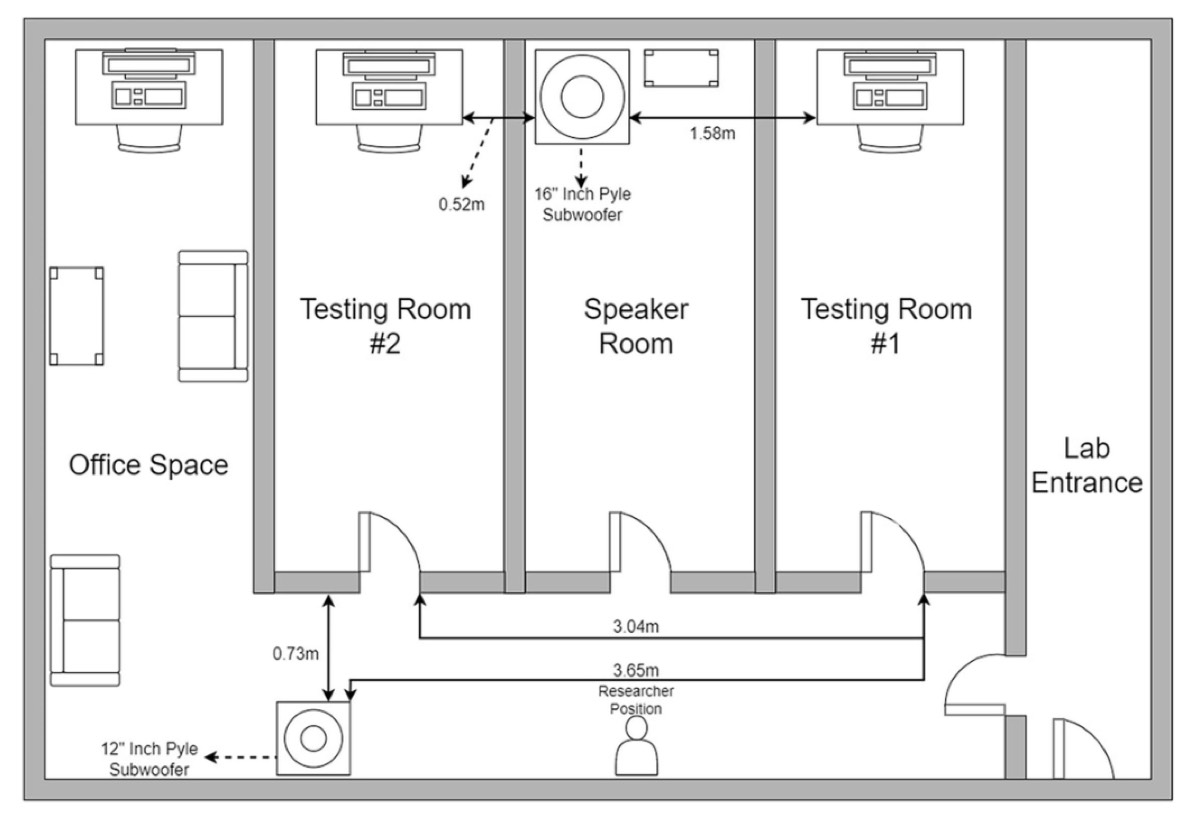
diagram showing setup of laboratory infrasound experiment

Visual layout of the testing area and equipment used in producing infrasound.

Credit: K.R. Scatterty et al., 2026

Visual layout of the testing area and equipment used in producing infrasound. Credit: K.R. Scatterty et al., 2026

Thirty-six participants sat alone in a room and were exposed either to calming music similar to what one might hear in a yoga setting, or “more unsettling ambient music,” per Schmaltz, with half of them also being exposed to infrasound emitted from hidden subwoofers. “What we thought might happen was when the infrasound was on, people would find the calming music even more relaxing, while the scarier music would be scarier,” he said.

Instead, the results showed that, across the board, participants felt more irritated and unsettled when the infrasound was turned on, regardless of which kind of music was playing, and their cortisol levels increased significantly. None of the participants could reliably tell when infrasound was present. This suggests that human beings can have a physiological response to infrasound even when we can’t consciously hear it.

While this is a promising result, infrasound is unlikely to be the sole factor behind our perceptions of hauntings; it’s probably one of several, including Wiseman’s earlier findings on suggestibility. “It’s not that infrasound is ‘causing’ hauntings,” said Schmaltz. “I want to be very clear on that. We’re definitely not saying we’ve solved hauntings. But in some of these older buildings, there could be low rumbling pipes [producing infrasound], and if somebody already has the expectation that something spooky might happen, the infrasound might drive that a bit. So infrasound doesn’t explain all of it, but it could certainly be a piece of the puzzle for some of these haunting experiences.”

It probably doesn’t explain Tandy’s strange visual illusion, however. “Tandy’s speculation was that the infrasound was making his eyes vibrate,” said Schmaltz. “I’m a bit skeptical. I just can’t imagine how you could generate that much infrasound.” His own experiments turned the decibel level quite high, as much as 75–78 dB, “but there was nothing along the lines of what Tandy experienced.”

Schmaltz readily acknowledges that his study has a very small, fairly homogenous sample size. That’s partly because testing saliva for cortisol levels is an expensive undertaking, and he only had an $8,000 grant to work with. He would love to expand on the work with a larger sample size, funds permitting. In the meantime, his team is visiting various supposedly haunted locations and measuring the infrasound levels to see if there is any difference between places thought to be haunted and those that are not. “We’re not finding much,” he admitted.

Future experiments might also expand the frequency range of the infrasound; the present study used infrasound in the 17–19 Hz range, about what one would get from a low-rumbling pipe or traffic. “We’re built to believe,” said Schmaltz of his ongoing efforts. “We’re hardwired to be belief engines. I’m just trying to promote tools to help people become better consumers of information, to identify when something sounds scientific but isn’t.”

Frontiers in Behavioral Neuroscience, 2026. DOI: 10.3389/fnbeh.2026.1729876 (About DOIs).

Photo of Jennifer Ouellette

Jennifer is a senior writer at Ars Technica with a particular focus on where science meets culture, covering everything from physics and related interdisciplinary topics to her favorite films and TV series. Jennifer lives in Baltimore with her spouse, physicist Sean M. Carroll, and their two cats, Ariel and Caliban.

149 Comments