Audi has developed an entirely new electric torque-vectoring rear differential.
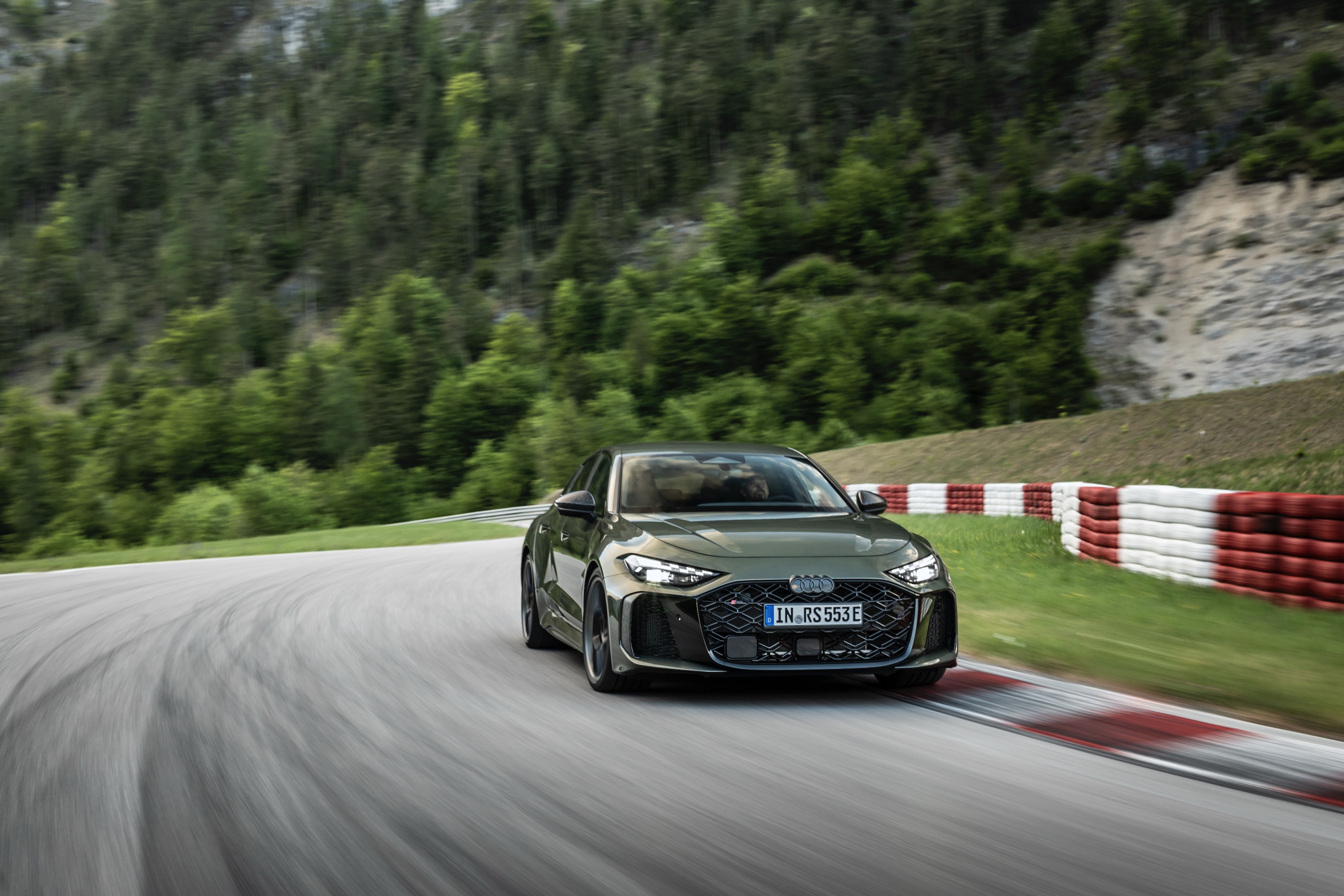
Audi Sport's new RS5 is also its first plug-in hybrid. Credit: Tobias Sagmeister/Audi
Audi Sport's new RS5 is also its first plug-in hybrid. Credit: Tobias Sagmeister/Audi
SAALFELDEN, Austria—Audi may have built a reputation for technology over the years, either pioneering or early-adopting things like all-wheel drive, direct-injection engines, and so on. But it’s also true that along the way it has earned a bit of a reputation for cars that look good inside and out but maybe aren’t the most exciting things on four wheels. Not so for the models reworked by Audi Sport, the company’s motorsports division, which now also spends its time building the company’s new Formula 1 power units.
And like those latest F1 cars, its newest RS5 road car also marries together a turbocharged V6 and an electric motor. How convenient.
The underlying chassis of the new RS5 is shared with the A5 that we first drove last summer, but the only common body panels between the lesser A5 and this car is the hood; everything else is RS5-specific. Aggressive wheel arch blisters add more than 3.5 inches (90 mm) of width compared to the A5, and massive air intakes dominate the front fascia. At the rear, a pair of large oval exhaust pipes are set into a diffuser. Oh, and you don’t get those kinds of carbon-fiber accents on a regular A5. Perhaps my favorite styling detail? The rear OLED tail lights have a checkered flag pattern (as do the daylight running lights up front).
The car looks good—although not as good as the RS5 Avant station wagon that we aren’t getting—but it’s what’s under the aluminum and carbon-fiber bodywork that’s more interesting. Audi’s lineup has been pretty sparse when it comes to plug-in hybrids, but Audi Sport decided that there were some tantalizing possibilities to unlock were it to leverage a high-voltage electrical system alongside a powerful internal combustion engine.
RS PHEV
That internal combustion engine shares the same 2.9 L capacity as the previous RS5 but is all-new. It uses a pair of variable geometry turbochargers in a hot-vee configuration (meaning the turbines are on top of the engine between the cylinder banks), with air-to-water intercoolers and air intakes as short as the Audi Sport engineers could make them. Even though it operates under a modified Miller cycle for better efficiency under partial loads, the new engine still manages to generate 502 hp (375 kW) and 442 lb (600 Nm). For the record, that’s 60 hp (45 kW) more than the old V6 while using about 20 percent less fuel.
Of course, if you’re worried about fuel consumption, make sure to plug the RS5 in regularly. There’s a usefully sized 22 kWh (net, 25.9 kWh gross) lithium-ion traction battery under the cargo floor that powers (among other things) the 174 hp (130 kW), 639 lb-ft (470 Nm) electric motor that also sends torque to the wheels via the car’s eight-speed ZF automatic transmission. That’s sufficient for about 50 miles (80 km) of emission-free motoring between charges, more than enough for most people’s daily driving needs. Since it’s a PHEV there’s obviously no DC charging ability, but it accepts AC power at up to 11 kW and takes 2.5 hours to recharge the battery.
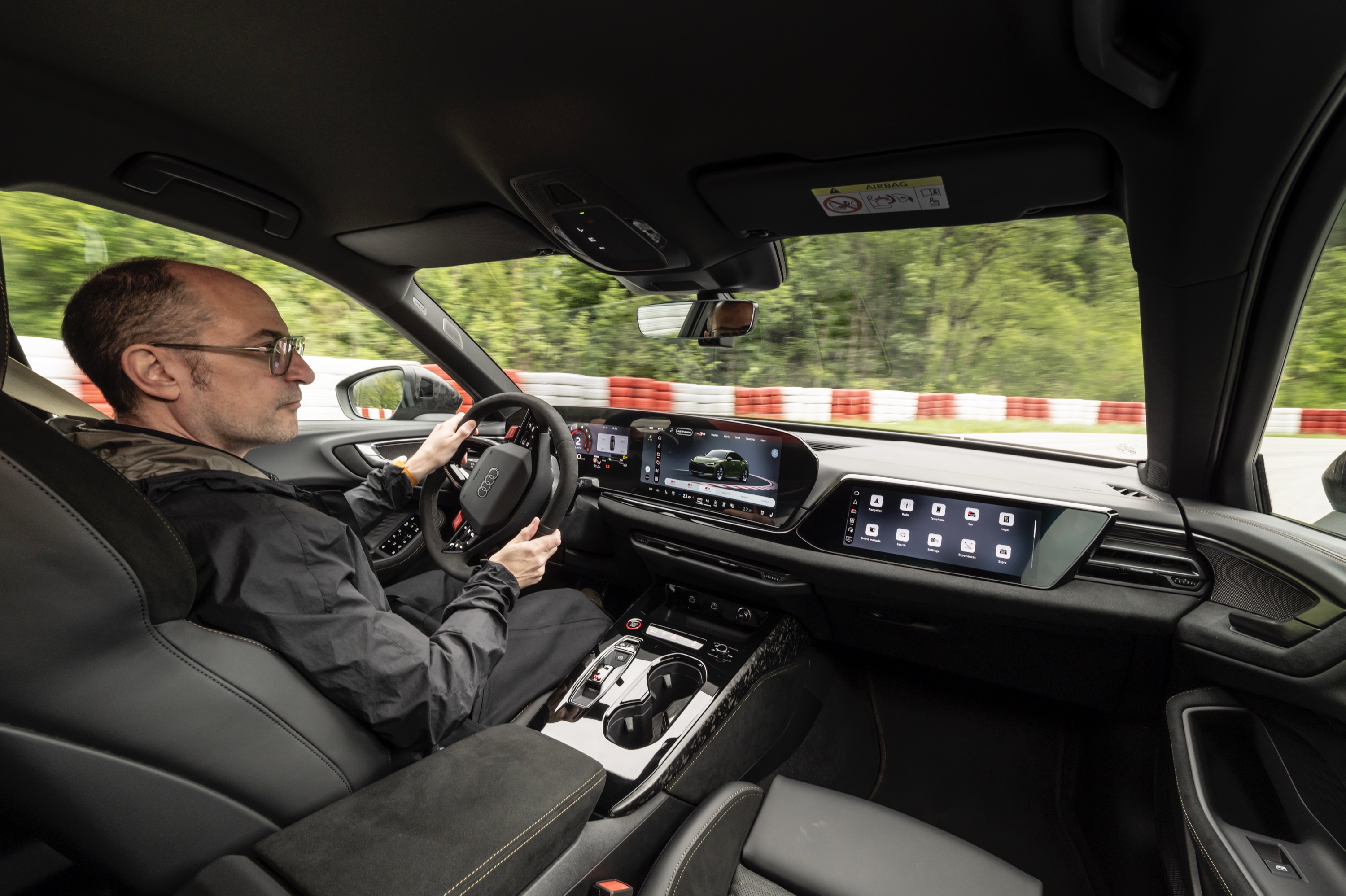
If you turn down the RS5’s electronic safety net it becomes a completely different car.
Credit: Tobias Sagmeister/Audi
If you turn down the RS5’s electronic safety net it becomes a completely different car. Credit: Tobias Sagmeister/Audi
It’s when both the V6 and electric motor are working together that you get all of the RS5’s performance—630 hp (470 kW) and 609 lb-ft (825 Nm)—making it more powerful but ever so slightly less torquey than the RS6 Avant that stole my heart a few weeks ago. You’ll want to select one of the RS drive modes to access that full performance; as we’ll see later, this car’s character is very electronic mode-dependent. Interestingly, you hear the hybrid system alongside the V6, with hums and whines from the electronics and electric motor that complement the usual induction, exhaust, and mechanical noises.
What’s the diff?
An actuator, overdrive gears, and a differential combine to intelligently transfer torque between the rear wheels. They do so almost fully variably depending on the driving situation and ensure Agility and Stability. Audi
Like all performance Audis, the RS5 uses Quattro all-wheel drive, here with a limited-slip center differential that splits power between 70/30 and 15/85 front to rear.
We have enjoyed torque-vectoring rear differentials on previous Audi RS models—the ability to send more power to individual rear wheels as necessary has played a big part in why people like cars like the RS3, TT-RS, R8, and so on. In those cars, the rear differential uses a clutch for each wheel to achieve that, but for the new RS5, Audi Sport decided to develop something new, internally.
It’s calling the new setup Dynamic Torque Control, and it does away with hydraulic clutches in favor of an 8 kW, 40 Nm electric motor (also powered by the 400 V traction battery) and some planetary gears. The electric motor lives on one side of the axle and applies torque to a powered sun gear at the other side. This sun gear acts on planetary gears, then a fixed sun gear connected to an open differential. It can add or subtract torque from the ring gear to the half shaft for an up to 1,475 lb-ft (2,000 Nm) split across the axle, or send it back to the open differential for a straight 50:50 split. Because it’s controlled by the electric motor, the diff will react in just 15 milliseconds, making the car neutral or allowing it to oversteer depending on the drive mode.
Split personalities
The handling can be neutral, or oversteer-y. Tobias Sagmeister/Audi
Driven on the road in Balanced, Comfort, or even Dynamic, you might not ever notice how clever the torque distribution is at the rear. The weather was fairly atrocious for much of my road driving in the RS5, with a mix of rain and late May snow at altitude. Yet despite wearing wide summer tires on 21-inch wheels and all that power and torque, its behavior was never anything less than locked down and stable on the road. So this really is a true all-weather performance car, in the way the best fast Audis always are.
With a curb weight of 5,180 lbs (2,350 kg), this PHEV is no featherweight, but the twin-valve dampers do a good job of controlling the ride and hiding that mass. As you switch into Dynamic, you notice the ride gets notably rougher, and the steering heavier but not any more communicative. And because the electric power is sent to the four wheels via that eight-speed ZF ‘box, sometimes the throttle response isn’t perhaps what you might expect from something electrified, as the transmission needs time to drop down a couple of gears.
I was also impressed with the battery capacity. Often on PHEV first drives, the cars’ battery packs are depleted by lunchtime and rarely recharged for the journalists who drive them later in the day. But with a 50-mile pack and a powertrain that tries to regenerate energy to the battery whenever it can, even my afternoon drives made full use of both aspects of the powertrain. It’s not that bad when limited to electric power alone—639 lb-ft is plenty to get the car moving, and it was quiet and smooth on battery power alone.
Lots of carbon trim for the interior. Tobias Sagmeister/Audi
Dare I say it, had I just driven the RS5 on the road, I would have left a little underwhelmed and missing that playful character that Audi Sport knows how to imbue in its models.
Then we tried it on track, where it felt like a completely different car. Set to RS Sport, with the electronic stability control turned down (but not off), an entirely new character emerged, one that was happy to spin its rear tires and slide its rear axle with the best of them. With a little power, it was simple to get the car into a slip angle and keep it balanced there with the throttle before straightening it all out for the next corner. I also have some praise for the brakes, which defer to using regenerative braking as much as possible before bringing in the friction brakes, again in the name of better efficiency.
Whether you have the RS5’s electronic brains set to Naughty or Nice, you still get a rather fabulous RS interior to enjoy it all from. I’d personally choose the Alcantara wheel over the dimpled leather as it feels so much nicer under the hand (although Alcantara can get grimy with heavy use), but all the touchpoints feel of the sort of quality you expect for a car of this price.
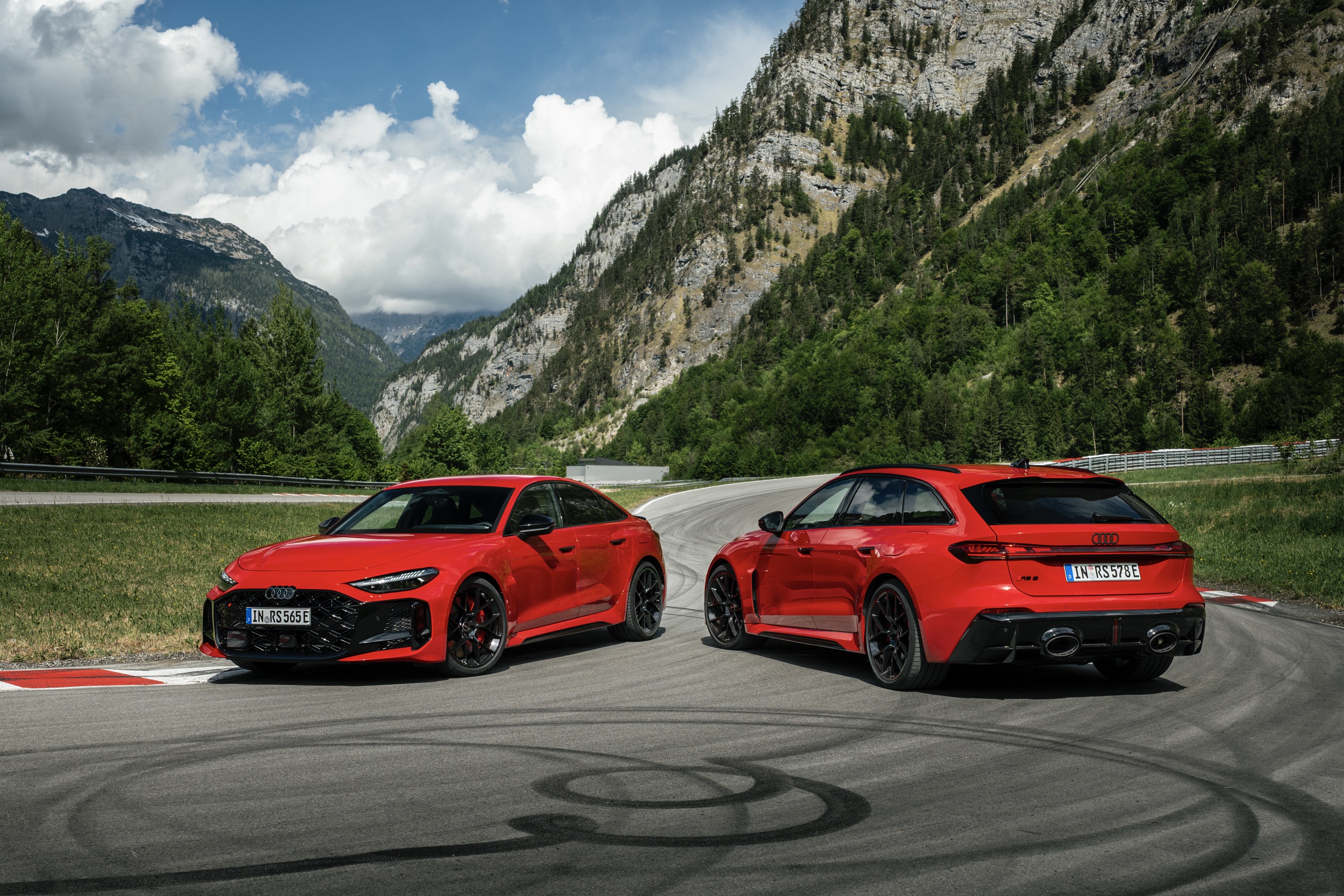
If you want the wagon, start bugging your dealership; it’s the only way it might happen.
Credit: Tobias Sagmeister/Audi
If you want the wagon, start bugging your dealership; it’s the only way it might happen. Credit: Tobias Sagmeister/Audi
Which is not finalized yet—US sales only start next year, and Audi of America is still finalizing specifications and pricing and so on. Expect a base starting price somewhere in the vicinity of $100,000 before you start adding options or packages. Now’s probably also the time to start hassling your local dealership if the one you really want is the RS5 Avant station wagon. Currently, there are no official plans to bring the RS5 wagon to the US, but they said that about the RS6 Avant, too, and as we learned earlier this week in our interview with Audi CEO Gernot Döllner, US Audi dealers persuaded the company to change its mind about that one.

Jonathan is the Automotive Editor at Ars Technica. He has a BSc and PhD in Pharmacology. In 2014 he decided to indulge his lifelong passion for the car by leaving the National Human Genome Research Institute and launching Ars Technica's automotive coverage. He lives in Washington, DC.