
惯性聚合 高效追踪和阅读你感兴趣的博客、新闻、科技资讯
阅读原文 在惯性聚合中打开

推荐订阅源

F
Fortinet All Blogs
S
Secure Thoughts
月光博客
月光博客
美团技术团队
雷峰网
雷峰网
Exploit-DB.com RSS Feed
奇客Solidot–传递最新科技情报
奇客Solidot–传递最新科技情报
N
News and Events Feed by Topic
freeCodeCamp Programming Tutorials: Python, JavaScript, Git & More
Forbes - Security
Forbes - Security
W
WeLiveSecurity
P
Proofpoint News Feed
阮一峰的网络日志
阮一峰的网络日志
爱范儿
爱范儿
G
GRAHAM CLULEY
cs.AI updates on arXiv.org
AI
AI
Last Week in AI
Last Week in AI
Google Online Security Blog
Schneier on Security
云风的 BLOG
云风的 BLOG
Threat Intelligence Blog | Flashpoint
Recent Announcements
Webroot Blog
Webroot Blog
T
Tor Project blog
Cisco Talos Blog
Cisco Talos Blog
N
News and Events Feed by Topic
罗磊的独立博客
The Register - Security
Blog — PlanetScale
Blog — PlanetScale
T
Threat Research - Cisco Blogs
博客园 - 【当耐特】
Apple Machine Learning Research
人人都是产品经理
人人都是产品经理
T
The Exploit Database - CXSecurity.com
www.infosecurity-magazine.com
B
Blog
腾讯CDC
Microsoft Azure Blog
酷 壳 – CoolShell
酷 壳 – CoolShell
H
Hacker News: Front Page
Application and Cybersecurity Blog
Engineering at Meta
Engineering at Meta
Latest news
Latest news
IT之家
IT之家
D
DataBreaches.Net
博客园 - 司徒正美
N
Netflix TechBlog - Medium
V
V2EX
钛媒体:引领未来商业与生活新知
钛媒体:引领未来商业与生活新知

Ars Technica

Microsoft issues emergency update for macOS and Linux ASP.NET threat Anthropic tested removing Claude Code from the Pro plan Coyote vs. Acme is finally getting released—with a killer trailer Google unveils two new TPUs designed for the "agentic era" Tabloid reports linking 10 missing and dead scientists spur FBI probe Physicists think they've solved the muon mystery New court ruling blocks many of the government's anti-renewable policies Indian med student rakes in thousands with AI-generated MAGA hottie As EV batteries improve, ChargePoint debuts 600 kW fast charger Our favorite gear at Sea Otter Classic wasn't the bikes—it was the accessories Investors lost billions on Trump’s memecoin. Another gala won’t fix that. Pentagon wants $54B for drones, more than most nations’ military budgets Mozilla: Anthropic's Mythos found 271 security vulnerabilities in Firefox 150 Supreme Court arguments make it clear that FCC fines are "nonbinding" Silo S3 teaser hints at the wasteland's origins Framework's CEO on the RAM crisis and creating a "MacBook Pro for Linux users" Florida probes ChatGPT role in mass shooting. OpenAI says bot "not responsible." Report: Meta will train AI agents by tracking employees' mouse, keyboard use Microsoft removes Call of Duty from Game Pass, lowers subscription pricing Framework Laptop 13 Pro is a major overhaul for the modular, upgradeable laptop Framework Laptop 16 upgrades make it look less like an unfinished prototype Internal emails show how Amazon raises prices across the Internet, lawsuit says Anthropic gets $5B investment from Amazon, will use it to buy Amazon chips CATL's new LFP battery can charge from 10 to 98% in less than 7 minutes AMD Ryzen 9 9950X3D2 Dual Edition review: Tons of cache for tons of dollars What's the deal with spacesuits for the Moon? Will they be ready in time? Loneliness in older adults can often lead to memory impairment Contrary to popular superstition, AES 128 is just fine in a post-quantum world Pentagon pulls the plug on one of the military's most troubled space programs John Ternus will replace Tim Cook as Apple CEO Blue Origin's rocket reuse achievement marred by upper stage failure I’ve fired one of America’s most powerful lasers—here’s what a shot day looks like Great white sharks are overheating US-sanctioned currency exchange says $15 million heist done by "unfriendly states" Man with @ihackedthegovernment Instagram account tells judge, “I made a mistake" Trump picks qualified, normal health leader to head CDC; experts still cautious $25,000 buys plenty of used EVs: Here are some options Satellite and drone images reveal big delays in US data center construction Amazon won’t release Fire Sticks that support sideloading anymore Ridley Scott's post-apocalyptic The Dog Stars drops first trailer Artemis II pilot talks about what it was really like to fly and land in Orion Meta's AI spending spree is helping make its Quest headsets more expensive Rocket Report: Starship V3 test-fired; ESA's tentative step toward crew launch Recent advances push Big Tech closer to the Q-Day danger zone After a saga of broken promises, a European rover finally has a ride to Mars Lucasfilm drops The Mandalorian and Grogu final trailer at CinemaCon Intel refreshes non-Ultra Core CPUs with new silicon for the first time OpenAI starts offering a biology-tuned LLM As they got close to the Moon, Artemis II astronauts were eager to land Mozilla launches Thunderbolt AI client with focus on self-hosted infrastructure Ad firms settle with Trump FTC over claims they boycotted conservative media New Codex features include the ability to use your computer in the background The Ukraine war's deep impact on Metro 2039’s development, story New undersea cable cutter risks Internet’s backbone Microsoft and Stellantis want to use AI to help car owners Gemini can now create personalized AI images by digging around in Google Photos RFK Jr. forces FDA to reconsider 12 unproven peptides after 2023 ban First look: Also's upcoming e-bike disconnects the pedals and wheels Meet the Quantum Kid The race to Shackleton Crater is on—will Jeff Bezos or China get there first? Florida surgeon charged with killing man after removing liver instead of spleen Jury finds Live Nation/Ticketmaster is illegal monopoly that overcharged fans "TotalRecall Reloaded" tool finds a side entrance to Windows 11's Recall database Google releases new apps for Windows and MacOS Boston Dynamics’ robot dog now reads gauges and thermometers with Google's AI Prime Video shows “technical difficulties” sign instead of NBA game in overtime New teaser gives us first look at Godzilla Minus Zero Vulcan woes will "absolutely" be a factor in Pentagon's next rocket competition Adobe takes Creative Cloud into Claude Code-esque territory Good Omens S3 trailer sets up a blessed conclusion Bubble watch: Fashion brand Allbirds pivots hard to become AI services company New 3D map of Universe could solve dark energy mystery What’s the deal with Alzheimer’s disease and amyloid? Blue Origin has a new employee stock plan, but not everyone is happy It's Tax Day, and no one knows how to file for prediction market winnings Ukraine’s military robot surge aims to offset drone risks to humans Sony killing features for antenna, set-top box users of Bravia smart TVs in May Americans ask AI for health care. Hospitals think the answer is more chatbots. Shock from Iran war has Trump's vision for US energy dominance flailing The Artemis II mission has ended. Where does NASA go from here? AI models are terrible at betting on soccer—especially xAI Grok Four astronauts are back home after a daring ride around the Moon Californians sue over AI tool that records doctor visits New paper argues history, not mantle plume, powers Yellowstone F1 moves a step closer to fixing its 2026 hybrid problem Report: US demands Reddit unmask ICE critic, summons firm to grand jury Microsoft's "commitment to Windows quality" starts with overhaul of beta program "Oobleck" still holds some surprises YouTube increases Premium price again, says 90-second unskippable ads are a bug Oldest octopus fossil found to not be an octopus What leaked "SteamGPT" files could mean for the PC gaming platform's use of AI Here's what to expect from the fiery, 14-minute return of Artemis II Pro-Iran Explosive Media trolls Trump with AI-generated Lego cartoons Dad stuck in support nightmare after teen lied about age on Discord Rocket Report: Chinese version of Falcon 9 fails; Artemis depends on rapid heavy lift Orion helium leak no threat to Artemis II reentry but will require redesign RFK Jr. rewrites CDC panel's charter, opening door to anti-vaccine quacks AI on the couch: Anthropic gives Claude 20 hours of psychiatry Clinical trial shows gene editing works for β-Thalassaemia, too “Negative” views of Broadcom driving thousands of VMware migrations, rival says
Eight months early and under budget, the Roman Telescope is ready to launch
John Timmer · 2026-04-24 · via Ars Technica

Spy satellite hardware has been repurposed to scan the Universe in the infrared.
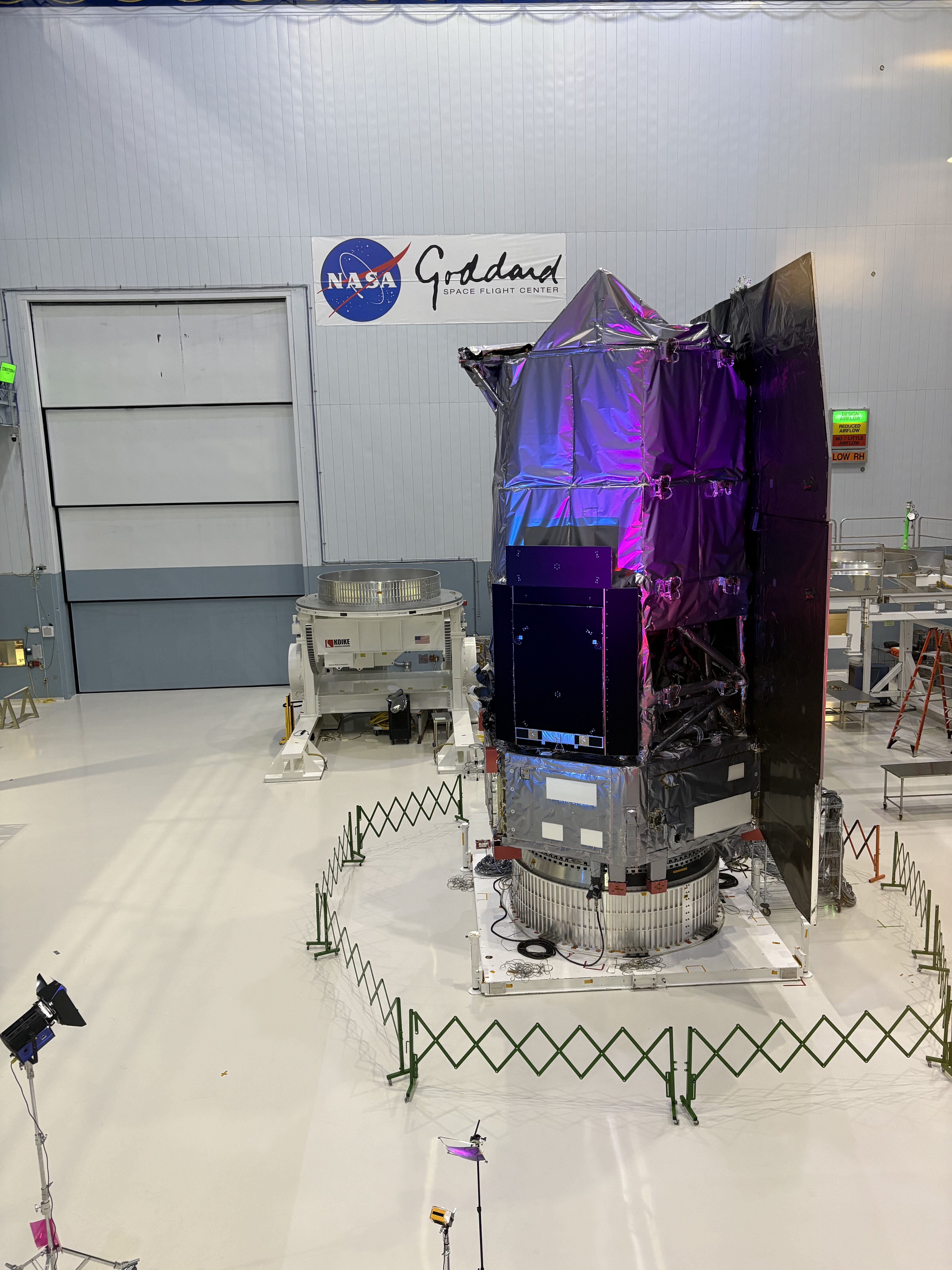
GREENBELT, Md.—On Tuesday, NASA invited the press to look at the fully assembled Nancy Grace Roman Space Telescope, which is now ready to join the ranks of the great observatories in orbit, ahead of its September launch. The Roman Space Telescope (NGRST), named after a key figure in the planning of the Hubble Space Telescope, is notably distinct from hardware like the Hubble and Webb, as it’s designed around a wide-field view and massive imaging system that will allow it to send back 1.4 terabytes of data to Earth every day.

It also has an unusual history that began when NASA’s planning intersected with surplus spy hardware.

In from the cold

Many of the gases in our atmosphere absorb infrared wavelengths, contributing to the greenhouse effect that has helped keep the planet habitable for us. But that effect also makes infrared astronomy from Earth extremely difficult. That’s unfortunate, as a number of important phenomena, from the earliest galaxies to the features of exoplanet atmospheres, are only detectable at infrared wavelengths. There have been a number of infrared-specific telescopes put into space, notably the Spitzer, one of the original suite of Great Observatories.

But those telescopes were largely designed to provide high-resolution imaging of a tiny slice of the sky. There was also a call for a survey telescope capable of imaging large swaths of the sky simultaneously. In the infrared, this could do everything from revealing the large-scale structure of the early Universe to cataloging far more of the asteroids orbiting in Earth’s vicinity. NASA eventually adopted the idea as a priority in the form of WFIRST, the Wide Field Infrared Survey Telescope.

Around the same time, the National Reconnaissance Office decided that two of its spy satellites were surplus to requirements and offered the hardware to NASA. By the time the news broke, NASA had already recognized that the hardware could work for WFIRST. NASA’s Mark Melton told Ars that WFIRST designs at the time used a 1.5-meter telescope; the NRO hardware was almost twice that size. This required scaling up a lot of the hardware—the present NGRST easily extended past the second story of the building it was housed in—but it also provided higher-resolution imaging and more space for some of the imaging hardware.

Since the rethink, things have gone incredibly smoothly. At the time of the hardware gift in 2012, estimates suggested that the earliest we could see a launch was earlier this decade. It’s only a bit beyond that highly optimistic estimate, and NASA Administrator Jared Isaacman told the press that the September launch would be “eight months ahead of schedule and under budget.” There was a lot of discussion about how the lessons learned here might inform future NASA projects.

What’s going to space?

The NGRST will carry just two instruments. The first is its Wide Field Instrument, meant to capture a huge portion of the sky at once. NASA compares the size of its field of view to that of a full Moon; it’s roughly 100 times wider than the largest images Hubble can capture. That will be paired with an array of 18 individual detectors, each capable of capturing 4096 x 4096 pixels.

The result is that a complete NGRST survey image will be enormous. NASA astronomer Julie McEnery said that using 4K displays to display it at single-pixel resolution would require enough TVs to cover the surface of El Capitan in Yosemite—hence the enormous bandwidth needed to get those images back to Earth.

Sitting between the mirrors and the imaging device will be a carousel of filters that limit which wavelengths get through. The carousel also includes both a prism and grism (a planar prism) that will allow the telescope to do spectroscopy, giving us a picture of what wavelengths of light are arriving from certain sources or how severely redshifted the light of distant objects has become.

The second instrument is a Coronagraph, which blocks out a star in the center of the field of view, allowing nearby orbits to be directly imaged, even if they are far dimmer than the star. The effectiveness of the coronagraph will determine just how close to the star an object can be imaged. The one flying on the NGRST will be the first time a coronagraph with active elements—components that can progressively adjust to decrease the light coming from the star—will be used on a space-based observatory.

Scientifically, it will be used to image exoplanets in distant orbits from their stars. But it also serves an engineering purpose: starting the development of a coronagraph for the planned Habitable Worlds Observatory that will need to be 100 times more effective at blocking out stars.

Compared to something like the Webb Telescope, Roman is also delightfully simple. It has relatively few moving parts that need to be deployed once in space, and those that exist, like the solar arrays and high-gain antenna, are simple spring-loaded devices. Once latches are released, they’ll simply open into place, a process that NASA’s Melton said will start as soon as 20 minutes after the NGRST separates from the launch vehicle. Commissioning is planned to take only 90 days, and Melton told Ars that it could be doing science before it completes the final burn to put it into orbit around the L2 Lagrange point.

He said the fuel needed to keep it in orbit will be the primary factor limiting the observatory’s life. Using very conservative estimates of its rate of use, NGRST will be sent to space with 10 years of fuel, so barring a major hardware failure, it’s likely to be operational for quite a bit longer.

What will we be looking for?

One of the key targets of the NGRST surveys is what are called baryon acoustic oscillations. In the extremely early Universe, matter was dense enough that sound waves could create interference patterns in the material, with areas forming that had higher or lower densities than average. As the Universe expanded, these patterns were frozen into place and ultimately formed regions with a higher or lower density of galaxies.

Identifying these patterns at large scales can tell us about the composition of the Universe, including the factors that shape most of its structure: dark matter and dark energy. Tracking how they evolve over time could also help us determine whether dark energy is changing with time rather than being in constant acceleration. There have been hints that some details of our understanding of these factors are wrong, and the NGRST will provide an independent measure of them.

In addition to directly imaging exoplanets, the NGRST will conduct a microlensing survey to detect them. This effort will focus on the galactic bulge, where star density is much higher, and will take advantage of the fact that a planet can act as a small gravitational lens, briefly brightening any background stars that pass between it and Earth.

These events are very brief, often only a few hours, and NGRST will repeatedly observe the same locations at a 15-minute cadence, providing the opportunity to capture much of the curve of the brightening and dimming. That will often be accompanied by the lensing event produced by the planet’s host star, but we’re also expecting to capture some “rogue planets” that have been ejected from extrasolar systems and are floating freely through space. In any case, the expectation is that we’ll identify tens of thousands of planets in this survey, most of them further from the host star than the ones spotted by Kepler.

Those are the planned targets for now. There will also be time set aside for individual research proposals that may find additional uses for the hardware. But there was a clear sense that we were likely to either find something entirely new with the RST or be able to use it to help tackle future problems. McEnery summed everything up by saying, “I very much hope and in fact expect that the most exciting science from Roman is going to be the things that we didn’t expect that we couldn’t predict, but that will set the new, deep questions [for] future missions to address.”

Photo of John Timmer

John is Ars Technica's science editor. He has a Bachelor of Arts in Biochemistry from Columbia University, and a Ph.D. in Molecular and Cell Biology from the University of California, Berkeley. When physically separated from his keyboard, he tends to seek out a bicycle, or a scenic location for communing with his hiking boots.
100 Comments