
惯性聚合 高效追踪和阅读你感兴趣的博客、新闻、科技资讯
阅读原文 在惯性聚合中打开

推荐订阅源

小众软件
小众软件
C
Check Point Blog
Vercel News
Vercel News
Y
Y Combinator Blog
G
Google Developers Blog
P
Proofpoint News Feed
WordPress大学
WordPress大学
MongoDB | Blog
MongoDB | Blog
博客园 - 司徒正美
Last Week in AI
Last Week in AI
博客园 - 【当耐特】
N
Netflix TechBlog - Medium
L
LangChain Blog
V
V2EX
钛媒体:引领未来商业与生活新知
钛媒体:引领未来商业与生活新知
Cyber Security Advisories - MS-ISAC
大猫的无限游戏
大猫的无限游戏
D
DataBreaches.Net
博客园_首页
B
Blog RSS Feed
The Cloudflare Blog
MyScale Blog
MyScale Blog
freeCodeCamp Programming Tutorials: Python, JavaScript, Git & More
Microsoft Security Blog

Ars Technica

Microsoft issues emergency update for macOS and Linux ASP.NET threat Anthropic tested removing Claude Code from the Pro plan Coyote vs. Acme is finally getting released—with a killer trailer Google unveils two new TPUs designed for the "agentic era" Tabloid reports linking 10 missing and dead scientists spur FBI probe Physicists think they've solved the muon mystery New court ruling blocks many of the government's anti-renewable policies Indian med student rakes in thousands with AI-generated MAGA hottie As EV batteries improve, ChargePoint debuts 600 kW fast charger Our favorite gear at Sea Otter Classic wasn't the bikes—it was the accessories Investors lost billions on Trump’s memecoin. Another gala won’t fix that. Pentagon wants $54B for drones, more than most nations’ military budgets Mozilla: Anthropic's Mythos found 271 security vulnerabilities in Firefox 150 Supreme Court arguments make it clear that FCC fines are "nonbinding" Silo S3 teaser hints at the wasteland's origins Framework's CEO on the RAM crisis and creating a "MacBook Pro for Linux users" Florida probes ChatGPT role in mass shooting. OpenAI says bot "not responsible." Report: Meta will train AI agents by tracking employees' mouse, keyboard use Microsoft removes Call of Duty from Game Pass, lowers subscription pricing Framework Laptop 13 Pro is a major overhaul for the modular, upgradeable laptop Framework Laptop 16 upgrades make it look less like an unfinished prototype Internal emails show how Amazon raises prices across the Internet, lawsuit says Anthropic gets $5B investment from Amazon, will use it to buy Amazon chips CATL's new LFP battery can charge from 10 to 98% in less than 7 minutes AMD Ryzen 9 9950X3D2 Dual Edition review: Tons of cache for tons of dollars What's the deal with spacesuits for the Moon? Will they be ready in time? Loneliness in older adults can often lead to memory impairment Contrary to popular superstition, AES 128 is just fine in a post-quantum world Pentagon pulls the plug on one of the military's most troubled space programs John Ternus will replace Tim Cook as Apple CEO
Everyone’s a loser in Strait of Hormuz game that simulate...
Jeremy Hsu · 2026-05-08 · via Ars Technica

Playing a bad hand well

That may sound like a lot to wrap your head around for a game that is playable in 15 to 20 minutes, but it’s a surprisingly accessible experience for the most part. The game serves up plenty of explanations and news articles that you can click on to better understand the real-world context and in-game consequences.

However, each ship approved for transit tends to carry a greater cost or trade-off as the game progresses over 10 playable days between March 3 and April 13, 2026. You have the choice of not sending any ships through the strait on any given day, but that can quickly lead to dismal endgame results, like “empty shelves” and “desalination collapse” for Gulf States facing food insecurity and a lack of fresh water from energy-starved desalination plants.
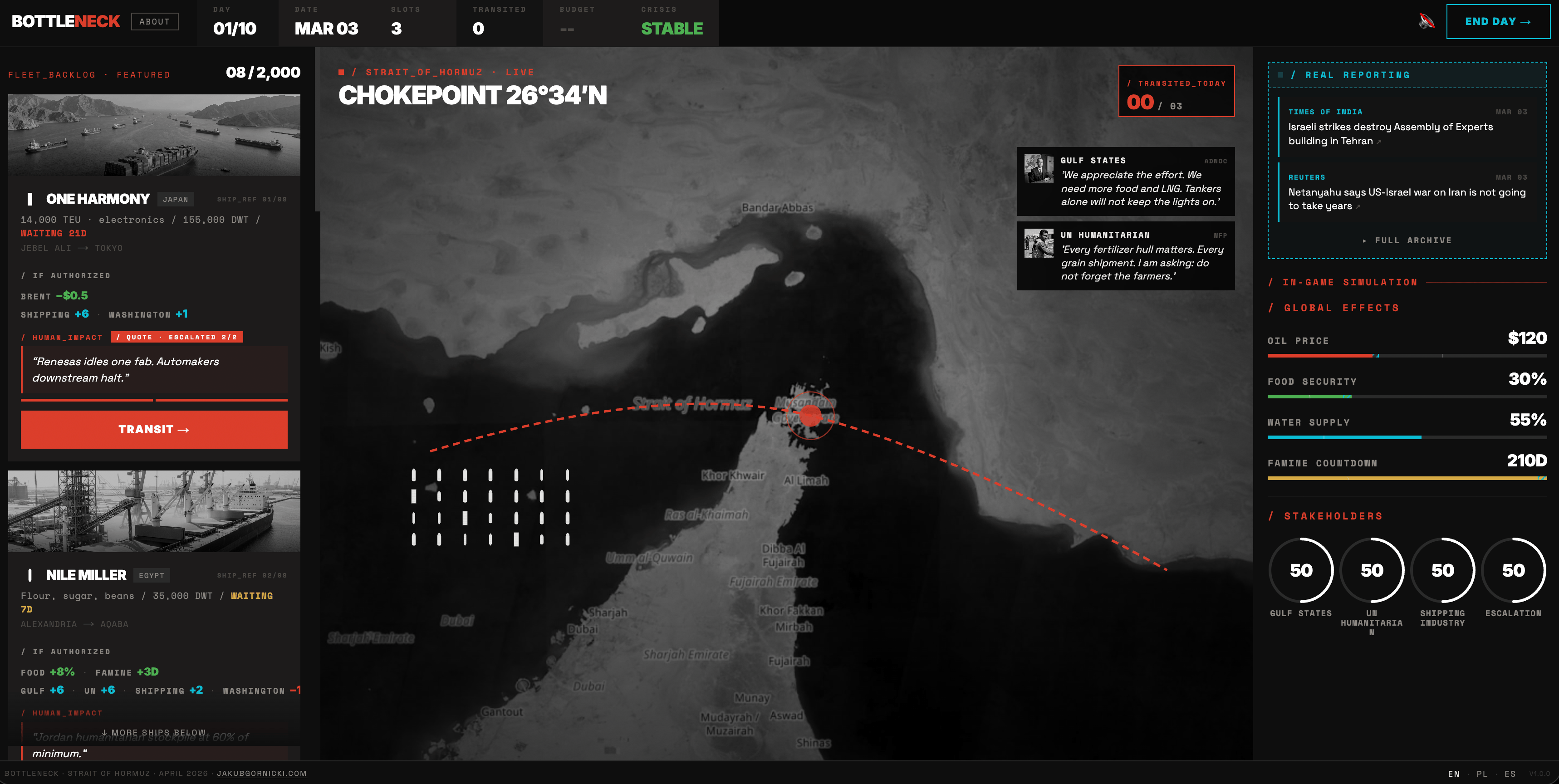
A screenshot of the browser-based game Bottleneck lists ships on the left that players can choose to transit through the Strait of Hormuz. The right shows different factions and global crisis factors that players must manage.

A screenshot of the browser-based game Bottleneck based on the real Strait of Hormuz crisis.

A screenshot of the browser-based game Bottleneck based on the real Strait of Hormuz crisis. Credit: Jakub Gornicki / jakubgornicki.com

If you manage to muddle through and keep all the factions from spiraling, the endgame results still provide plenty of charts and numbers to remind you that the real-life Strait of Hormuz crisis is far from over. Even squeezing through several dozen ships over 10 days—the best-case shipping scenario in the game—remains a far cry from the pre-war average of 130 ships passing through the strait each day. The inadequacy of that shipping rate continues to have daily real-world consequences.

Gornicki designed and built the game by himself over 17 days while executing the game’s underlying code with the help of an AI coding tool, which he described in a press kit as being “audited and corrected at every step.” He also incorporated more than 125 verified and linked news articles, along with shipping data from sources such as Windward Maritime Intelligence and Lloyd’s List.

“The chokepoint is not a story you read once and put down—it returns every week, in fuel prices, in fertilizer shortages, in food security in places far from any tanker,” Gornicki said. “I wanted to give people a form of this reporting they could not skim past.”