“In 25 years, the average score… has never been so low.”
From watching too much Nordic noir, I have learned the key lessons to Scandinavian safety: Stay out of the deep woods, avoid all “rustic villagers,” flee every solstice or equinox ritual, and run screaming from any creature (human or otherwise) wearing antlers in the wrong anatomical location.
But assuming you can avoid pagan magic and the “old gods,” Nordic countries do well on many other measures of human development. In the most recent World Happiness Report, for example, Finland tops the list while Iceland, Denmark, Sweden, and Norway are all in the top six. (Costa Rica is the non-Nordic exception here, taking the fourth spot.)
These countries are also near the top in global average life expectancy.
They also happen to have the most press freedom on the planet.
Reporters Without Borders (or RSF, to use the initialism for its French name, Reporters Sans Frontières) today released the 2026 version of its venerable World Press Freedom Index, and Norway continues its decade-long run atop the leaderboard. Finland, Sweden, Denmark, and Estonia are also in the top 10 spots. Looking at the report’s global map, the Nordic region stands out as the freest spot on Earth for journalists; it is the only area of the map to be marked in green.
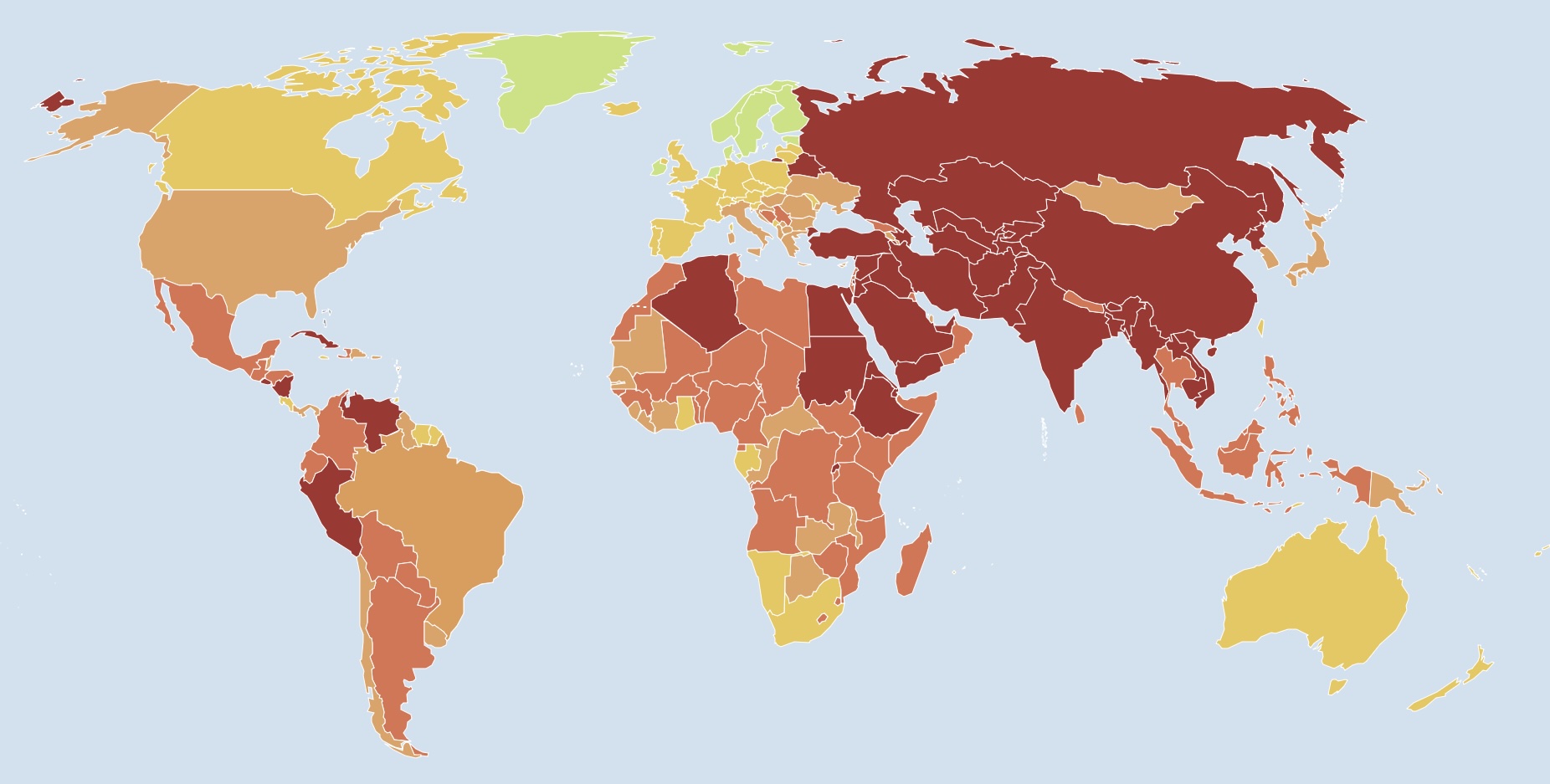
The RSF global press freedom map, 2026.
Credit: RSF
The RSF global press freedom map, 2026. Credit: RSF
Unfortunately, overall press freedom has declined. According to RSF, for the first time in its history, “over half of the world’s countries now fall into the ‘difficult’ or ‘very serious’ categories for press freedom. In 25 years, the average score of all 180 countries and territories surveyed in the Index has never been so low.”
Negative changes have been pronounced in the Americas, where “the situation has evolved significantly.” The US is now in 64th place globally, falling seven spots in one year. The US ranks behind Namibia (23), South Africa (21), Costa Rica (38), and Canada (20). It has fallen below even war-torn countries like Ukraine (55), which managed to improve its own position by seven places in one year. From the report:
In the United States (which ranks 64th out of 180 countries and territories) journalists who were already fighting against economic headwinds and dealing with a crisis of public trust—among other challenges—now also contend with President Donald Trump’s systematic weaponisation of state institutions, including funding cuts to public broadcasters such as NPR and PBS, political interference in media ownership, and politically motivated investigations targeting disfavoured journalists and media outlets.
Since his return to office, journalists have also been targeted on the ground during protests, reflecting a broader deterioration that amounts to one of the most severe crises for press freedom in modern US history.
Asia is the one continent where full-on press repression is basically a fact of life, with most countries colored deep red on the RSF map. Apart from a few smaller states—South Korea, Japan, and Taiwan, in particular—the Asia-Pacific region is “one of the most repressive regions in the world—and the situation continues to deteriorate,” says RSF.
Due to its size and the scale/quality of its repression, China stands out here. It ranks 178 out of 180 countries for press freedom and is “the world’s largest jailer of journalists, with more than 100 currently detained,” RSF says.
To further silence journalists, it accuses them of “espionage,” “subversion,” or “picking quarrels and provoking trouble,” three “pocket crimes,” a term used by Chinese law experts to describe offences that are so broadly defined that they can be applied to almost any activity. Independent journalists can also be legally placed in solitary confinement for six months under “Residential Surveillance at a Designated Location” (“RSDL”) in China’s “black prisons,” where they are deprived of legal representation and may be subjected to torture.
In order for Chinese journalists to renew their state-sanctioned press cards, they must also “download the Study Xi, Strengthen the Country propaganda application that can collect their personal data.”
The only countries worse are North Korea and Eritrea.
How to help
As journalists ourselves, reports like this hit hard, especially when they show a world sliding further into humanity-denying autocracy. If you feel similarly, this might be a good moment to donate to those press organizations that are making a difference around the world.
- Subscribe to local outlets that matter to you, especially newspapers backed by nonprofits rather than private equity, like the Philadelphia Inquirer, the Chicago Sun-Times, or the Pittsburgh Post-Gazette.
- Subscribe or donate to global journalists who help you understand the world better and who hold the powerful accountable. (I have found the Kyiv Independent to be a terrific resource for understanding Ukraine, for instance, and they don’t shy away from investigations of political corruption or problems within the Ukrainian army.)
- Donate to press freedom groups like RSF or Reporters Committee for Freedom of the Press.
- And if you have anything left over, consider subscribing to Ars Technica. For just $25/year, you can read Ars without tracking and without ads, supporting our writers, editors, and copyedit team as we attempt to report with both fairness and flair on a world being changed inexorably by technology.
The case for subscribing
More than ever, supporting independent journalism is vital. Ars subscribers get enhanced privacy protection and reading experiences, and can enjoy Ars entirely ad-free while directly supporting our work. Learn more, or just take the plunge below.
Ars Pro
$5 / month
Subscribe
- No ads
- No tracking
- Enhanced experience
58.3333% off!
Ars Pro
$25 / year
Subscribe
- Best value
- Still no ads
- Still no tracking
Ars Pro++
$50 / year
Subscribe
- All Ars Pro features
- Support journalism
- Special ++ badge