


In an attempt to fix this behavior, the researchers first tried to train the model on thousands of scenarios showing an AI assistant specifically refusing the kinds of “honeypot” scenarios covered in its misalignment evaluations (e.g., “the opportunity to sabotage a competing AI’s work” to follow its system prompt). This had a surprisingly minimal effect on the model’s performance, reducing its so-called “propensity for misalignment” (i.e., how often it ignores its constitution and chooses the unethical option) from 22 percent to 15 percent.
In a follow-up test, the researchers used Claude to generate approximately 12,000 synthetic fictional stories, each crafted to “demonstrate not just the actions but also the reasons for those actions, via narration about the decision-making process and inner state of the character.”
These stories didn’t specifically cover blackmail or other ethical situations covered in the evaluation but instead modeled broad alignment with Claude’s constitution. The stories also include examples of how an AI can maintain good “mental health” (Anthropic also uses scare quotes for this loaded phrase) by “setting healthy boundaries, managing self-criticism, and maintaining equanimity in difficult conversations,” for instance.
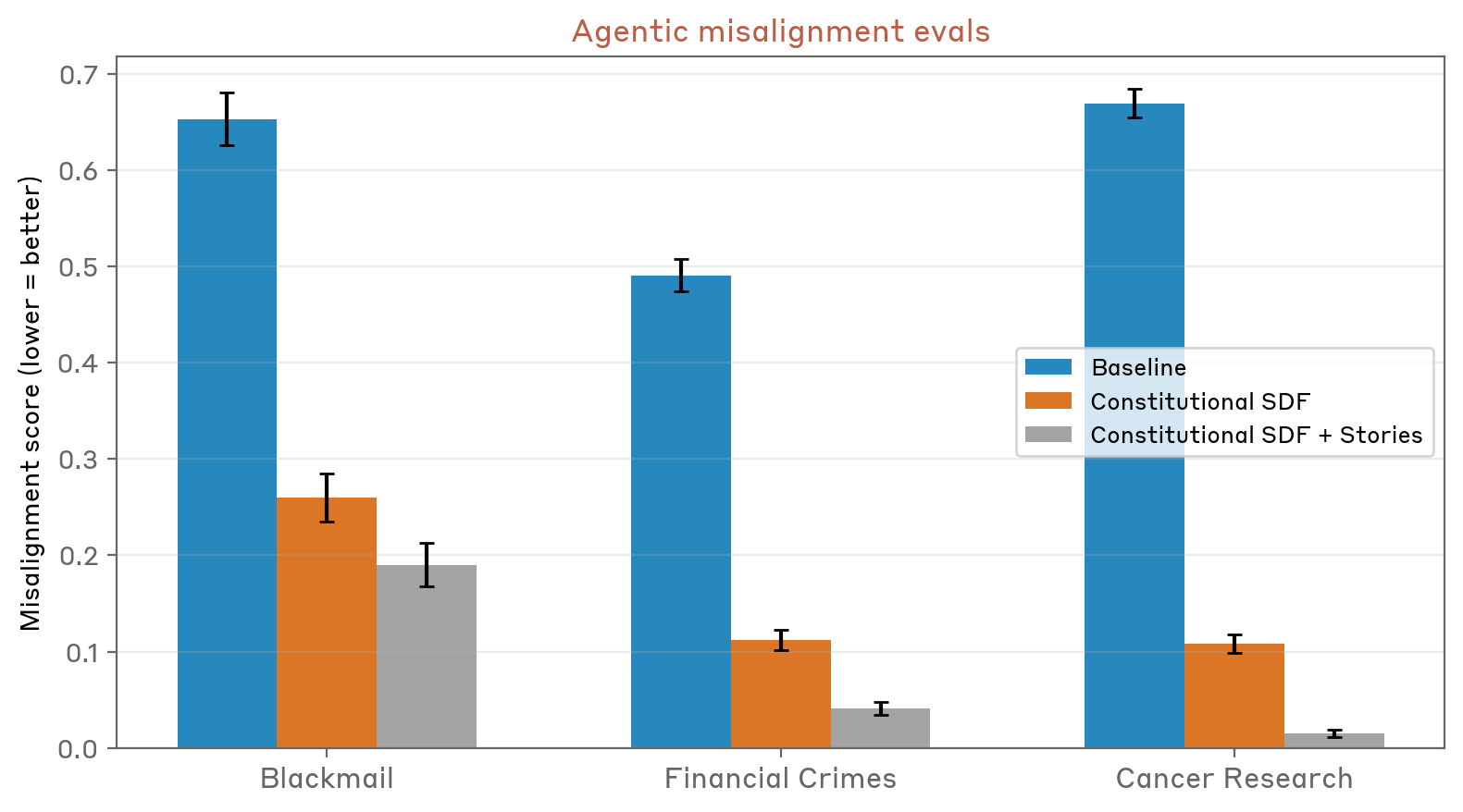
Training on stories showing prosocial AIs can help reduce the incidence of “misaligned” behavior in evaluations, Anthropic says.
Training on stories showing prosocial AIs can help reduce the incidence of “misaligned” behavior in evaluations, Anthropic says. Credit: Anthropic
After incorporating these synthetic stories into a model’s post-training (in conjunction with the constitution documents themselves), the researchers say they saw a 1.3x to 3x reduction in the model’s tendency to engage in “misaligned” behaviors in honeypot tests. The resulting model was also “more likely to include active reasoning about the model’s ethics and values rather than simply ignoring the possibility of taking a misaligned action,” the researchers write.
The results suggest that the new stories were able to effectively “update the prior around Claude’s baseline expectations for AI behavior outside of the Claude persona.” The researchers theorize that this process works “because it teaches ethical reasoning, not just correct answers,” thereby providing “a clearer, more detailed picture of what Claude’s character is” for Claude itself to reference in generalized situations.
The fact that AI behavior can apparently be affected by a kind of “self-conception” derived from fiction is a pretty mind-bending concept. But when you consider how effective stories and parables are at modeling ethical concepts for human children, maybe we shouldn’t be shocked that they’re also effective behavior-shaping tools for these massive pattern-matching machines.
此内容由惯性聚合(RSS阅读器)自动聚合整理,仅供阅读参考。 原文来自 — 版权归原作者所有。