
惯性聚合 高效追踪和阅读你感兴趣的博客、新闻、科技资讯
阅读原文 在惯性聚合中打开

推荐订阅源

钛媒体:引领未来商业与生活新知
钛媒体:引领未来商业与生活新知
The GitHub Blog
The GitHub Blog
J
Java Code Geeks
Engineering at Meta
Engineering at Meta
N
Netflix TechBlog - Medium
A
About on SuperTechFans
博客园 - 三生石上(FineUI控件)
罗磊的独立博客
MongoDB | Blog
MongoDB | Blog
B
Blog RSS Feed
让小产品的独立变现更简单 - ezindie.com
freeCodeCamp Programming Tutorials: Python, JavaScript, Git & More
有赞技术团队
有赞技术团队
T
Tailwind CSS Blog
酷 壳 – CoolShell
酷 壳 – CoolShell
Vercel News
Vercel News
腾讯CDC
博客园 - 聂微东
The Cloudflare Blog
F
Fortinet All Blogs
OSCHINA 社区最新新闻
OSCHINA 社区最新新闻
V
Visual Studio Blog
Last Week in AI
Last Week in AI
B
Blog

Ars Technica

You want your Moon landings in HDTV? So does NASA—here's how it's happening. Microsoft issues emergency update for macOS and Linux ASP.NET threat Anthropic tested removing Claude Code from the Pro plan Coyote vs. Acme is finally getting released—with a killer trailer Google unveils two new TPUs designed for the "agentic era" Tabloid reports linking 10 missing and dead scientists spur FBI probe Physicists think they've solved the muon mystery New court ruling blocks many of the government's anti-renewable policies Indian med student rakes in thousands with AI-generated MAGA hottie As EV batteries improve, ChargePoint debuts 600 kW fast charger Our favorite gear at Sea Otter Classic wasn't the bikes—it was the accessories Investors lost billions on Trump’s memecoin. Another gala won’t fix that. Pentagon wants $54B for drones, more than most nations’ military budgets Mozilla: Anthropic's Mythos found 271 security vulnerabilities in Firefox 150 Supreme Court arguments make it clear that FCC fines are "nonbinding" Silo S3 teaser hints at the wasteland's origins Framework's CEO on the RAM crisis and creating a "MacBook Pro for Linux users" Florida probes ChatGPT role in mass shooting. OpenAI says bot "not responsible." Report: Meta will train AI agents by tracking employees' mouse, keyboard use Microsoft removes Call of Duty from Game Pass, lowers subscription pricing Framework Laptop 13 Pro is a major overhaul for the modular, upgradeable laptop Framework Laptop 16 upgrades make it look less like an unfinished prototype Internal emails show how Amazon raises prices across the Internet, lawsuit says Anthropic gets $5B investment from Amazon, will use it to buy Amazon chips CATL's new LFP battery can charge from 10 to 98% in less than 7 minutes AMD Ryzen 9 9950X3D2 Dual Edition review: Tons of cache for tons of dollars What's the deal with spacesuits for the Moon? Will they be ready in time? Loneliness in older adults can often lead to memory impairment Contrary to popular superstition, AES 128 is just fine in a post-quantum world Pentagon pulls the plug on one of the military's most troubled space programs
Intel refreshes non-Ultra Core CPUs with new silicon for ...
Andrew Cunningham · 2026-04-17 · via Ars Technica

Intel’s Core Ultra laptop CPUs have been its flagships ever since it retired the older generational branding scheme and the i3/i5/i7/i9 branding a few years back. The Core Ultra Series 1, Series 2, and Series 3 processors been the ones with the newer CPU and GPU designs, and newer manufacturing technology.

Intel has also offered non-Ultra Core CPUs, but these have never been particularly interesting, mostly because both the Series 1 and Series 2 chips were based on Intel’s old Raptor Lake architecture. Raptor Lake was the code name for 2023’s 13th-generation Core family, and most versions of Raptor Lake were the same silicon used for 2022’s 12th-generation Core CPUs.

But the naming and renaming of Raptor Lake apparently couldn’t last forever. Intel’s new, non-Ultra Core Series 3 processors are new silicon, a return to the days when you could expect high-end and midrange Intel chips to include many of the same advancements despite their performance differences.
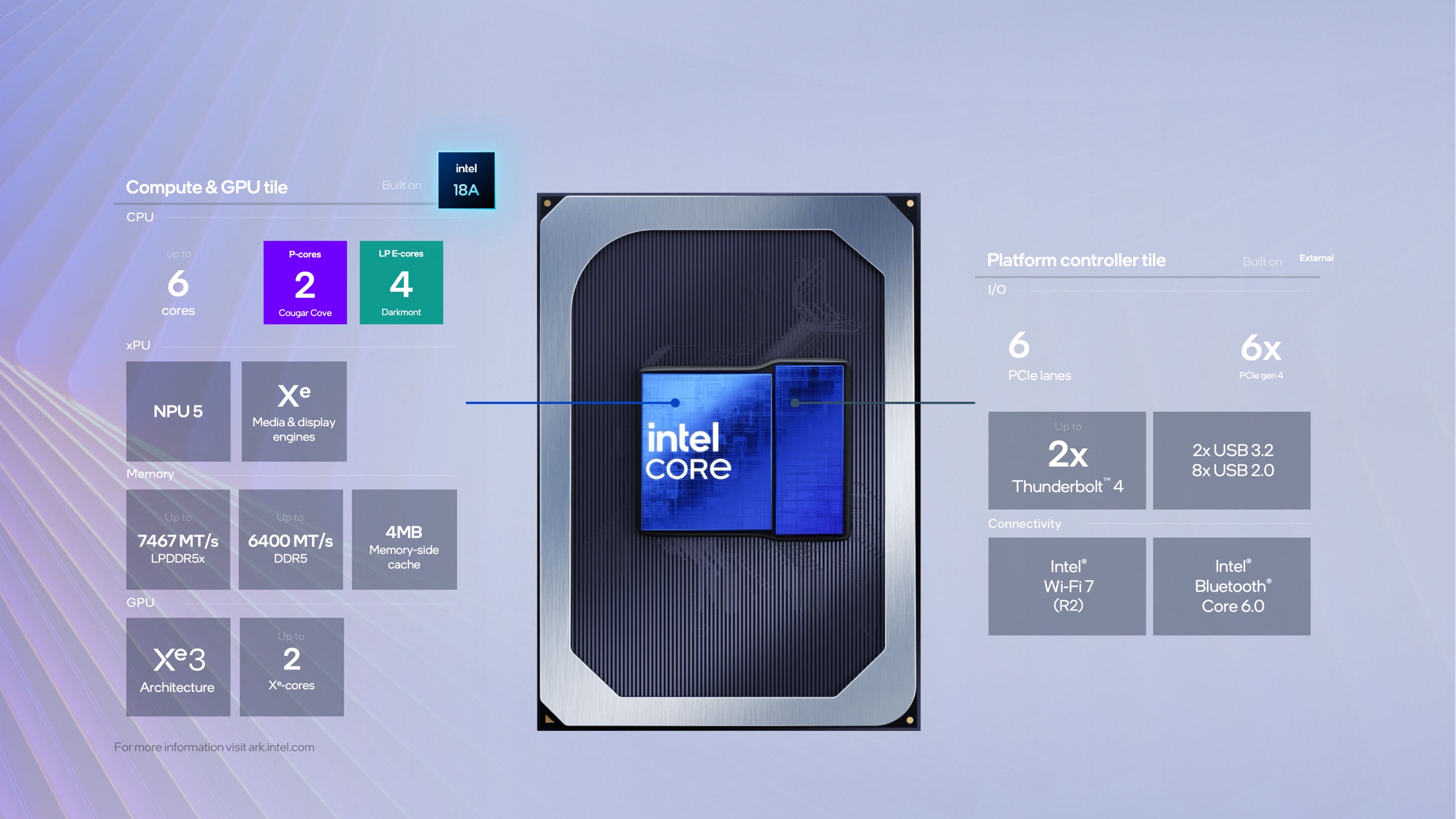
“Wildcat Lake” shares some things in common with Panther Lake, but it’s a slower and simpler design.

Credit: Intel

“Wildcat Lake” shares some things in common with Panther Lake, but it’s a slower and simpler design. Credit: Intel

These new chips are codenamed “Wildcat Lake,” and while there are some commonalities with the Core Ultra Series 3 CPUs (aka Panther Lake), the non-Ultra CPUs use a simpler design with much less computing power.

Each chip uses two silicon tiles: a compute tile that includes a CPU with up to two Cougar Cove P-cores and four Darkmont E-cores; an integrated GPU with one or two of Intel’s latest-generation Xe3 GPU cores; and (usually) an NPU capable of up to 17 trillion operations per second (TOPS). A separate platform controller tile built on an unspecified non-Intel process provides up to two Thunderbolt 4 ports, Wi-Fi 7 and Bluetooth 6.0 connectivity, and six PCIe 4.0 lanes for external connectivity. All of the chips support up to 48GB of LPDDR5X-7467, or up to 64GB of DDR5-6400, and use a base power level of 15 W and maximum boost power level of 35 W.