“It wasn’t a big deal. It just coincided with the fact that Moon was farther away from the Earth.”
Former NASA astronaut Fred Haise stands in front of an RS-25 engine for the Space Launch System rocket at Stennis Space Center, Mississippi, on December 7, 2021. Credit: NASA/Danny Nowlin
With the circumlunar flight of Artemis II, and the prospect of landing astronauts on the lunar surface within a few years, humanity is preempting an era where the imprint of visiting the Moon would be erased from living memory.
There are five men still alive who flew to the Moon on NASA’s Apollo missions. All are now in their 90s. Between 1968 and 1972, 24 astronauts visited the Moon, and 12 of them walked on its surface. We’ll have to wait a little longer to add to the roster of Moonwalkers, but there are four new names to etch on the list of lunar explorers.
The Artemis II astronauts, all in their 40s or 50s, flew a little more than 4,000 miles from the Moon, higher above the surface than the Apollo lunar missions. The four-person crew on Artemis II set a new record for the farthest humans have ever traveled from Earth: 252,756 miles (406,771 kilometers).
Artemis II broke the record set on the Apollo 13 mission in April 1970, when astronauts Jim Lovell, Jack Swigert, and Fred Haise soared to a maximum distance from Earth of 248,655 miles (400,171 kilometers). Ars recently visited with Haise to discuss his perspective on the record and the Artemis II mission, and we include the interview later in this story.
The Apollo 13 record stood for almost exactly 56 years. NASA officials, astronauts, and space enthusiasts alike hope the Artemis II record won’t last quite as long.
Parsing the numbers
When might Artemis II’s record actually be broken? Missions heading to the lunar surface won’t have to venture so far beyond the far side of the Moon. Artemis II followed a free-return trajectory, using the Moon’s gravity to slingshot the Orion capsule back toward the Earth for reentry.
But there are other factors that make calculating the distance of future Artemis missions a little complicated. These considerations center on orbital dynamics. The Moon’s 27-day orbit around the Earth is not a perfect circle. On average, the distance between the centers of the Earth and the Moon ranges between about 225,800 and 252,000 miles (363,400 to 405,500 km).
The Sun’s gravitational influence throws the Moon’s orbit into a constant state of change. Sometimes the Moon’s perigee, or nearest point to Earth, is closer than average. Similarly, the Moon’s apogee stretches farther from Earth on some orbits. The Moon’s apogee can reach as far as 252,727 miles (406,725 km). The Moon’s orbit only touches this distance about once every 5,000 years, but it routinely gets close (within 100 km, or 62 miles, three times between now and 2040). A NASA website explains all of this in extensive detail.
Suffice it to say, it is impossible to predict when humans might break the Artemis II distance record. NASA planned to place the Gateway mini-space station into a so-called near-rectilinear halo orbit looping as close as 1,900 miles (3,000 km) and as far as 43,500 miles (70,000 km) from the Moon, opening up opportunities for astronauts to reach greater distances from Earth than Artemis II.
This is where NASA planned to send future Artemis crews to meet up with lunar landers to carry them to the Moon’s south pole. The space agency has now canceled Gateway to focus on building a base on the lunar surface, where astronauts can learn to harvest resources like water, live in partial gravity, and prove out technologies for future expeditions to Mars.
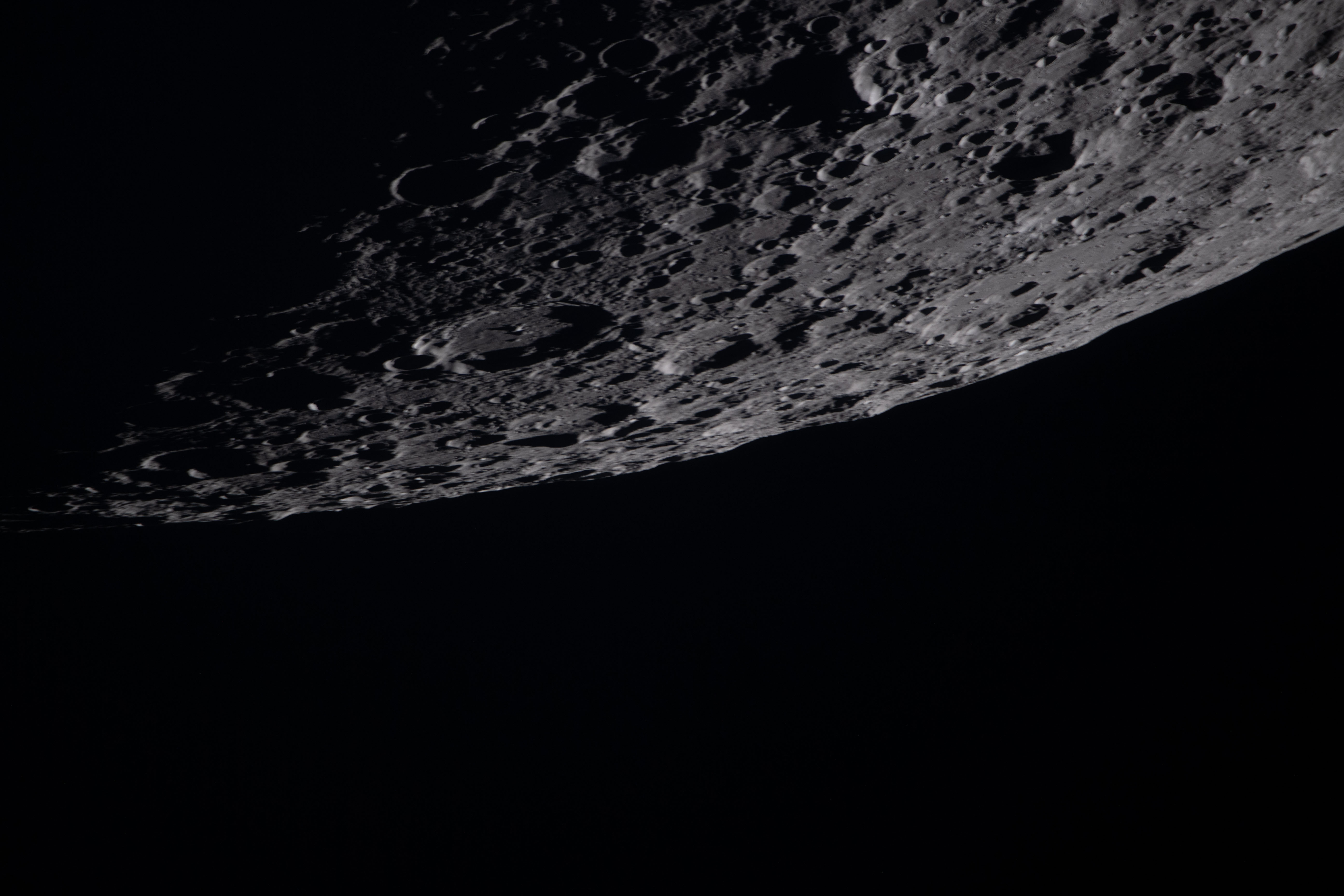
The Artemis II astronauts captured this view of the Moon, showing the rugged lunar terrain, on April 6, 2026.
Credit: NASA
The Artemis II astronauts captured this view of the Moon, showing the rugged lunar terrain, on April 6, 2026. Credit: NASA
NASA hasn’t yet selected a new orbit for Artemis crews and their Orion spacecraft to rendezvous with human-rated landers, but the meetup point will certainly be closer to the Moon. The Orion spacecraft’s service module lacks the ability to reach a low-lunar orbit—Apollo missions circled the Moon at altitudes of below 70 miles (110 km)—and then safely return to Earth. Ars recently reported on the factors in NASA’s decision on a new orbit for Orion at the Moon, including the capabilities of Orion itself, a higher-performing upper stage on the Space Launch System rocket, and the ability of NASA’s Human Landing System vehicles—provided by SpaceX or Blue Origin—to shuttle between that orbit and the lunar surface.
The bottom line: Astronauts likely won’t exceed Artemis II’s distance from Earth on most lunar landing missions, but it’s conceivable that on some occasions, circumstances will align to propel a crew a little beyond the 252,756-mile mark. The sure bet will come when someone finally takes aim at Mars.
“Big disappointment”
Haise, the only Apollo 13 astronaut still living, didn’t care much for the record he and his crewmates set in 1970. It was a consolation prize, of sorts, for Haise. You probably know the story of Apollo 13’s aborted lunar landing and the around-the-clock, high-stakes effort to bring the crew home.
Still, among the more than 100 billion people who have walked the Earth in human history, the Artemis II astronauts have ventured farther from the cradle than anyone else. Sure, it’s not walking on the Moon, but it’s something more than a piece of trivia.
Haise, 92, spoke with Ars as Artemis II made its way back to Earth earlier this month. We present our conversation below, lightly edited for clarity.
Ars: How closely have you followed the Artemis II mission?
Fred Haise: Not real close. Today, I have not seen anything. I just got home from my great-grandson’s baseball game. I noticed, from their projected flight plan, they’re past the Moon, sort of on their cruise back toward Earth for the reentry. I’ve seen the pictures they’ve shot, which are excellent. They have better cameras and better equipment than we had on Apollo, because it really looks like they got much higher-resolution pictures than we were able to from that altitude.
Ars: I presume this all brings back some memories for you.
Haise: Vaguely. When they splash down Friday, if you go to the next day, Saturday, the 11th, that’s when I launched, 56 years ago. So, yes, I’ve lived several lifetimes, the Shuttle program, then in the business world. It was a long time ago.
Ars: Was the distance record ever a big deal to you?
Haise: Somebody figured out how to get it in Guinness to make us feel better because we didn’t land. That was the big disappointment. I hoped to walk on the Moon, and that went away. If you look at the so-called distance record, all the orbits around the Moon, all the missions that went, were 60 miles or so [from the Moon]. If you take our flight, it just so happened that the Moon was a little farther away. The Moon doesn’t go in a circle. It’s an ellipse, so it was kind of at its farthest point from Earth, and we were only a little above the normal orbit. It wasn’t a big deal. It just coincided with the fact that the Moon was farther away from the Earth.
Ars: Are you surprised your record stood for as long as it did?
Haise: It’s a surprise, mainly because our US government hasn’t supported programs to get us back. The average citizen I know and talk to a lot, they somehow think NASA has a big pot of gold somewhere that they can just use to do whatever they want. They don’t realize that to get monies to do things, be it unmanned research, satellite programs or whatever, including any manned program, it requires getting money from Congress and through the annual budgeting cycle.
NASA spent [nearly] 25 or 30 years making this [Orion] capsule. They finally got it made. The Artemis I mission, when did they fly? It was two-and-a-half years ago, without people, right? And here it is, the first time it’s ever flown with people. That’s the nature of the business in space. Apollo was, uniquely, I would say, the only program that was fully funded, supported from the president through Congress from the start to achieving the goal, which was to land by the end of the decade. Even then, the funding started getting cut. That’s the nature of the business. But the average person I talk to, a lot of them are children, of course. I don’t expect them to know that. But a lot of the citizens I talk to, they have absolutely no idea of how a program is spawned and how it’s budgeted to keep it alive and make it happen.
Ars: It’s remarkable looking back at Apollo, when you guys were typically landing on the Moon every four to six months.
Haise: Actually, from the Apollo 7 launch through Apollo 11, we launched every two months. Every two months. Then we started slipping. After Apollo 11, when they made the landing in July of that year, they slipped. Apollo 12 was normally to be flown in September, but even then, they slipped it to November, so it waited four months to launch. Then they stretched us even further. On 13, we went all the way to the next April, because of budget cuts.
Ars: It’s been two-and-a-half years since Artemis I, and it will be another year or longer until Artemis III, an Earth orbit mission.
Haise: You could accomplish it faster if you had the program laid out and funded it. I mean, it’s that simple. It ain’t simple to plan it and everything. But if you had the program planned and laid out and done the technology trades and everything, and a preliminary design for where you’re headed with what you’re doing, if you fund it, you can go accomplish it. There’s no magic to it. It’s just you need to apply the money and the resources, the right people, the right engineering, and you can do it.
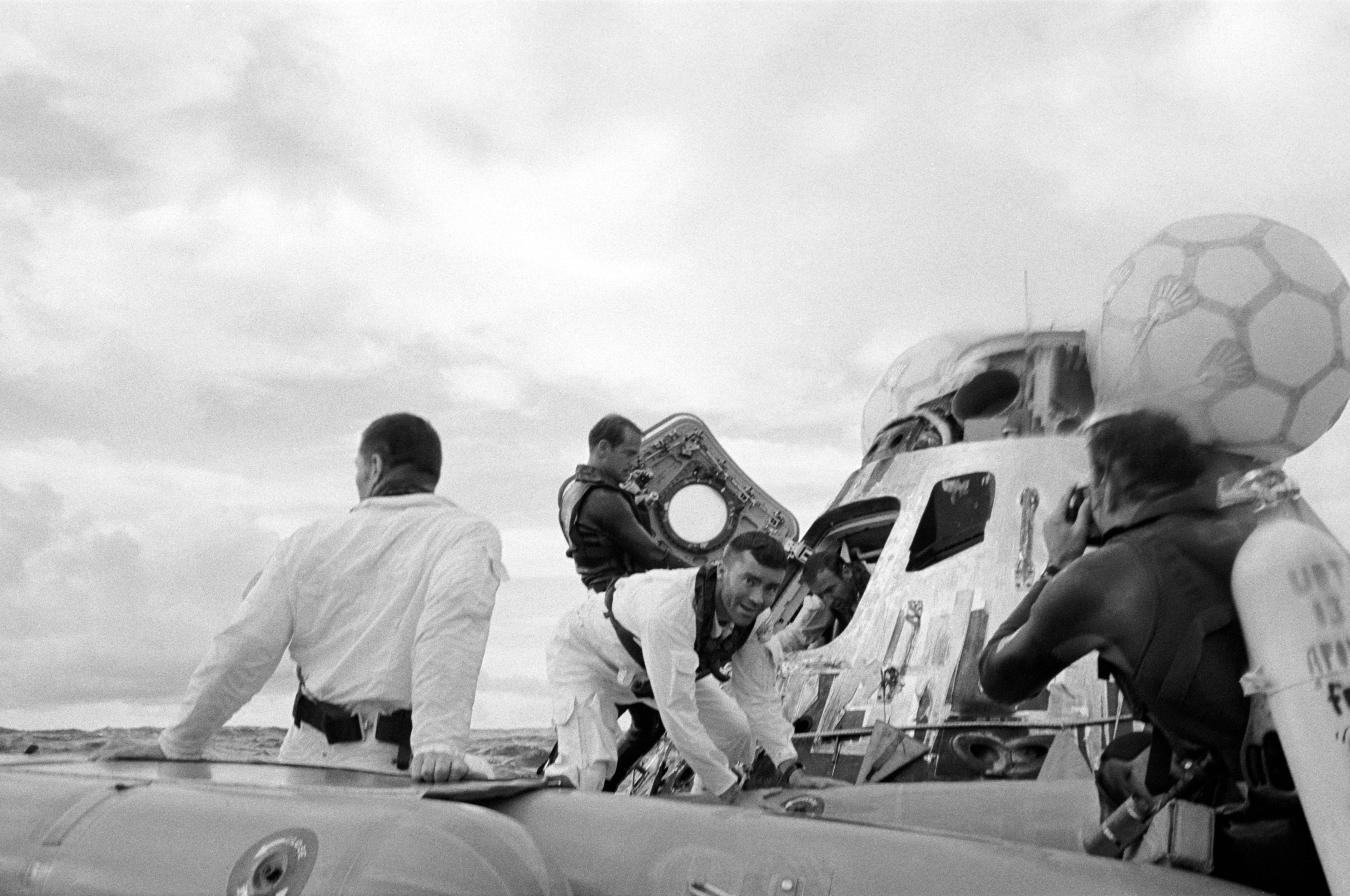
NASA astronaut Fred Haise, center, moments after exiting the Apollo 13 command module following splashdown in the South Pacific Ocean on April 17, 1970.
Credit: NASA
NASA astronaut Fred Haise, center, moments after exiting the Apollo 13 command module following splashdown in the South Pacific Ocean on April 17, 1970. Credit: NASA
Ars: What do you remember about being on the far side of the Moon?
Haise: We had done a maneuver earlier, approaching the Moon, because where our explosion happened, we were not on a path to get home. We were not on a free return, which they were on this [Artemis II] flight … When our capsule had the explosion and we had to shut it down, the very first thing to work on after getting the LM (Lunar Module) powered up was to use its rocket engine to change our path to get us sort of in a rough direction of heading home. And that first burn we did looped us around the Moon. Then we did a second maneuver, the biggest one, using the decent landing engine after we passed the Moon. That shaved 10 to 12 hours off our return time, which was helpful, because the LM didn’t have enough power if we kept it powered up, so we had to critically power it down and only had battery power.
Going around the Moon, after we finished that burn, and Jack [Swigert] and I were tourists. We got out our cameras and put color and black and white film packs in it, and shot a lot of pictures. We got pictures with a little better resolution, but still didn’t get anywhere near like they’ve taken on Artemis II. Hopefully, some of their pictures are near the South Pole, which is where it’s hoped that we’ll land someday and actually have a lunar base, close to the water ice in some of the craters near the South Pole.
Ars: Did you have an opportunity to take in the view at the Moon?
Haise: Jim (Lovell) wasn’t as interested as I was. He was too disappointed about not landing, and he had been already once. So he had seen the Moon quite a bit on Apollo 8, when they went around a number of orbits.
Ars: Did you have a chance to meet with any of the Artemis II astronauts before they flew?
Haise: I had lunch with Victor Glover one time after he had flown the Dragon capsule, the second flight in the Dragon. I wanted to know a little bit about Dragon. I met the commander [Reid Wiseman] at an event one time in Houston, and that was quite a while ago. It was before his wife passed away. In fact, she was at the luncheon also.
I met Christina Koch, the youngest member of the crew, a couple of times. She very nicely came to speak at the Memorial Tree ceremony for [Apollo 15 astronaut] Al Worden [at Johnson Space Center in Houston]. Al was head of the Astronaut Scholarship Foundation. He was the chairman when she was given an award that helped her with education funding. So she appreciated that, and came and spoke at Al’s event, and then I met her again at Jim Lovell’s son’s house. Jeffrey [Lovell], he lives in Houston here, and he hosted an event at his house, again, trying to draw in some people he had invited to help fund the Astronaut Scholarship Foundation, which gives out over 30 scholarships a year.
Ars: What else stands out to you about the Artemis II mission?
Haise: My commander, as you know, recorded a message for the crew with his son, Jeffrey, and his daughter, Susan. Unfortunately, Jim passed away, but the message was read up to them. I was FaceTiming with Jim at least once a week over the years, and he unfortunately passed away last year.
Ars: That was very poignant. There have been a lot of touching moments on this mission.
Haise: One of the biggest values, I feel, is the photography. Hopefully, they got good photography of the proposed eventual landing places. But the biggest value of all, and this is underplayed in the media, is this was a test flight. Who rode the rocket before? Nobody. How many humans have ridden in that capsule? Nobody. So they tested the capsule … to make sure it’s OK, testing all its variety of systems and making sure everything is working. To me, it was a great test pilot mission. Everybody’s got so excited about some pictures, which is good, but to me, I was a test pilot, so that’s the way I look at the mission. This was a great test pilot mission.
Ars: This mission seems to have captured a lot of public interest. I’m sure you can understand that after everything that’s been written about Apollo 13.
Haise: Apollo 13, to young people, when they hear a little bit about the story in school, it’s like a folktale, a survival folktale, much like many you may read about, like Shackleton’s sailing ship that got trapped in the ice. Apollo 13 has gotten to be in the same class as that. That makes it interesting.

Stephen Clark is a space reporter at Ars Technica, covering private space companies and the world’s space agencies. Stephen writes about the nexus of technology, science, policy, and business on and off the planet.