So many questions
“If boost-phase intercept from space is not affordable and scalable, we will not produce it.”
Missiles launched by Iran are seen in the skies over the West Bank on April 06, 2026. Credit: Wisam Hashlamoun/Anadolu via Getty Images
The US Space Force released a list Friday of a dozen companies working on Space-Based Interceptors for the Pentagon’s Golden Dome initiative, a multilayer defense system to shield US territory from drones and ballistic, hypersonic, and cruise missile attacks.
The roster of Golden Dome Space-Based Interceptor (SBI) contractors, some of which were previously reported, includes Anduril Industries, Booz Allen Hamilton, General Dynamics Mission Systems, GITAI USA, Lockheed Martin, Northrop Grumman, Quindar, Raytheon, Sci-Tec, SpaceX, True Anomaly, and Turion Space.
The Space Force made 20 individual awards to the 12 companies in late 2025 and early 2026 using an acquisition mechanism known as Other Transaction Authority, or OTA, agreements. OTAs allow the Pentagon to bypass federal acquisition regulations and cast a wide net to attract a larger number of potential contractors and are especially useful for rapid prototyping. That is exactly what the Space Force wants to see with the first phase of the SBI program.
The agreements have a combined value of up to $3.2 billion and will capitalize on a mix of public and private investment to move SBIs closer to testing in low-Earth orbit.
Officials have not released details of each company’s contribution, but the contractors come to the SBI program with different skill sets. The agreements are for early-stage development and tech demos, not for full-scale production, which will come with a significantly higher price tag.
“No additional information will be available at this time due to operational security requirements regarding the SBI program,” the Space Force said in a statement.
The usual players
Some of the companies on the list, such as SpaceX, Lockheed Martin, and Northrop Grumman, are well known in the space industry. They seem positioned to become lead or prime contractors. Others, such as Anduril and True Anomaly, are full-stack developers that are newer to the space industry but have lofty ambitions in the national security market. Quindar and SciTec, a subsidiary of Firefly Aerospace, have expertise in software. Turion develops space sensing technology, and GITAI USA had its start as an in-space robotics company.
Booz Allen Hamilton is best known as an integrator and data services company serving the defense sector. General Dynamics provides “critical communications and electronics” for space missions and was already selected to develop the ground control system for the military’s network of low-Earth orbit missile tracking and data connectivity satellites, according to its website. Raytheon, also known as RTX, builds missile warning sensors and ground control software (with a not-so-stellar recent track record), and manufactures small satellites through its subsidiary, Blue Canyon Technologies.
“Adversary capabilities are advancing rapidly, and our acquisition strategies must move even faster to counter the growing speed and maneuverability of modern missile threats,” said Col. Bryon McClain, program executive officer for space combat power at Space Systems Command.
The OTA acquisition framework for SBIs “attracted both traditional and non-traditional vendors, while harnessing American innovation, and ensuring continuous competition,” McClain said in a Space Force press release. “With the commitment and collaboration of these industry partners, the Space Force will demonstrate an initial capability in 2028.”
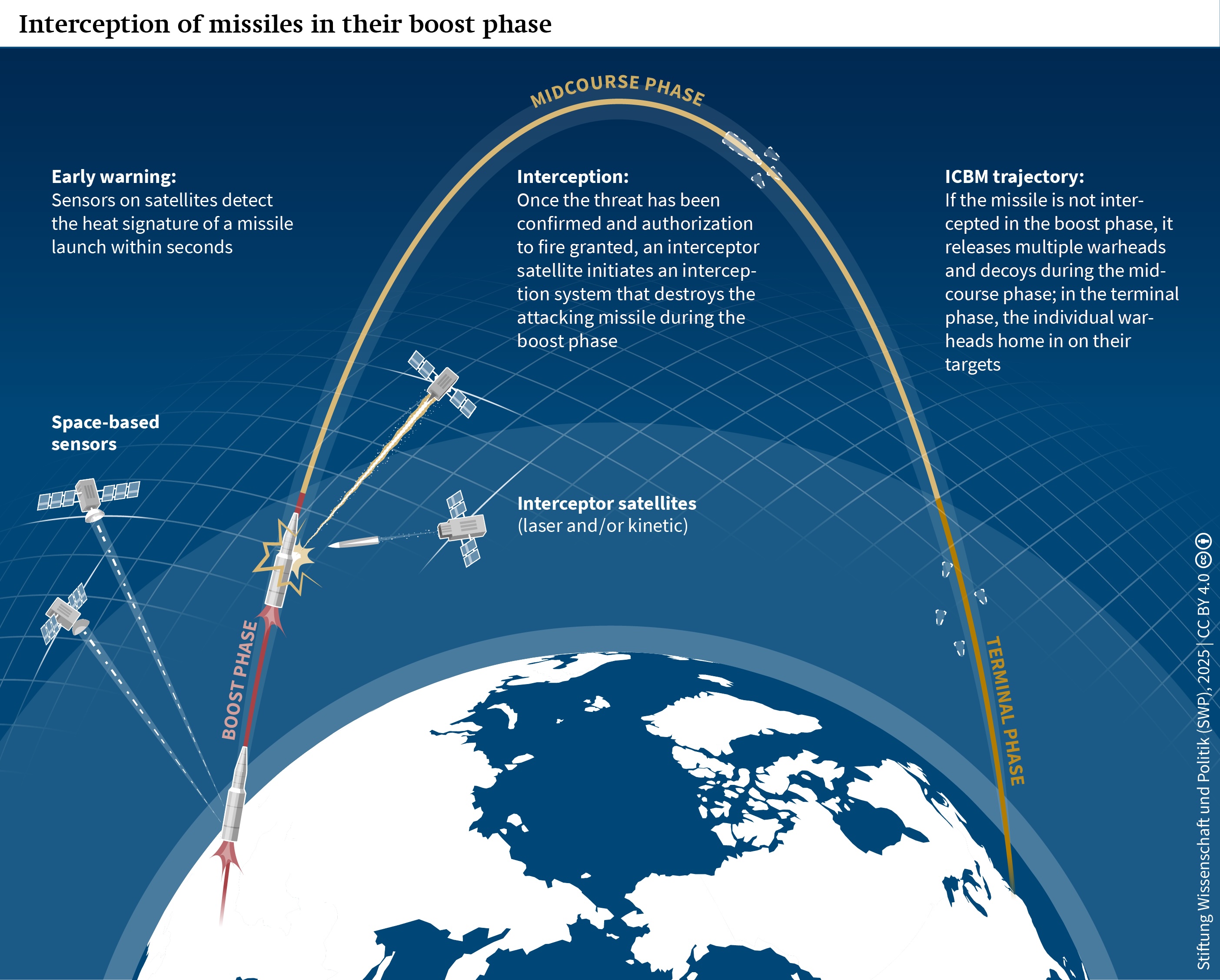
This infographic produced by the German Institute for International and Security Affairs illustrates the elements of a space-based missile defense system.
Credit: German Institute for International and Security Affairs (SWP), 2025/CC BY 4.0
This infographic produced by the German Institute for International and Security Affairs illustrates the elements of a space-based missile defense system. Credit: German Institute for International and Security Affairs (SWP), 2025/CC BY 4.0
In addition to SBIs to defend against missile attacks, Golden Dome will include lower-altitude and ground-based munitions suited for eliminating drones and other smaller, slower-moving aerial weapons. All of this “must be integrated with Artificial Intelligence to counter the speed, maneuverability, and lethality of the threats,” the Space Force said in a press release.
The US and Israeli war with Iran has been an acid test for missile defense. Ground- and sea-based US and Israeli interceptors have shot down thousands of missiles and drones since the first wave of Iranian ballistic missiles launched toward Israel in 2024, with a success rate of more than 90 percent. But the war has also shown that missile defenses are not impenetrable, with at least seven US service members killed by hostile action. Several costly early warning radars and US military airplanes in the Gulf states have been damaged or destroyed on the ground by Iranian drone or missile strikes.
The Iran war has also diminished existing stocks of US missile interceptors, which the Pentagon plans to integrate with Golden Dome to form ground, sea, and airborne layers to go along with the space layer in low-Earth orbit. Air Force Lt. Gen. Heath Collins, director of the Missile Defense Agency, told a House subcommittee April 15 that it will take a “number of years to replenish” the interceptors used in less than two months of the Iran war.
Should this be the priority?
Gen. Michael Guetlein, the Space Force general serving as director of the Golden Dome program, said replenishing the interceptors used up in the Iran war will have no schedule impact and “no direct cost impact” to Golden Dome, which the Trump administration says will cost $185 billion to develop and deploy.
Many analysts dispute the cost and schedule projections. Guetlein said outside estimates, some of which peg Golden Dome’s cost at several trillion dollars, don’t take into account what the Pentagon is actually building. However, defense officials are keeping much of the Golden Dome architecture secret, so it’s hard to know what it entails. Getting any working SBI capability into orbit in the next two-and-a-half years would require herculean efforts by the Space Force and the defense industry. Contractors would have to drastically cut down on the time it usually takes to deliver space systems of lesser complexity.
SBIs are widely seen as the most challenging and expensive element for Golden Dome. Space-based missile tracking sensors, satellite networks for targeting and data relay, and terrestrial interceptors already exist or will soon be operational. But SBIs may not be the panacea administration officials argued for when President Donald Trump signed the executive order for Golden Dome in January 2025. The order has a clear requirement for the Pentagon to develop plans for the deployment of “proliferated Space-Based Interceptors capable of boost-phase intercept.”

Gen. Michael Guetlein, direct report program manager for Golden Dome for America in the Office of the Secretary of Defense, appears before the House Armed Services Strategic Forces subcommittee on April 15, 2026 in Washington, DC.
Credit: Luke Johnson/Getty Images
Gen. Michael Guetlein, direct report program manager for Golden Dome for America in the Office of the Secretary of Defense, appears before the House Armed Services Strategic Forces subcommittee on April 15, 2026 in Washington, DC. Credit: Luke Johnson/Getty Images
“We are so focused on affordability. If we cannot do it affordably, we will not go into production,” Guetlein said in an April 15 hearing before the House Armed Services Strategic Forces subcommittee.
“We are looking at the threats from a multi-domain perspective to make sure I have redundant capabilities and I don’t have single points of failure,” he added. “So, if boost-phase intercept from space is not affordable and scalable, we will not produce it, because we have other options to get after it.”
Boost-phase intercepts would aim to destroy a missile within a few minutes after its launch, when it is still within or close to the atmosphere. In those early minutes, the heat from the missile’s exhaust plume would make it relatively easy to detect and target, but an interceptor in orbit would require a powerful impulse to reach it. The military is also interested in using SBIs for midcourse intercepts, when a missile is coasting through space, and during glide phase as they reenter the atmosphere. By then, though, a missile may have released countermeasures or multiple reentry vehicles.
Rep. Seth Moulton (D-Mass.) is the top Democrat on the House Strategic Forces subcommittee. He questions the premise that Golden Dome could deter future attacks, pointing to Iran’s sustained missile and drone strikes across the Middle East, despite the operational success of US and Israeli defenses.
“That basic theory seems blown out of the water by our current experience, which is that we have incredibly robust missile defense across the Middle East,” Moulton said. “We’ve been singing its praises in a very bipartisan way, and yet it has not stopped Iran in the least from shooting a lot of missiles and drones at us and our allies.”
“I think we’re talking about a regime that may be beyond deterrence,” said Marc Berkowitz, the assistant secretary of defense for space policy, referring to Iran. “They have, for decades, pursued nuclear weapons and ballistic missiles.”
The Trump administration is requesting $17 billion for Golden Dome in fiscal-year 2027, which begins October 1. Nearly all of the requested funding is packaged in a reconciliation bill, not in the White House’s regular annual funding request. While Republican lawmakers still voice support for Golden Dome, there is little appetite for the partisan budget battle a party-line reconciliation bill would spark ahead of this year’s midterm elections, Politico reported Thursday.
Putting the Golden Dome funding request in a bill that may never reach the House or Senate floor is “not great signaling by this White House about the supposedly drastic need for Golden Dome,” a former defense official told Politico.

Stephen Clark is a space reporter at Ars Technica, covering private space companies and the world’s space agencies. Stephen writes about the nexus of technology, science, policy, and business on and off the planet.