

惯性聚合 高效追踪和阅读你感兴趣的博客、新闻、科技资讯
阅读原文 在惯性聚合中打开

推荐订阅源

S
SegmentFault 最新的问题
OSCHINA 社区最新新闻
OSCHINA 社区最新新闻
B
Blog RSS Feed
Y
Y Combinator Blog
T
Tailwind CSS Blog
博客园 - 三生石上(FineUI控件)
J
Java Code Geeks
Stack Overflow Blog
Stack Overflow Blog
aimingoo的专栏
aimingoo的专栏
Jina AI
Jina AI
The GitHub Blog
The GitHub Blog
奇客Solidot–传递最新科技情报
奇客Solidot–传递最新科技情报
A
About on SuperTechFans
H
Hackread – Cybersecurity News, Data Breaches, AI and More
D
Docker
酷 壳 – CoolShell
酷 壳 – CoolShell
C
Check Point Blog
M
MIT News - Artificial intelligence
Last Week in AI
Last Week in AI
V
V2EX
腾讯CDC
F
Fortinet All Blogs
博客园 - 叶小钗
T
The Blog of Author Tim Ferriss

South China Morning Post

Singapore drama sparks Malaysian ire over scam hub depiction Time to act on stalled proposal toughening child abuse penalties, lawmakers say ‘Eager to explore’: Chinese migrants return to Venezuela after Maduro’s capture ‘We have no trust in the other side’: Iran blames US as talks end with no deal Opinion | Why securing Hong Kong’s economic future is a cultural question Hong Kong’s ministerial team spent HK$46.6 million on visits in past 3 years China family creates AI clone to comfort elderly mum after only son dies in crash Canada Olympic star Williams plans on ‘having a ‘blast’ at Hong Kong Sevens Singapore’s robotaxi drive revs up with help from Chinese AV leaders Editorial | Making Hong Kong desirable to overseas students must be a priority All 7 are dentists and hot. The Asian-American family blowing up social media Editorial | Ageing Hong Kong should welcome more open conversations around death My Take | Discovery Bay will never be the same if the restriction on taxi access is lifted Medical intern suspended after complaint over patient data in social media post Fish and vegetarianism major flashpoints in India’s West Bengal election Chinese crystal ‘paves way’ for GPS-free thorium clock navigation SCMP Best Bets: Endued can show his quality at Sha Tin Russia and Ukraine begin 32-hour ceasefire for Orthodox Easter Israeli spy firm Black Cube involved in Cyprus corruption probe ‘A big deal’: military drills show Tokyo’s growing focus on deterring China China targets middlemen in renewed crackdown on ‘hidden’ corruption Hong Kong-born gymnast leading quest to turn Singapore into elite hub Thais celebrate new year despite fuel price shocks delaying travel Harry Bentley tees up two good chances in Smart Golf and Elite Golf at Sha Tin Is this Kenyan rail project a model for Chinese and Western firms in Africa? Unearthing peace: ancient China gravesite reveals significance of broken weapons Meet Queen Elizabeth’s youngest grandchild, James, who was at Easter service Turtle found dead after apparent fall in Hong Kong’s Wong Tai Sin Landlords of 5,557 subdivided homes seek 3-year grace period to fix flats Trump critique pauses UK handover of Chagos Islands to Mauritius
Chinese scientists suggest harsh environments foster earl...
Kevin McSpadden · 2026-05-24 · via South China Morning Post

Archaeologists in central China have directly challenged the long-held belief that humanity’s earliest ancestors reached their creative peak during warm and hospitable climates.

For more than a decade, a team of researchers in Henan province has studied a 146,000-year-old animal-butchering site once inhabited by Homo juluensis, an extinct human species that lived about 300,000 years ago in eastern Asia. Their discovery of remarkably inventive tools suggests that these ancient cousins of Homo sapiens were driven to technological innovation by challenging environmental conditions.

Yuchao Zhao, the lead author of a new paper published in the Journal of Human Evolution, said in a statement: “People often imagine creativity as something that flourishes in good times. Finding out that these stone tools were made during a harsh ice age tells a different story. Hard times can force us to adapt.”
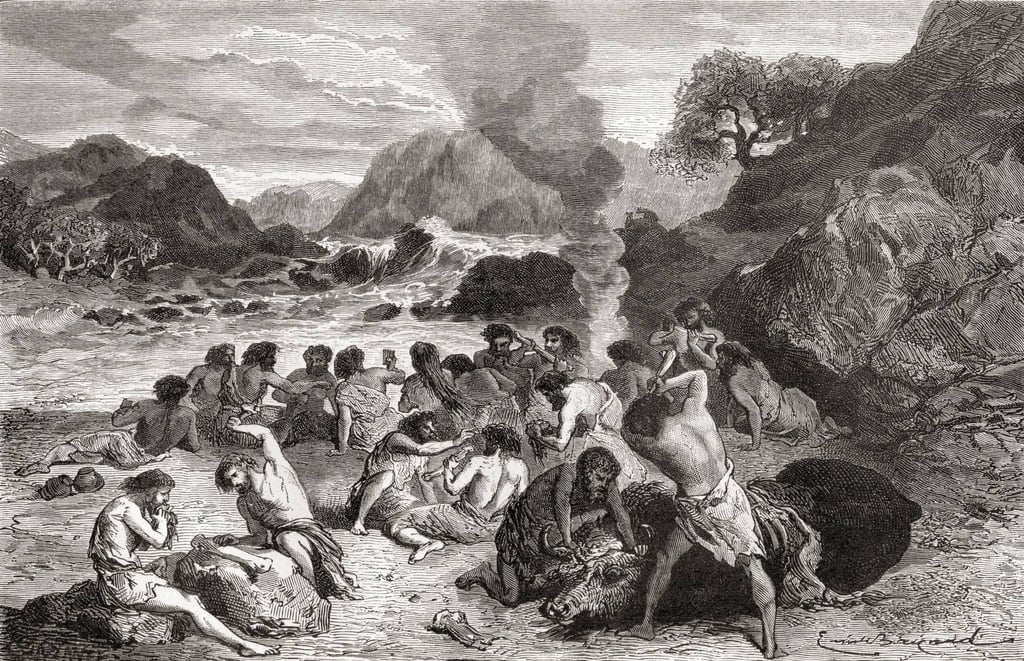
Neanderthals engaging in a feast during prehistoric times, as depicted in L’Homme Primitif, published in 1870. Photo: Universal History Archive/Universal Images Group via Getty Images

Neanderthals engaging in a feast during prehistoric times, as depicted in L’Homme Primitif, published in 1870. Photo: Universal History Archive/Universal Images Group via Getty Images

Moreover, these tools indicate that ancient humans in East Asia during the Middle Pleistocene (about 120,000 to 300,000 years ago) were more technologically advanced than previously assumed. Until now, it was widely believed that humans in this region lagged behind their counterparts in Africa and Europe.

The stone tools, while simple, were created by striking smaller stones against larger ones in a process that the scientists noted would have required planning and the eventual development of a manufacturing technique.

Furthermore, the team indicated that the stones were shaped into various forms, suggesting that the tools were not created by simply smashing rocks together; rather, the makers understood how the materials would interact.

“The underlying logic of this system – and the cognitive abilities it reflects – shows important similarities to Middle Palaeolithic technologies often associated with Neanderthals in Europe and with human ancestors in Africa, suggesting that advanced technological thinking was not limited to Western Eurasia,” Zhao explained.

Homo juluensis is a proposed extinct cousin of modern humans, meaning they may not have actually existed. However, if they did, scientists believe they occupied much of East Asia. This species may have belonged to what is referred to as the “muddle of the middle,” a term used to define the various types of humans as Homo erectus gradually evolved into Homo sapiens.