
惯性聚合 高效追踪和阅读你感兴趣的博客、新闻、科技资讯
阅读原文 在惯性聚合中打开

推荐订阅源

J
Java Code Geeks
腾讯CDC
博客园 - 聂微东
爱范儿
爱范儿
罗磊的独立博客
P
Proofpoint News Feed
博客园 - Franky
博客园 - 三生石上(FineUI控件)
OSCHINA 社区最新新闻
OSCHINA 社区最新新闻
酷 壳 – CoolShell
酷 壳 – CoolShell
Jina AI
Jina AI
Blog — PlanetScale
Blog — PlanetScale
让小产品的独立变现更简单 - ezindie.com
博客园 - 司徒正美
美团技术团队
MongoDB | Blog
MongoDB | Blog
WordPress大学
WordPress大学
A
About on SuperTechFans
I
InfoQ
博客园_首页
钛媒体:引领未来商业与生活新知
钛媒体:引领未来商业与生活新知
H
Help Net Security
Microsoft Azure Blog
G
Google Developers Blog

South China Morning Post

Singapore drama sparks Malaysian ire over scam hub depiction Time to act on stalled proposal toughening child abuse penalties, lawmakers say ‘Eager to explore’: Chinese migrants return to Venezuela after Maduro’s capture ‘We have no trust in the other side’: Iran blames US as talks end with no deal Opinion | Why securing Hong Kong’s economic future is a cultural question Hong Kong’s ministerial team spent HK$46.6 million on visits in past 3 years China family creates AI clone to comfort elderly mum after only son dies in crash Canada Olympic star Williams plans on ‘having a ‘blast’ at Hong Kong Sevens Singapore’s robotaxi drive revs up with help from Chinese AV leaders Editorial | Making Hong Kong desirable to overseas students must be a priority All 7 are dentists and hot. The Asian-American family blowing up social media Editorial | Ageing Hong Kong should welcome more open conversations around death My Take | Discovery Bay will never be the same if the restriction on taxi access is lifted Medical intern suspended after complaint over patient data in social media post Fish and vegetarianism major flashpoints in India’s West Bengal election Chinese crystal ‘paves way’ for GPS-free thorium clock navigation SCMP Best Bets: Endued can show his quality at Sha Tin Russia and Ukraine begin 32-hour ceasefire for Orthodox Easter Israeli spy firm Black Cube involved in Cyprus corruption probe ‘A big deal’: military drills show Tokyo’s growing focus on deterring China China targets middlemen in renewed crackdown on ‘hidden’ corruption Hong Kong-born gymnast leading quest to turn Singapore into elite hub Thais celebrate new year despite fuel price shocks delaying travel Harry Bentley tees up two good chances in Smart Golf and Elite Golf at Sha Tin Is this Kenyan rail project a model for Chinese and Western firms in Africa? Unearthing peace: ancient China gravesite reveals significance of broken weapons Meet Queen Elizabeth’s youngest grandchild, James, who was at Easter service Turtle found dead after apparent fall in Hong Kong’s Wong Tai Sin Landlords of 5,557 subdivided homes seek 3-year grace period to fix flats Trump critique pauses UK handover of Chagos Islands to Mauritius
Asian Angle | What the China-US stability pact means for ...
Hoang Thi Ha · 2026-05-23 · via South China Morning Post

When Xi Jinping and Donald Trump concluded their Beijing summit, the most consequential outcome – for China at least – may prove not material, but conceptual: the adoption of “constructive strategic stability” (CSS) as the guiding framework for managing their intensifying competition.

For Southeast Asia, a region often caught in the rivalry between the two powers, understanding what this means will matter in the years ahead.

The framework reflects a long-held Chinese strategic aspiration. Beijing has sought for years to anchor its relationship with Washington within an overarching paradigm – one that would codify, at the highest level, a set of principles governing how the two powers relate to each other.

From Beijing’s perspective, it also reflects Washington’s implicit recognition of China as a near-peer – if not already a coequal

When Xi visited Washington during the Obama administration in 2015, Beijing floated the concept of a “new type of major power relations”. Washington was cool. The balance of power then still favoured the US and American policymakers were wary of any formulation that smacked of a G2 condominium, with its implicit endorsement of Chinese co-primacy.

A decade later, the arithmetic has changed. Trump’s instinct for leader-to-leader deal making, his desire to reset relations after a bruising 2025 and China’s growing self-assurance as a peer competitor have together created the space for Beijing to update its proposal.

The resulting CSS framework carries significant symbolic and strategic weight for China. For the first time, observers say Beijing officially acknowledges “competition” as a feature of the bilateral relationship – a departure from its long-held preference for “win-win cooperation”. This signals a posture of confidence: a China no longer defensive about its standing as a rising power, now willing to compete with the status quo power on its own terms. From Beijing’s perspective, the framework also reflects Washington’s implicit recognition of China as a near-peer – if not already a coequal – in the global system.
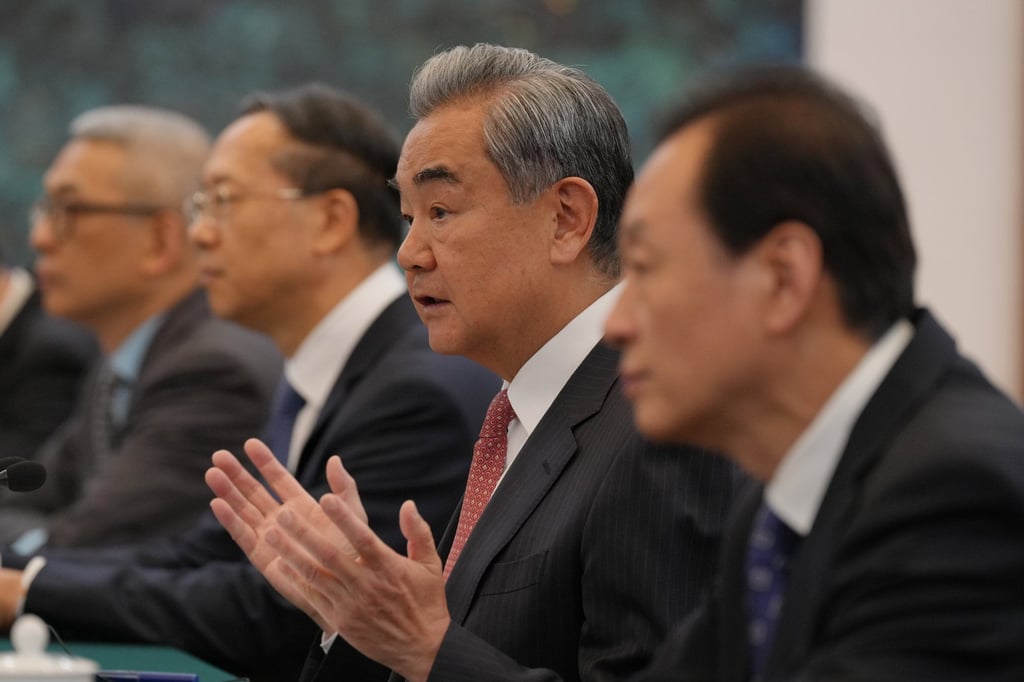
Chinese Foreign Minister Wang Yi (centre) speaks to a US congressional delegation during a bilateral meeting at the Great Hall of the People in Beijing on May 7. Photo: AP

Chinese Foreign Minister Wang Yi (centre) speaks to a US congressional delegation during a bilateral meeting at the Great Hall of the People in Beijing on May 7. Photo: AP

What does Beijing mean by “constructive strategic stability”? Chinese Foreign Minister Wang Yi’s post-summit briefing and commentary in a column associated with China’s official foreign policy positions laid out four dimensions:

  • Positive stability envisions cooperation as the mainstay of US-China relations.

  • Healthy stability frames competition as bounded and conducted on an equal footing – a “track-and-field contest” in which either side wins by outperforming the other rather than by tripping up its rival.

  • Constant stability refers to maintaining bilateral mechanisms and communication channels for managing differences, including through the US-China boards of trade and investment that are set to be established soon.

  • Enduring stability signals that Taiwan remains Beijing’s “core of core interests” and the ultimate test of whether the framework can hold.