











In Paris, police deployed tear gas. In Milan, a fist-fight erupted. In Hong Kong, Singapore, London and New York, all-night queues snaked from the doors of Swatch stores – the latest examples of “drop culture” to flash across the globe when status symbols and resale value collide.
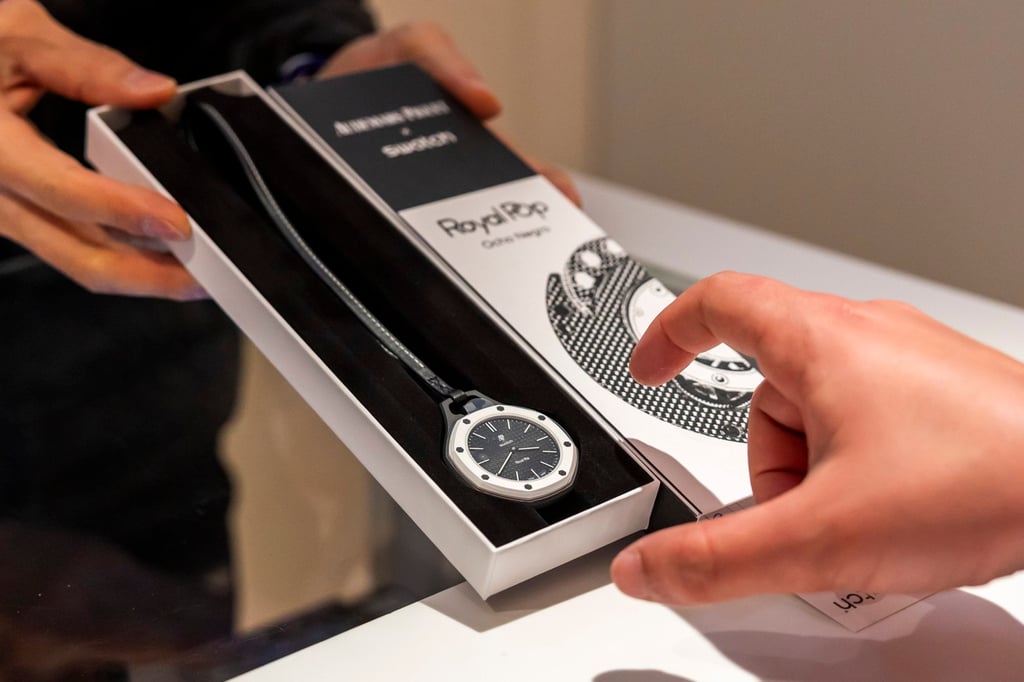
The company at the centre of it all, Swatch, is no stranger to over-the-top retail outbreaks, and said on May 18 that there is no shortage of its Royal Pop pocket watch – a collaboration with luxury watchmaker Audemars Piguet.
All for a “bioceramic” timekeeper that retails for around US$400 – but perhaps more to the point, resells for thousands of dollars. By May 18, the candy-coloured flex objects had proliferated on eBay, with one boasting: “In hand!!! Swatch x AP Royal Pop,” £3,055 (US$4,100) “or best offer”.
It was the latest eruption in a generation-long trail of consumerist frenzy – both online and in the physical world – that has touched companies from Nike to Walmart to Apple as human beings race, sometimes frantically, to keep pace with buying trends and the potential for resale.
“It looks like people got crazy to get a Royal Pop to make money through resale, not because they are fans of the Swatch,” says Pierre-Yves Donze, a professor of business history at Osaka University’s Graduate School of Economics in Japan. “People want money, especially. Royal Pop is not like a cool product, but a way to make easy money.”
此内容由惯性聚合(RSS阅读器)自动聚合整理,仅供阅读参考。 原文来自 — 版权归原作者所有。