





Artificial intelligence is reshaping Southeast Asia’s economic architecture — influencing how businesses scale, how small enterprises access capital and how essential services are delivered. At the South China Morning Post’s China Conference: Southeast Asia 2026, leaders across technology, finance, healthcare and insurance explored what it will take to turn digital momentum into inclusive growth.
Held on February 10-11 at The St Regis Jakarta, the conference brought together policymakers and industry leaders as China and Indonesia marked 75 years of diplomatic relations. Against a backdrop of deepening China–Asean integration, discussions focused on a central question: how can infrastructure, capital and partnerships align to accelerate Asean’s AI-powered future?
Demonstrable action and the execution of ideas, the speakers agreed, will define success.

Building the AI backbone
During the panel “Building Indonesia’s Digital Future: AI Infrastructure and Opportunities Ahead of the China–Asean Corridor,” Sean Yuan, vice-president, Alibaba Cloud International and general manager, South Pacific region, Alibaba Cloud Intelligence Group, highlighted the fact that talent development sits at the heart of AI transformation: “The first one is about talent,” he said. “It’s a key factor for the digital economy in this AI era.”
Alibaba Cloud’s Qwen family of large language models (LLMs) supports a range of use cases — from enterprise deployments to lightweight models embedded in devices.
“We are trying to cover a wide range of different scenarios and workflows,” he said.

Adoption is already delivering measurable results. Sean Yuan cited an Indonesian fintech firm that has reduced daily data-processing time by 60 per cent after integrating Qwen models.
Beyond products, Alibaba Cloud is expanding its Indonesia team, supporting local developers and localising its model studio to support sovereign AI initiatives.
“We are open source,” Yuan said. “We want to support local innovative ideas.” Ecosystem-building, he added, is essential. “We cannot do things alone.”
Jo Miyake, head of banking for Asia and the Middle East at HSBC’s Corporate and Institutional Banking division, highlighted the broader structural momentum behind this growth.
“We see three tailwinds that are very substantive when we think about this space,” he said, pointing to Asean’s expanding role in AI-linked supply chains, rising cross-border trade with China, and strengthening infrastructure investment.
Rather than focusing solely on financing gaps, Miyake noted that capital is becoming more diversified. “It’s less to talk about gaps. It’s more about recycling capital because there’s a lot of demand,” he said, as sovereign investors, institutional capital and private markets increasingly participate alongside banks and technology firms.
Expanding digital financial access
Financial inclusion remains equally critical to digital transformation.
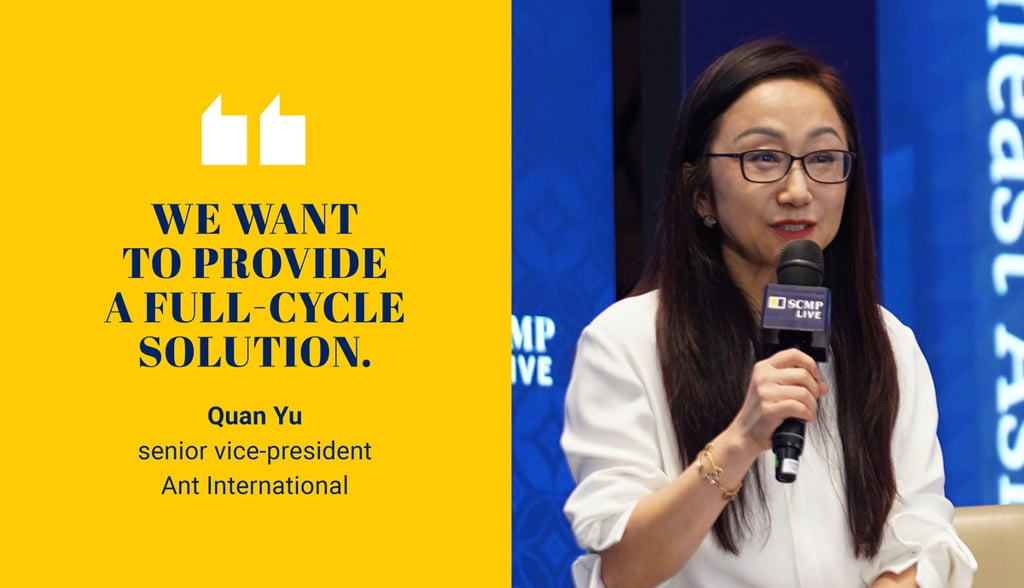
Quan Yu, senior vice-president of Ant International, spoke about the way digital payments and alternative-data based credit models are helping micro-entrepreneurs grow their businesses and access financial support more easily: “How can they open a digital store in 10 minutes? How can they accept payments from diverse merchants? How can they gain financial solutions?” she said. “We want to provide a full-cycle solution.”
Through partnerships such as its collaboration with Indonesian wallet DANA, Ant International connects local users to global merchants in selected online shopping scenarios. Beyond payments, Ant International helps DANA leverage transaction data to extend credit, complementing traditional bureau-based approach.
“Banks want to serve them,” Yu said. “However, many micro-entrepreneurs don’t have financial records. Using digital footprint and transactional data can help provide the right credit at the right time.”
Across markets, Ant International and its partners have extended credit access to more than 30 million users and merchants — underscoring the role of data-driven finance in expanding opportunity.

Digitising healthcare supply chains
Healthcare infrastructure is evolving in parallel.
Hu Hang, global partner of Fosun and chairman and CEO of Fosun Health Group, noted Indonesia’s potential in his company’s sector.“ I think Indonesia must be the hub for the [healthcare] supply chain in the Asian region,” he said.
Hu emphasised aligning green development with digital transformation and deepening China–Asean collaboration. Fosun is exploring hospital development, pharmaceutical distribution and biosimilar manufacturing partnerships in Indonesia.
“We want to establish several hospitals here,” he said, underscoring long-term cooperation as a driver of local capacity-building.
Scaling insurance inclusion
As economies digitise, protection must keep pace.
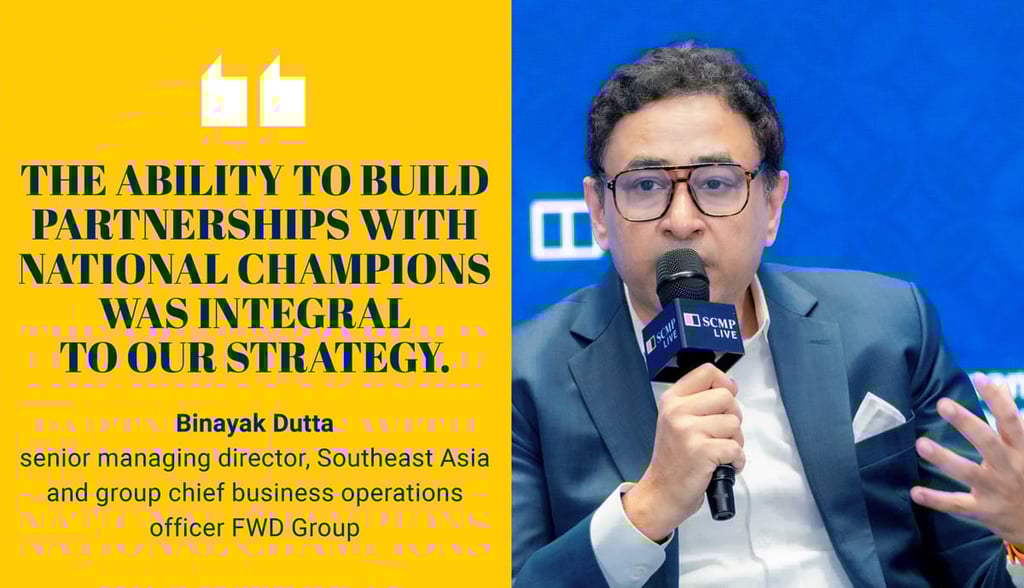
Binayak Dutta, senior managing director, Southeast Asia and group chief business operations officer at FWD Group, said Indonesia represents both opportunity and responsibility.
A key pillar of FWD’s strategy is its joint venture with Bank Rakyat Indonesia (BRI), the country’s largest bank and the world’s largest microloan distributor. “The ability to build partnerships with national champions was integral to our strategy,” he said.
By combining BRI’s nationwide reach with FWD’s underwriting and digitisation capabilities, the partnership has embedded micro-insurance into microloan journeys. Products are simple, low-cost — sometimes as little as US$1-US$3 — digitally issued and supported by rapid claims processing. “We cover almost 1 million of these policies every month,” Dutta said.
He added that stronger ecosystem collaboration — among banks, insurers, payment providers and regulators — will further accelerate inclusion.
From ambition to implementation
From AI infrastructure and digital payments to healthcare and micro-insurance, the discussions at the Jakarta conference reflected a shared conclusion: Asean’s digital future will be built through partnerships.
As Yuan said, this can’t be done alone.
Across sectors, that message resonated — sustainable growth in the AI era will depend not only on technology but also on aligning talent, capital and institutions to deliver inclusion at scale.
此内容由惯性聚合(RSS阅读器)自动聚合整理,仅供阅读参考。 原文来自 — 版权归原作者所有。