


惯性聚合 高效追踪和阅读你感兴趣的博客、新闻、科技资讯
阅读原文 在惯性聚合中打开

推荐订阅源

GbyAI
GbyAI
B
Blog
Stack Overflow Blog
Stack Overflow Blog
量子位
freeCodeCamp Programming Tutorials: Python, JavaScript, Git & More
T
Tailwind CSS Blog
MongoDB | Blog
MongoDB | Blog
小众软件
小众软件
博客园 - 三生石上(FineUI控件)
Recent Announcements
U
Unit 42
奇客Solidot–传递最新科技情报
奇客Solidot–传递最新科技情报
腾讯CDC
D
DataBreaches.Net
Microsoft Azure Blog
G
Google Developers Blog
M
MIT News - Artificial intelligence
P
Proofpoint News Feed
罗磊的独立博客
L
LangChain Blog
V
Visual Studio Blog
雷峰网
雷峰网
aimingoo的专栏
aimingoo的专栏
宝玉的分享
宝玉的分享

South China Morning Post

Singapore drama sparks Malaysian ire over scam hub depiction Time to act on stalled proposal toughening child abuse penalties, lawmakers say ‘Eager to explore’: Chinese migrants return to Venezuela after Maduro’s capture ‘We have no trust in the other side’: Iran blames US as talks end with no deal Opinion | Why securing Hong Kong’s economic future is a cultural question Hong Kong’s ministerial team spent HK$46.6 million on visits in past 3 years China family creates AI clone to comfort elderly mum after only son dies in crash Canada Olympic star Williams plans on ‘having a ‘blast’ at Hong Kong Sevens Singapore’s robotaxi drive revs up with help from Chinese AV leaders Editorial | Making Hong Kong desirable to overseas students must be a priority All 7 are dentists and hot. The Asian-American family blowing up social media Editorial | Ageing Hong Kong should welcome more open conversations around death My Take | Discovery Bay will never be the same if the restriction on taxi access is lifted Medical intern suspended after complaint over patient data in social media post Fish and vegetarianism major flashpoints in India’s West Bengal election Chinese crystal ‘paves way’ for GPS-free thorium clock navigation SCMP Best Bets: Endued can show his quality at Sha Tin Russia and Ukraine begin 32-hour ceasefire for Orthodox Easter Israeli spy firm Black Cube involved in Cyprus corruption probe ‘A big deal’: military drills show Tokyo’s growing focus on deterring China China targets middlemen in renewed crackdown on ‘hidden’ corruption Hong Kong-born gymnast leading quest to turn Singapore into elite hub Thais celebrate new year despite fuel price shocks delaying travel Harry Bentley tees up two good chances in Smart Golf and Elite Golf at Sha Tin Is this Kenyan rail project a model for Chinese and Western firms in Africa? Unearthing peace: ancient China gravesite reveals significance of broken weapons Meet Queen Elizabeth’s youngest grandchild, James, who was at Easter service Turtle found dead after apparent fall in Hong Kong’s Wong Tai Sin Landlords of 5,557 subdivided homes seek 3-year grace period to fix flats Trump critique pauses UK handover of Chagos Islands to Mauritius
Opinion | Iran crisis casts light on energy security from...
Warwick Powe · 2026-04-22 · via South China Morning Post

In the spring of 2026, amid a fragile ceasefire in the Strait of Hormuz, President Donald Trump continues to insist that the United States is untouched by disruptions in the Persian Gulf. “We don’t use it”, he has claimed, echoing years of “energy dominance” rhetoric.

The numbers tell a different story. The United States remains a net importer of crude oil. Its refineries are engineered for the medium sour barrels that flow through the Hormuz Strait. And the global price shock triggered by the US’ military actions against Iran has already pushed American petrol above US$4 a gallon while hammering Europe and Asia far harder.

Start with the feedstock reality. In 2025, the US produced a record 13.6 million barrels per day of crude oil. Yet it still imported an average of 6.2 million barrels per day and exported only 4 million, leaving net crude imports at 2.2 million barrels per day.

Countries in the Persian Gulf, such as Saudi Arabia, Iraq, Kuwait and the United Arab Emirates, supplied roughly 490,000 barrels per day through the Strait of Hormuz in 2025, accounting for about 8 per cent of total US crude imports and roughly 2–3 per cent of refinery throughput. That is not “almost no oil”. It is a quality-specific slice needed by complex refineries along the Gulf of Mexico and the US West Coast.

A chemistry mismatch is the heart of the issue. American shale output is overwhelmingly light and sweet – high American Petroleum Institute (API) gravity and low sulphur. Most US refineries, however, were built over decades to run heavier, sourer crudes that yield more middle distillates (diesel and jet fuel) and fewer low-value residuals.

Roughly 70 per cent of US refining capacity relies on other units optimised for medium-to-heavy sour blends averaging 33-34 degrees API and 1.3 per cent sulphur. Light shale crude alone produces too much petrol and too little of the high-value products that drive refinery margins and exports. Without the imported sour barrels for blending, refiners face lower throughput, suboptimal yields and higher operating costs. Persian Gulf crude that does arrive – 88 per cent of it medium sour – fills exactly that gap.
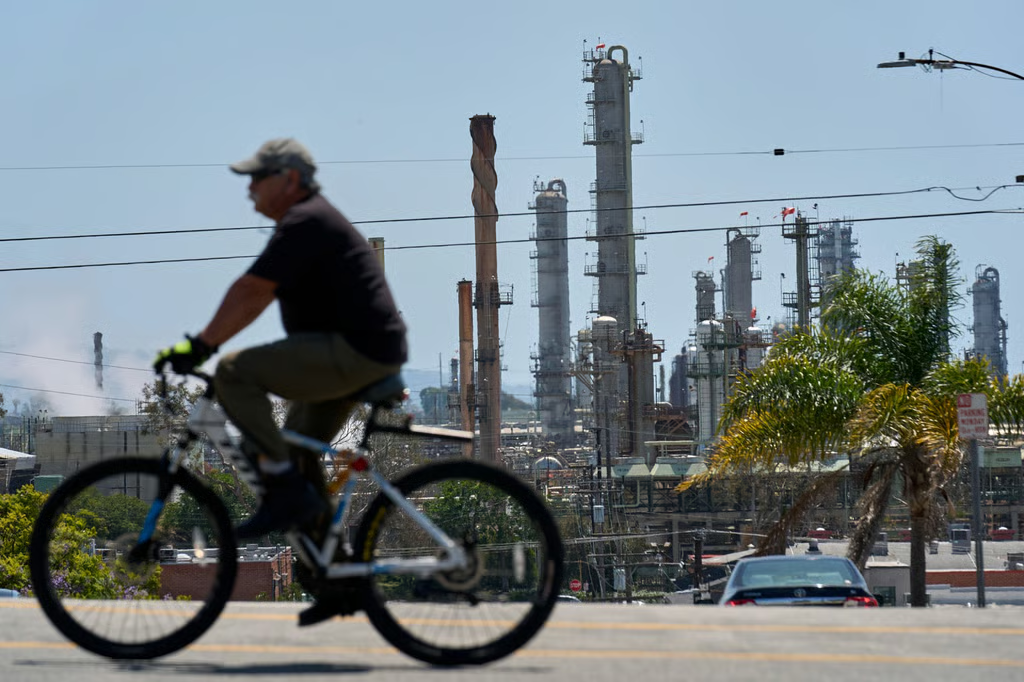
A cyclist rides past the Chevron refinery in El Segundo, California on April 17. US refiners rely on imported heavier blends to turn domestic light crude into exportable products like diesel and jet fuel. Photo: AP

A cyclist rides past the Chevron refinery in El Segundo, California on April 17. US refiners rely on imported heavier blends to turn domestic light crude into exportable products like diesel and jet fuel. Photo: AP