
惯性聚合 高效追踪和阅读你感兴趣的博客、新闻、科技资讯
阅读原文 在惯性聚合中打开

推荐订阅源

V
Visual Studio Blog
量子位
大猫的无限游戏
大猫的无限游戏
Hugging Face - Blog
Hugging Face - Blog
S
SegmentFault 最新的问题
Blog — PlanetScale
Blog — PlanetScale
月光博客
月光博客
Google DeepMind News
小众软件
小众软件
WordPress大学
WordPress大学
宝玉的分享
宝玉的分享
MongoDB | Blog
MongoDB | Blog
B
Blog RSS Feed
博客园 - Franky
奇客Solidot–传递最新科技情报
奇客Solidot–传递最新科技情报
B
Blog
博客园 - 聂微东
The GitHub Blog
The GitHub Blog
Recent Announcements
Y
Y Combinator Blog
Microsoft Security Blog
雷峰网
雷峰网
Jina AI
Jina AI
酷 壳 – CoolShell
酷 壳 – CoolShell

South China Morning Post

Singapore drama sparks Malaysian ire over scam hub depiction Time to act on stalled proposal toughening child abuse penalties, lawmakers say ‘Eager to explore’: Chinese migrants return to Venezuela after Maduro’s capture ‘We have no trust in the other side’: Iran blames US as talks end with no deal Opinion | Why securing Hong Kong’s economic future is a cultural question Hong Kong’s ministerial team spent HK$46.6 million on visits in past 3 years China family creates AI clone to comfort elderly mum after only son dies in crash Canada Olympic star Williams plans on ‘having a ‘blast’ at Hong Kong Sevens Singapore’s robotaxi drive revs up with help from Chinese AV leaders Editorial | Making Hong Kong desirable to overseas students must be a priority All 7 are dentists and hot. The Asian-American family blowing up social media Editorial | Ageing Hong Kong should welcome more open conversations around death My Take | Discovery Bay will never be the same if the restriction on taxi access is lifted Medical intern suspended after complaint over patient data in social media post Fish and vegetarianism major flashpoints in India’s West Bengal election Chinese crystal ‘paves way’ for GPS-free thorium clock navigation SCMP Best Bets: Endued can show his quality at Sha Tin Russia and Ukraine begin 32-hour ceasefire for Orthodox Easter Israeli spy firm Black Cube involved in Cyprus corruption probe ‘A big deal’: military drills show Tokyo’s growing focus on deterring China China targets middlemen in renewed crackdown on ‘hidden’ corruption Hong Kong-born gymnast leading quest to turn Singapore into elite hub Thais celebrate new year despite fuel price shocks delaying travel Harry Bentley tees up two good chances in Smart Golf and Elite Golf at Sha Tin Is this Kenyan rail project a model for Chinese and Western firms in Africa? Unearthing peace: ancient China gravesite reveals significance of broken weapons Meet Queen Elizabeth’s youngest grandchild, James, who was at Easter service Turtle found dead after apparent fall in Hong Kong’s Wong Tai Sin Landlords of 5,557 subdivided homes seek 3-year grace period to fix flats Trump critique pauses UK handover of Chagos Islands to Mauritius
Opinion | Heroics will only turn middle power dreams into...
Jeffrey Robertson · 2026-05-29 · via South China Morning Post

Recent articles in an Asia-focused international policy forum suggest that states such as Australia, Canada and South Korea can join up with other middle powers to secure the maritime order and restore the liberal international order. While well meaning and encouraging, the unfortunate truth is that these tasks are beyond the capacity of middle powers. The smartest ones won’t even try.

Maritime security has transformed from a permissive environment dominated by uncontested naval supremacy into a contested battlespace shaped by long-range missiles, drones, submarines, cyberwarfare and anti-access systems. Even the US Navy struggles to guarantee uninterrupted maritime security. The idea that a loose coalition of middle powers could independently safeguard Indo-Pacific trade routes borders on strategic fantasy.

The regional order has transformed from a stable US-led hierarchy into a fragmented and increasingly competitive strategic environment. After the Cold War ended, liberal-internationalist middle powers could amplify their influence through multilateral institutions, coalition-building and the language of a rules-based order because overwhelming American power underwrote the system. That has ended. The “US-led” epithet to “liberal international order” was there for a reason. That order collapsed without US leadership.

The greatest middle power initiatives were built through diplomatic specialisation, innovative and creative policies facilitated through a close academic-policymaker nexus, steady and well-planned diplomatic groundwork, and an ability to secure the support – or at least not the outright opposition – of great powers. Central to this was the maintenance of well-funded and well-trained diplomatic personnel. The capacity of middle power states to sustain such action has long passed.

Australia is one example. Between the 1989 establishment of the Asia-Pacific Economic Cooperation (Apec) forum in a Canberra meeting and the failure of then-Australian prime minister Kevin Rudd’s Asia-Pacific Community proposal some 20 years later, the cancer in liberal international middle power diplomacy was revealed.

Apec emerged at a moment of favourable strategic conditions, strong bureaucratic capacity, expanding economic globalisation and, crucially, support from the US and regional great powers. Every middle power success story from the era has one feature in common: the support, or at least acquiescence, of the dominant great power.
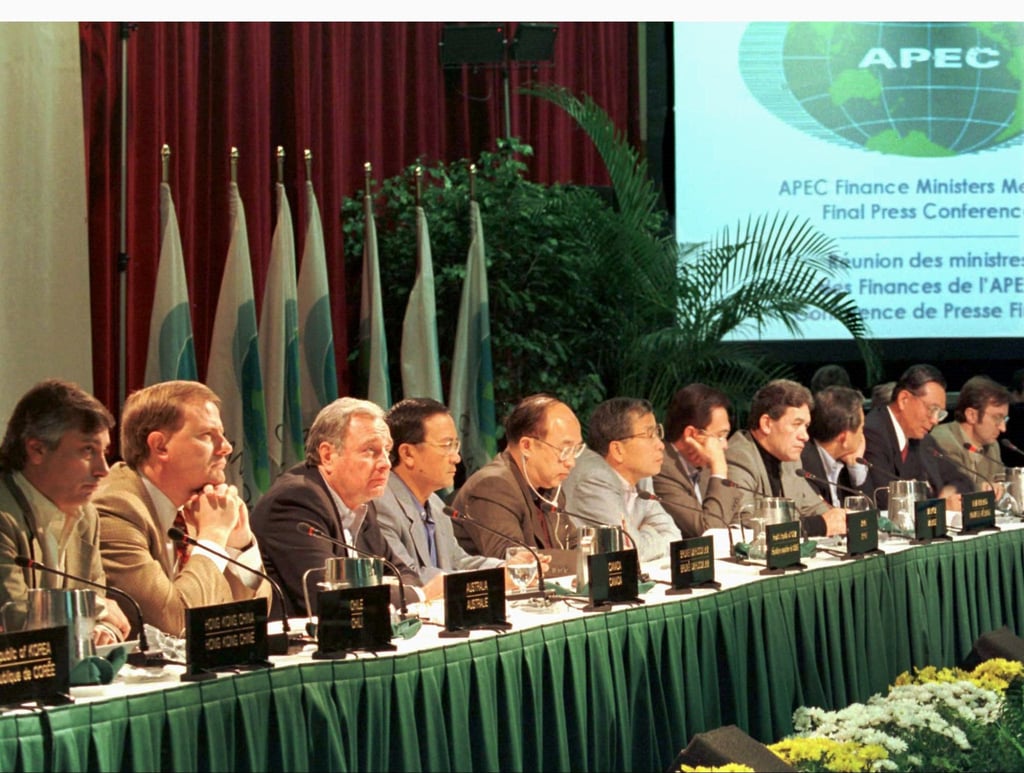
Finance ministers field media questions at the Apec finance ministers’ conference in Kananaskis, Alberta, Canada, on May 24, 1998. Photo: Reuters

Finance ministers field media questions at the Apec finance ministers’ conference in Kananaskis, Alberta, Canada, on May 24, 1998. Photo: Reuters