








So you’ve finally decided to sign up for Hyrox.
With no finishing time restriction, no qualifications required for entrance, and highly trainable functional movements, Hyrox is a welcoming sport for beginners.
The fitness race – exploding in popularity across Asia – sounds simple on paper: eight one-kilometre runs, punctuated by eight workout stations: SkiErg for 1km, a 50m weighted sledge push, 50m sledge pull, 80m burpee broad jumps, 1km on the stationary row machine, 200m farmer’s carry with kettlebells, 100m sandbag lunges, and the dreaded final 100 wall balls, right before you dash your way to the finishing podium.
A common misconception is that the workout stations are the biggest challenges, but results have shown that the running portion accounts for an average 60 per cent of race time. To prepare adequately, experts recommend working out at least four to five days each week, tailoring an exercise split depending on your own strengths and weaknesses.
“If you’re a strong runner, spend more time on strength. If you’re naturally strong, work on your running speed and endurance,” says Maximilian Lai, regional event manager, East Asia at Hyrox APAC. “A solid weekly plan includes one strength day, one speed training day, one long run day and one Hyrox-style circuit session to simulate race demands.”

Hyrox pro athlete and ambassador Clare Cheung, an events manager, has ranked first in 13 races and is set to compete in her third World Championships in June. She advises beginners to focus on building strength and aerobic capacity about eight weeks before the race. At four to three weeks before, focus on station efficiency and compromised running, which stretches your endurance on fatigue.
“Two weeks out, make sure to do one race simulation to monitor your progress and tweak your race day strategy. At that point, start to deload by reducing workout volume – think fewer reps or sets – while maintaining intensity. Test your race day kit, and prioritise sleep and nutrition,” she explains.

There are an increasing number of Hyrox Training Clubs, affiliated gyms and even partner hotels around the globe that emphasise race preparation and recovery for local and visiting racers.
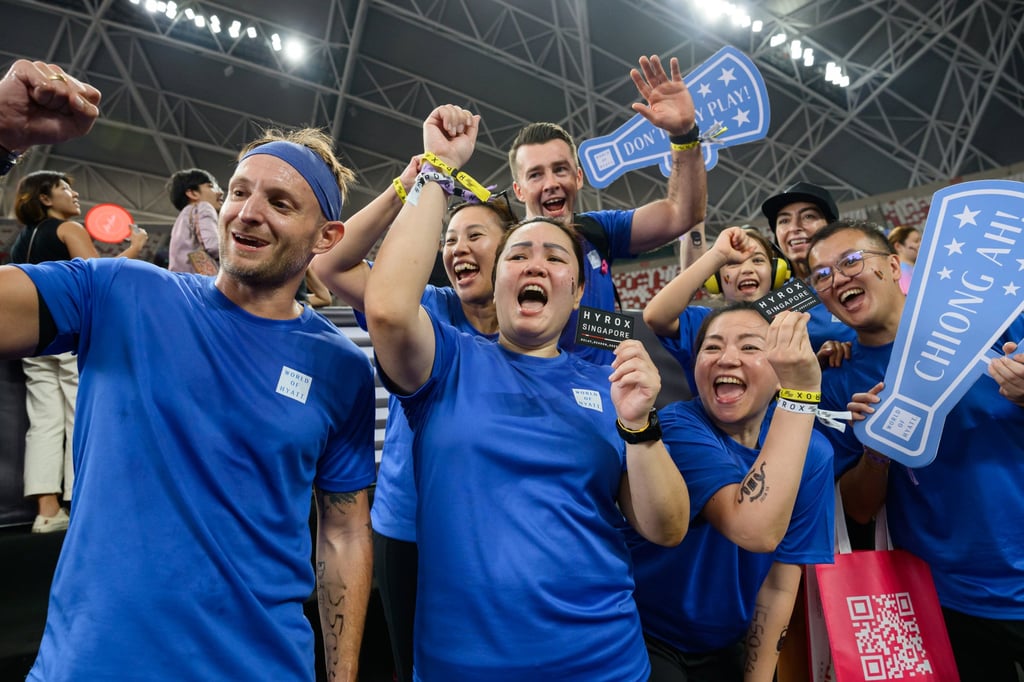
Charis Choi, regional vice-president at Hyatt Asia Pacific, participated in her first corporate mixed relay in her 50s, in Singapore earlier this year. Hosted at the partially open-air National Stadium, Hyrox Singapore adds an extra layer of challenge as racers need to contend with the outdoor climate.
To prepare, Choi joined a Hyrox training camp at Grand Hyatt Singapore. “Parts of the training were conducted on the open-air lawn in similar conditions, which helped me feel mentally and physically prepared for race day,” she says.
Recovery is an important facet of training often overlooked by busy individuals, says Silja Giel, global head of product development at DHL Global Forwarding, who has competed in 18 races across eight countries so far. Time is one of the biggest constraints, she says, so she sometimes schedules both running and strength workouts in a day – with at least six hours in between to rest. “A simple way to gauge [proper] recovery would be to test how light I feel in my runs and strength sessions,” she says. Seven to nine hours’ sleep a night, proper nutrition and supplementation – such as magnesium, turmeric and greens powder – also improve recovery.
On race day itself, seasoned racers all agree not to try anything new: make sure to fuel with familiar foods and carbohydrates. Walk the venue, learn the layout and run laps, warm up – and don’t forget to soak in the vibe and have fun.
Finally, the right mindset is key. For many racers, it is the sense of accomplishment, community and confidence gained from Hyrox that keeps them coming back for more.
“I went into the race with the mindset of participating as a team and pushing myself beyond my comfort zone, but enjoying the journey was just as important,” Choi says. “This was my very first Hyrox race, and I truly hope it won’t be my last.”
此内容由惯性聚合(RSS阅读器)自动聚合整理,仅供阅读参考。 原文来自 — 版权归原作者所有。