







Artificial intelligence (AI) has become the latest version of the corporate arms race, with companies under pressure to quickly adopt the newest tools or risk being left behind. But in banking, the calculation is different. These technologies cannot just be exciting or efficient; they also have to be secure and accountable.
UOB approaches this moment with what Lee Zhu Kuang, head of the bank’s Innovation Group, describes as “discipline over hype”. Rather than chasing every trend, the bank is focused on applications that can deliver long-term resilience and operating efficiency. That means building capabilities that are “regulator ready” and safe to scale across Asean.
“Strong governance is not something we add later,” he says. “It is designed and built in from the beginning, so trust is never compromised as we move forward.”
For UOB, that discipline also extends to how the bank develops its people. Lee notes that one of its core beliefs is that AI transformation should be “led by people, powered by technology”, with new ways of working designed to build upon employees’ existing strengths.

He says that since last year, the bank has deployed more than 300 AI and advanced analytics use cases, in addition to the more than 30 domain-specific knowledge chatbots under the Build-Your-Own-Bot platform, which is designed to help employees obtain information faster and support more efficient decision-making. It allows business units to create chatbots within a secure, governed environment. In practice, that can be as simple as helping an employee understand human resources (HR) policies. They can query the bot, which scans large volumes of information and then returns a summarised answer, saving time for both the HR team and the employee.
That emphasis on helping employees retrieve information more quickly is also carried into UOB’s Singapore branches, where Branch Bot scans product information and client inquiries so frontline staff can respond more promptly to customers’ questions, whether they are about interest rates, available investment options or other product details. In addition, UOB has rolled out the Microsoft 365 Copilot Chat to more than 30,000 employees across its global franchise, helping them speed up routine tasks. Together, these initiatives show how the bank is integrating AI into its employees’ everyday work.
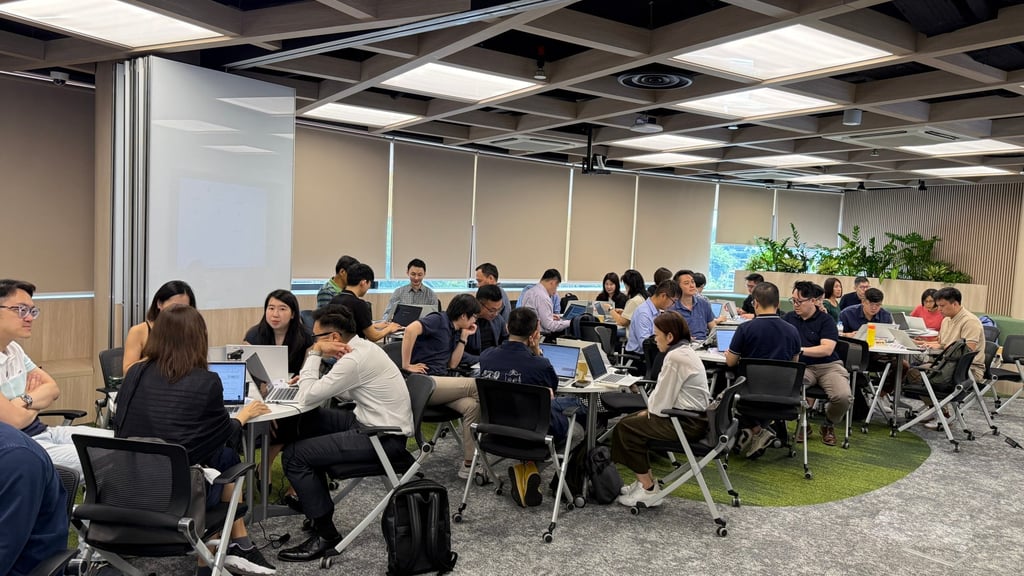
That people-first approach also informs how UOB thinks about workplace readiness. The bank says its Innovation Academy is equipping its 32,000 employees with the skills and mindset to integrate new tools into day-to-day work, with structured learning pathways spanning AI, data analytics, blockchain and design thinking. About 90 per cent of the bank’s employees have received generative AI upskilling to strengthen enterprise-wide readiness. At the same time, programmes such as Better U Pivot are retraining employees to transition into roles in growth areas such as risk, compliance and sales.
“At UOB, we believe innovation is about empowerment,” Lee says. “Our employees should feel supported by emerging technology, not replaced by it. This gives them the confidence to adopt these technologies and know that AI can augment them and assist them in their work.”
That link between employee enablement and customer experience sits at the heart of UOB’s innovation strategy. When evaluating a new technology, the bank starts by looking at a real problem.
“Every initiative begins by asking what friction we are trying to remove, and what decision we are improving, for customers and colleagues,” Lee says. “If a solution does not make banking simpler, it does not scale.”
That principle is already shaping the way AI is used across the bank’s client-facing operations. At branches, UOB offers a wait-time prediction model. In corporate banking, AI supports portfolio optimisation, while in personal banking, it helps spot early warning signs of fraud.
Rolling out these kinds of initiatives across a regional bank requires purpose-built architecture behind the scenes. At UOB, this includes the Enterprise GenAI Platform (EGP), which allows generative AI applications to operate across the bank with security and compliance guardrails in place. The EGP is reinforced by the AI Ethics and Model Governance Taskforce, an internal oversight group responsible for embedding the Monetary Authority of Singapore’s Fairness, Ethics, Accountability, Transparency (FEAT) principles for responsible AI and data analytics into the bank’s governance framework.
“A key focus of our governance-by-design approach is ensuring that we scale AI responsibly as we continue to build trust,” Lee says.
For a bank like UOB that operates across Asean – where customer needs, regulations and operating models differ from market to market – Lee says the goal is to build capabilities whose benefits can compound across businesses, borders and markets while still being adapted for local relevance. The bank is now focused on making sure it gets the right infrastructure in place to drive adoption and deliver a return on investment over time.
此内容由惯性聚合(RSS阅读器)自动聚合整理,仅供阅读参考。 原文来自 — 版权归原作者所有。