


惯性聚合 高效追踪和阅读你感兴趣的博客、新闻、科技资讯
阅读原文 在惯性聚合中打开

推荐订阅源

M
MIT News - Artificial intelligence
雷峰网
雷峰网
OSCHINA 社区最新新闻
OSCHINA 社区最新新闻
Last Week in AI
Last Week in AI
奇客Solidot–传递最新科技情报
奇客Solidot–传递最新科技情报
阮一峰的网络日志
阮一峰的网络日志
月光博客
月光博客
博客园 - Franky
腾讯CDC
T
Tailwind CSS Blog
Recent Announcements
V
V2EX
N
Netflix TechBlog - Medium
量子位
Jina AI
Jina AI
Y
Y Combinator Blog
The GitHub Blog
The GitHub Blog
G
Google Developers Blog
爱范儿
爱范儿
博客园 - 叶小钗
D
Docker
MongoDB | Blog
MongoDB | Blog
D
DataBreaches.Net
T
The Blog of Author Tim Ferriss

South China Morning Post

Singapore drama sparks Malaysian ire over scam hub depiction Time to act on stalled proposal toughening child abuse penalties, lawmakers say ‘Eager to explore’: Chinese migrants return to Venezuela after Maduro’s capture ‘We have no trust in the other side’: Iran blames US as talks end with no deal Opinion | Why securing Hong Kong’s economic future is a cultural question Hong Kong’s ministerial team spent HK$46.6 million on visits in past 3 years China family creates AI clone to comfort elderly mum after only son dies in crash Canada Olympic star Williams plans on ‘having a ‘blast’ at Hong Kong Sevens Singapore’s robotaxi drive revs up with help from Chinese AV leaders Editorial | Making Hong Kong desirable to overseas students must be a priority All 7 are dentists and hot. The Asian-American family blowing up social media Editorial | Ageing Hong Kong should welcome more open conversations around death My Take | Discovery Bay will never be the same if the restriction on taxi access is lifted Medical intern suspended after complaint over patient data in social media post Fish and vegetarianism major flashpoints in India’s West Bengal election Chinese crystal ‘paves way’ for GPS-free thorium clock navigation SCMP Best Bets: Endued can show his quality at Sha Tin Russia and Ukraine begin 32-hour ceasefire for Orthodox Easter Israeli spy firm Black Cube involved in Cyprus corruption probe ‘A big deal’: military drills show Tokyo’s growing focus on deterring China China targets middlemen in renewed crackdown on ‘hidden’ corruption Hong Kong-born gymnast leading quest to turn Singapore into elite hub Thais celebrate new year despite fuel price shocks delaying travel Harry Bentley tees up two good chances in Smart Golf and Elite Golf at Sha Tin Is this Kenyan rail project a model for Chinese and Western firms in Africa? Unearthing peace: ancient China gravesite reveals significance of broken weapons Meet Queen Elizabeth’s youngest grandchild, James, who was at Easter service Turtle found dead after apparent fall in Hong Kong’s Wong Tai Sin Landlords of 5,557 subdivided homes seek 3-year grace period to fix flats Trump critique pauses UK handover of Chagos Islands to Mauritius
From Udaipur’s Jal Sanjhi to Jaipur’s City Palace – Rajas...
Gavin Yeung · 2026-05-16 · via South China Morning Post

With powder-caked hands, Shri Rajesh Vaishnav gingerly lays a centuries-old paper stencil, passed down through generations, onto the canvas. In another motion, he rubs his finger back and forth into a spoonful of coloured dust held in a fine gauze pouch, pushing the light-blue pigment out. The pigment gently drifts onto the stencil, settling in a diaphanous layer.

Satisfied, Vaishnav lifts the stencil in a swift, decisive motion, revealing an image of the major deity Krishna as a flute-playing cowherd, poised against an Elysian scene of cattle grazing on lush, berry-laden bushes with peacocks and monkeys weaving in between. A breeze enters the room and the painting ripples ever so slightly, betraying the nature of the canvas underneath: not cotton fabric stretched over a wooden frame, but rather a square tub of holy water extracted from the River Ganges.
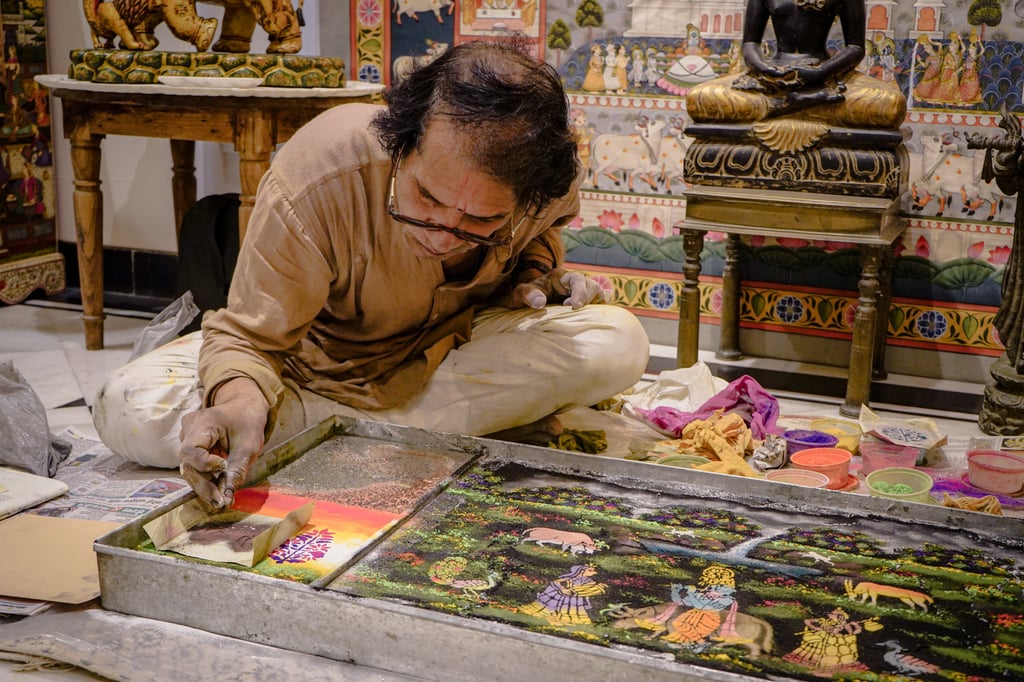
Shri Rajesh Vaishnav creates a Jal Sanjhi work by stencilling pigment on holy water from the River Ganges. Photo: Gavin Yeung

Shri Rajesh Vaishnav creates a Jal Sanjhi work by stencilling pigment on holy water from the River Ganges. Photo: Gavin Yeung

This is Jal Sanjhi, a religious art form specific to the historic city of Udaipur, in Rajasthan, India, that dates back 300 years and is practised by only two artists today, both of whom inherited the art form from their ancestors. Taking around an hour to create, each composition lasts at most for a day, before the pigments begin to sink into the water – a fitting metaphor for the beauty found in transience.

Standing over Vaishnav with his arms crossed is Hemendra Pujari, the founder of the Shyam Arts gallery that we find ourselves in. “There was a time when we Indians were looking for Van Gogh, then there were Van Goghs everywhere in the streets of India,” he says, scanning his eyes over the waterborne artwork and appreciating the fine details. “But when people went to visit the museums in London and realised that they were exhibiting the best of Indian art, it started making them feel proud of their own art. And they are bringing it back to their lives.”
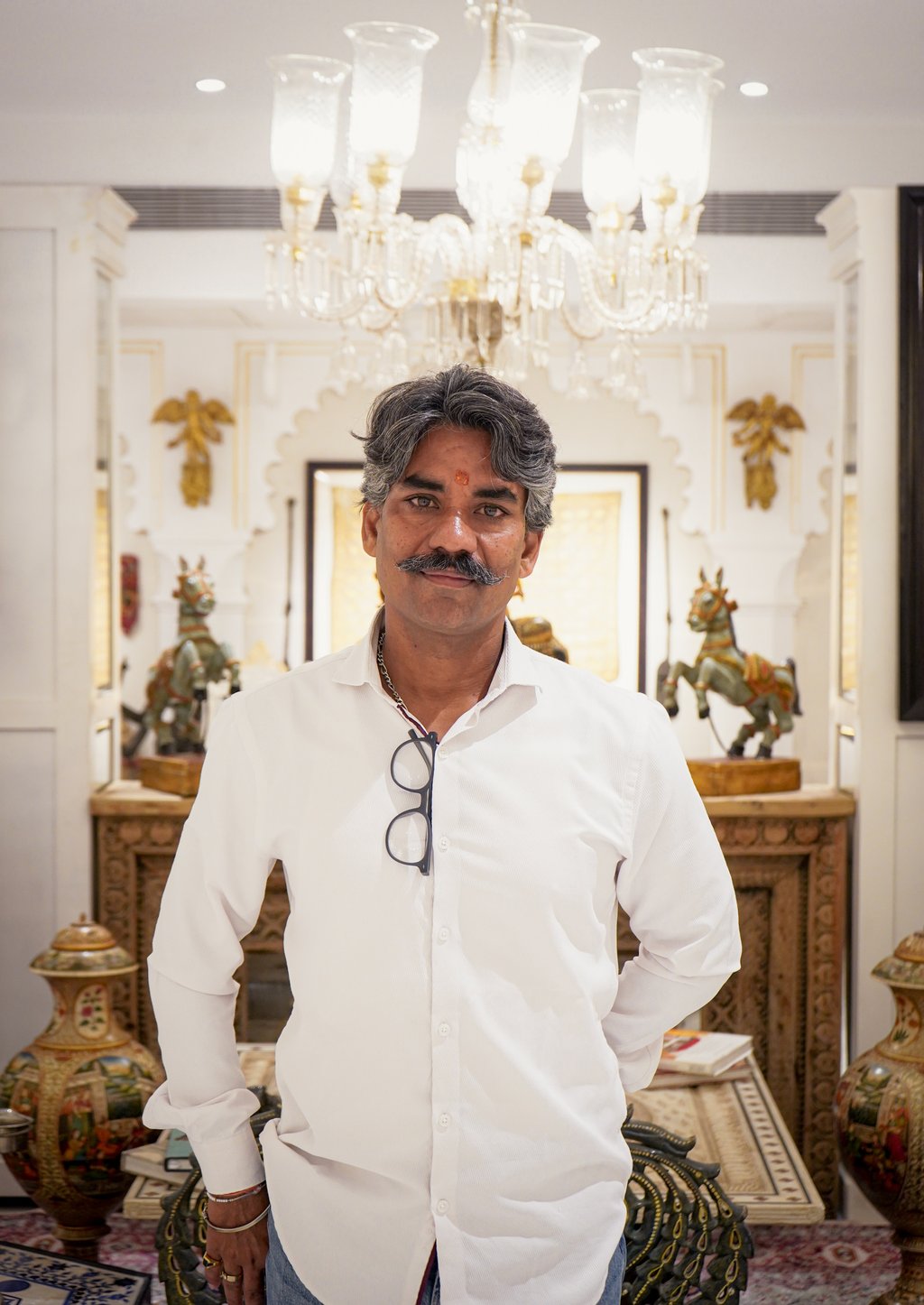
Hemendra Pujari, the founder of the Shyam Arts gallery in Udaipur. Photo: Gavin Yeung

Hemendra Pujari, the founder of the Shyam Arts gallery in Udaipur. Photo: Gavin Yeung

Pujari, whose glassy eyes and thick moustache give him the air of a reformed bohemian, is descended from a lineage of priests from the nearby temple of Jagdish Mandir. Having grown up with a deep appreciation for traditional and religious arts, the Udaipur native has made it his mission to educate the droves of foreign tourists from as far afield as the United States, Australia and Canada – more than 155,000 of whom arrived in 2024 alone – about the craft heritage of his hometown.

Tourism is what “gave a new hope of life to so many different things which would have disappeared”, says Pujari, gesturing at the classical artworks and antiquities hanging on the walls of his gallery. His life’s mission is to harness the power of tourism to breathe new life into Rajasthan’s disappearing arts, making them commercially viable and culturally relevant again.