


惯性聚合 高效追踪和阅读你感兴趣的博客、新闻、科技资讯
阅读原文 在惯性聚合中打开

推荐订阅源

小众软件
小众软件
博客园 - Franky
罗磊的独立博客
G
Google Developers Blog
The GitHub Blog
The GitHub Blog
P
Proofpoint News Feed
Recent Announcements
V
V2EX
F
Fortinet All Blogs
阮一峰的网络日志
阮一峰的网络日志
Blog — PlanetScale
Blog — PlanetScale
月光博客
月光博客
U
Unit 42
GbyAI
GbyAI
A
About on SuperTechFans
WordPress大学
WordPress大学
Engineering at Meta
Engineering at Meta
雷峰网
雷峰网
Microsoft Azure Blog
Martin Fowler
Martin Fowler
D
DataBreaches.Net
The Cloudflare Blog
H
Hackread – Cybersecurity News, Data Breaches, AI and More
MongoDB | Blog
MongoDB | Blog

South China Morning Post

Singapore drama sparks Malaysian ire over scam hub depiction Time to act on stalled proposal toughening child abuse penalties, lawmakers say ‘Eager to explore’: Chinese migrants return to Venezuela after Maduro’s capture ‘We have no trust in the other side’: Iran blames US as talks end with no deal Opinion | Why securing Hong Kong’s economic future is a cultural question Hong Kong’s ministerial team spent HK$46.6 million on visits in past 3 years China family creates AI clone to comfort elderly mum after only son dies in crash Canada Olympic star Williams plans on ‘having a ‘blast’ at Hong Kong Sevens Singapore’s robotaxi drive revs up with help from Chinese AV leaders Editorial | Making Hong Kong desirable to overseas students must be a priority All 7 are dentists and hot. The Asian-American family blowing up social media Editorial | Ageing Hong Kong should welcome more open conversations around death My Take | Discovery Bay will never be the same if the restriction on taxi access is lifted Medical intern suspended after complaint over patient data in social media post Fish and vegetarianism major flashpoints in India’s West Bengal election Chinese crystal ‘paves way’ for GPS-free thorium clock navigation SCMP Best Bets: Endued can show his quality at Sha Tin Russia and Ukraine begin 32-hour ceasefire for Orthodox Easter Israeli spy firm Black Cube involved in Cyprus corruption probe ‘A big deal’: military drills show Tokyo’s growing focus on deterring China China targets middlemen in renewed crackdown on ‘hidden’ corruption Hong Kong-born gymnast leading quest to turn Singapore into elite hub Thais celebrate new year despite fuel price shocks delaying travel Harry Bentley tees up two good chances in Smart Golf and Elite Golf at Sha Tin Is this Kenyan rail project a model for Chinese and Western firms in Africa? Unearthing peace: ancient China gravesite reveals significance of broken weapons Meet Queen Elizabeth’s youngest grandchild, James, who was at Easter service Turtle found dead after apparent fall in Hong Kong’s Wong Tai Sin Landlords of 5,557 subdivided homes seek 3-year grace period to fix flats Trump critique pauses UK handover of Chagos Islands to Mauritius
Opinion | China-UK cooperation vital in ensuring the AI e...
Shaoshan Liu · 2026-06-11 · via South China Morning Post

During a recent discussion in Shenzhen with British Foreign Secretary Yvette Cooper, I was reminded that the development of artificial intelligence (AI) is no longer only a technological race. It is a test of whether major economies can build the institutions, standards and economic systems needed to integrate intelligent machines into human society.

Britain has every reason to enter this new era with confidence. It has contributed to much of the modern world’s foundations. In 1687, Isaac Newton published Philosophiae Naturalis Principia Mathematica, helping establish the scientific world view that made modern engineering and the Industrial Revolution possible. In 1776, Adam Smith published The Wealth of Nations, giving the industrial age one of its most influential economic models: division of labour, specialisation, markets, trade and capital accumulation.

In the 20th century, Alan Turing laid the intellectual foundation for computation and machine intelligence. His work helped define what computation is, and later opened one of the most profound questions of the modern age: whether machines can think.

This history matters. The AI era needs both technological confidence and viable economic systems. Britain has helped provide both. It should not see the AI age only as a challenge from larger markets or faster-moving competitors. It should see it as another moment when its strengths in science, political economy, law, education and governance can help shape the rules of a new era.

China, meanwhile, has developed at extraordinary speed over the past few decades. In particular, it has built the world’s strongest manufacturing and robotics capabilities, along with supply-chain resilience and large-scale application ecosystems. There is little doubt that China will be one of the global powerhouses of the AI age. From smart manufacturing and AI deployment, there is no question that China’s scale and engineering capacity matter.

Clearly, both countries have a role to play. The real question is whether Britain or China can cooperate on problems that neither country can solve alone.
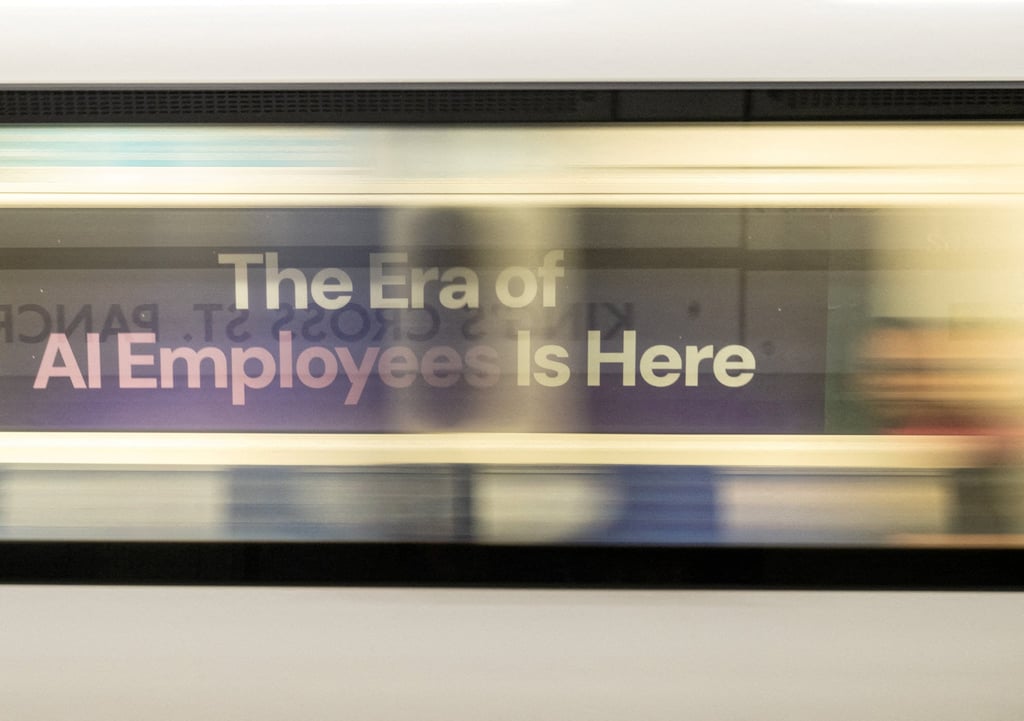
A London Underground train passes an advertisement for a company promoting AI in London in 2025. Photo: Reuters

A London Underground train passes an advertisement for a company promoting AI in London in 2025. Photo: Reuters