



惯性聚合 高效追踪和阅读你感兴趣的博客、新闻、科技资讯
阅读原文 在惯性聚合中打开

推荐订阅源

Microsoft Azure Blog
J
Java Code Geeks
量子位
腾讯CDC
C
Check Point Blog
小众软件
小众软件
IT之家
IT之家
I
InfoQ
Hugging Face - Blog
Hugging Face - Blog
Stack Overflow Blog
Stack Overflow Blog
让小产品的独立变现更简单 - ezindie.com
GbyAI
GbyAI
Apple Machine Learning Research
大猫的无限游戏
大猫的无限游戏
博客园_首页
S
SegmentFault 最新的问题
The Cloudflare Blog
阮一峰的网络日志
阮一峰的网络日志
aimingoo的专栏
aimingoo的专栏
P
Proofpoint News Feed
钛媒体:引领未来商业与生活新知
钛媒体:引领未来商业与生活新知
Google DeepMind News
T
Tailwind CSS Blog
Martin Fowler
Martin Fowler

South China Morning Post

Singapore drama sparks Malaysian ire over scam hub depiction Time to act on stalled proposal toughening child abuse penalties, lawmakers say ‘Eager to explore’: Chinese migrants return to Venezuela after Maduro’s capture ‘We have no trust in the other side’: Iran blames US as talks end with no deal Opinion | Why securing Hong Kong’s economic future is a cultural question Hong Kong’s ministerial team spent HK$46.6 million on visits in past 3 years China family creates AI clone to comfort elderly mum after only son dies in crash Canada Olympic star Williams plans on ‘having a ‘blast’ at Hong Kong Sevens Singapore’s robotaxi drive revs up with help from Chinese AV leaders Editorial | Making Hong Kong desirable to overseas students must be a priority All 7 are dentists and hot. The Asian-American family blowing up social media Editorial | Ageing Hong Kong should welcome more open conversations around death My Take | Discovery Bay will never be the same if the restriction on taxi access is lifted Medical intern suspended after complaint over patient data in social media post Fish and vegetarianism major flashpoints in India’s West Bengal election Chinese crystal ‘paves way’ for GPS-free thorium clock navigation SCMP Best Bets: Endued can show his quality at Sha Tin Russia and Ukraine begin 32-hour ceasefire for Orthodox Easter Israeli spy firm Black Cube involved in Cyprus corruption probe ‘A big deal’: military drills show Tokyo’s growing focus on deterring China China targets middlemen in renewed crackdown on ‘hidden’ corruption Hong Kong-born gymnast leading quest to turn Singapore into elite hub Thais celebrate new year despite fuel price shocks delaying travel Harry Bentley tees up two good chances in Smart Golf and Elite Golf at Sha Tin Is this Kenyan rail project a model for Chinese and Western firms in Africa? Unearthing peace: ancient China gravesite reveals significance of broken weapons Meet Queen Elizabeth’s youngest grandchild, James, who was at Easter service Turtle found dead after apparent fall in Hong Kong’s Wong Tai Sin Landlords of 5,557 subdivided homes seek 3-year grace period to fix flats Trump critique pauses UK handover of Chagos Islands to Mauritius
Is Huawei’s new chip scaling law a true breakthrough, or ...
Howard Liu · 2026-05-30 · via South China Morning Post

Microchip development has always been a race to build smaller and smaller transistors – the fundamental components of chip circuits. Now China’s Huawei Technologies wants to change the game entirely.

Faced with US tech export restrictions that block its access to the world’s most advanced chipmaking machinery, Huawei is proposing a fundamental shift in semiconductor progress: stop obsessing over how small the transistors are and start focusing on how fast data moves through the system.

It is a strategy born out of necessity. But how much of an advance is it? And can it rewrite the playbook for China’s tech survival? The South China Morning Post explores all you need to know about the tech giant’s innovation.

What is Huawei’s Tau Scaling Law

Huawei’s semiconductor chief He Tingbo unveiled a new framework called the Tau, or τ, Scaling Law, at the Institute of Electrical and Electronics Engineers’ International Symposium on Circuits and Systems in Shanghai on Monday.

To understand why this matters, you first have to understand the traditional rule of the tech world: Moore’s Law. For decades, this law dictated that chip progress meant shrinking transistors so you could cram more of them into a given area of silicon, boosting chip performance and cutting costs. The law was named for Intel co-founder Gordon Moore, who first identified that the early semiconductor industry was roughly doubling transistor density every two years.

Huawei’s Tau Law takes a different tack, based on the idea that users do not care about the physical size of transistors; they care how fast computing tasks get done.
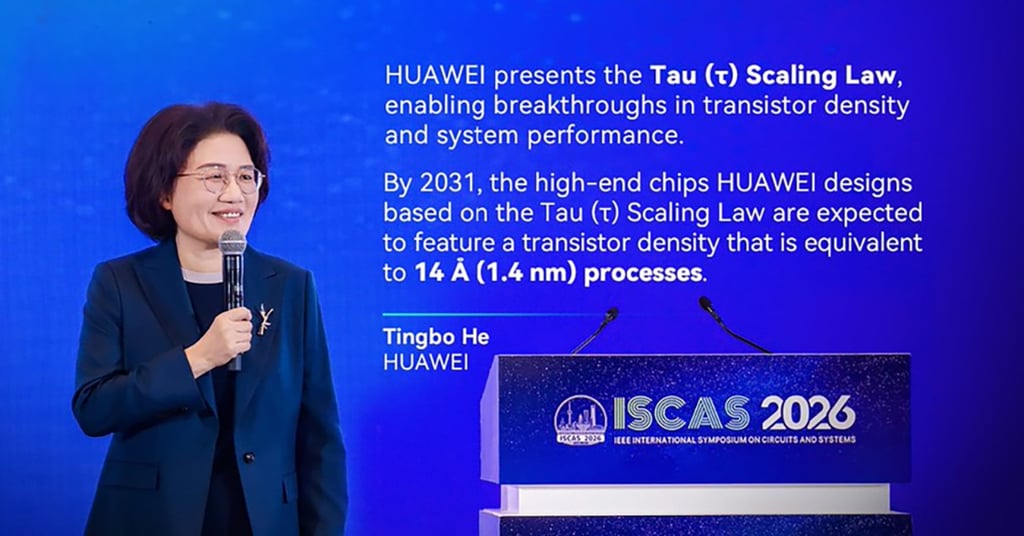
He Tingbo, chair of Huawei Scientist Committee and president of the company’s semiconductor business department, introduces the scaling law on Monday in Shanghai. Photo: Handout

He Tingbo, chair of Huawei Scientist Committee and president of the company’s semiconductor business department, introduces the scaling law on Monday in Shanghai. Photo: Handout

In physics, the Greek letter τ represents time constants. This includes delays that occur as data travels across an electronic system – inside transistors, along wires, through memory systems and across chips and data-centre clusters.