
惯性聚合 高效追踪和阅读你感兴趣的博客、新闻、科技资讯
阅读原文 在惯性聚合中打开

推荐订阅源

F
Fortinet All Blogs
有赞技术团队
有赞技术团队
量子位
N
Netflix TechBlog - Medium
博客园 - 叶小钗
博客园 - 三生石上(FineUI控件)
Google DeepMind News
aimingoo的专栏
aimingoo的专栏
GbyAI
GbyAI
钛媒体:引领未来商业与生活新知
钛媒体:引领未来商业与生活新知
Blog — PlanetScale
Blog — PlanetScale
奇客Solidot–传递最新科技情报
奇客Solidot–传递最新科技情报
月光博客
月光博客
Martin Fowler
Martin Fowler
Y
Y Combinator Blog
宝玉的分享
宝玉的分享
博客园 - 司徒正美
云风的 BLOG
云风的 BLOG
V
Visual Studio Blog
V
V2EX
IT之家
IT之家
L
LangChain Blog
大猫的无限游戏
大猫的无限游戏
freeCodeCamp Programming Tutorials: Python, JavaScript, Git & More

South China Morning Post

Singapore drama sparks Malaysian ire over scam hub depiction Time to act on stalled proposal toughening child abuse penalties, lawmakers say ‘Eager to explore’: Chinese migrants return to Venezuela after Maduro’s capture ‘We have no trust in the other side’: Iran blames US as talks end with no deal Opinion | Why securing Hong Kong’s economic future is a cultural question Hong Kong’s ministerial team spent HK$46.6 million on visits in past 3 years China family creates AI clone to comfort elderly mum after only son dies in crash Canada Olympic star Williams plans on ‘having a ‘blast’ at Hong Kong Sevens Singapore’s robotaxi drive revs up with help from Chinese AV leaders Editorial | Making Hong Kong desirable to overseas students must be a priority All 7 are dentists and hot. The Asian-American family blowing up social media Editorial | Ageing Hong Kong should welcome more open conversations around death My Take | Discovery Bay will never be the same if the restriction on taxi access is lifted Medical intern suspended after complaint over patient data in social media post Fish and vegetarianism major flashpoints in India’s West Bengal election Chinese crystal ‘paves way’ for GPS-free thorium clock navigation SCMP Best Bets: Endued can show his quality at Sha Tin Russia and Ukraine begin 32-hour ceasefire for Orthodox Easter Israeli spy firm Black Cube involved in Cyprus corruption probe ‘A big deal’: military drills show Tokyo’s growing focus on deterring China China targets middlemen in renewed crackdown on ‘hidden’ corruption Hong Kong-born gymnast leading quest to turn Singapore into elite hub Thais celebrate new year despite fuel price shocks delaying travel Harry Bentley tees up two good chances in Smart Golf and Elite Golf at Sha Tin Is this Kenyan rail project a model for Chinese and Western firms in Africa? Unearthing peace: ancient China gravesite reveals significance of broken weapons Meet Queen Elizabeth’s youngest grandchild, James, who was at Easter service Turtle found dead after apparent fall in Hong Kong’s Wong Tai Sin Landlords of 5,557 subdivided homes seek 3-year grace period to fix flats Trump critique pauses UK handover of Chagos Islands to Mauritius
Poison books: Hong Kong joins the search for Victorian-er...
Kamala Thiag · 2026-04-24 · via South China Morning Post

In early September 2025, Lesley Liu, head of preservation and conservation at the University of Hong Kong Libraries, carefully surveyed the institution’s collection of rare Western books from the Victorian era (1837–1900). Recent research had made her acutely aware that within these cloth bindings, a century-old danger could be hidden within fingertip’s reach. She was on the lookout for titles that matched a growing online database of “poison books”: book bindings known to contain substances such as arsenic in combination with other heavy metals.

In 2017, Liu had taken a month-long course on historical book structures for conservators at the Winterthur Museum, Garden and Library in Delaware, in the United States, where she’d met Melissa Tedone, assistant professor of library and archives conservation at the University of Delaware. Over the years, they kept in touch.

In 2019, Tedone received a book she was tasked with restoring for an exhibit. Published in 1857, Rustic Adornments for Homes and Taste was wrapped in a brilliant emerald-green cover. Tedone noticed that the dye used to strengthen the book’s cloth cover was flaking away. “I was reading about Victorian-era wallpapers,” Tedone says, “and how arsenic was often bound with copper to create vibrant, eye-catching colours, particularly greens.”
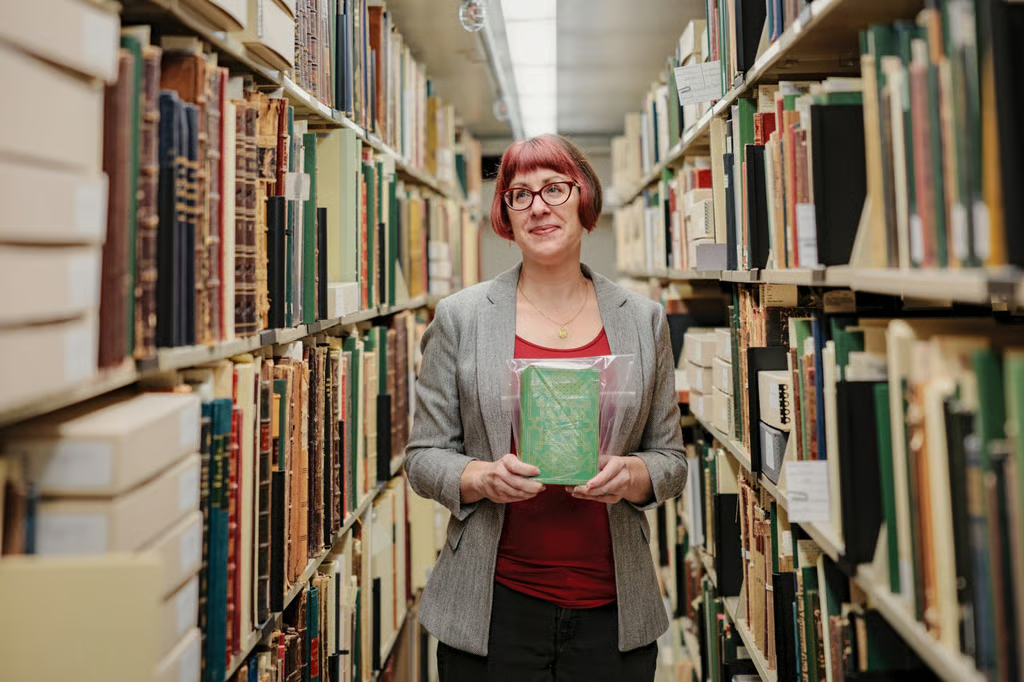
Melissa Tedone at the Winterthur Museum, Garden and Library in Wilmington, Delaware. Photo: Getty Images

Melissa Tedone at the Winterthur Museum, Garden and Library in Wilmington, Delaware. Photo: Getty Images

The tragic history of Victorian wallpaper is well-documented, the culprit being a Swedish chemist, Carl Wilhelm Scheele, who invented the arsenic green pigment in 1775. The brightness of “Scheele’s green”, as it came to be known, made it an instant success, so much so that it became the predominant shade of the 19th century, edging out older pigments and dyes. It didn’t take long for the trend to turn deadly. While most Victorians believed that wallpaper infused with arsenic couldn’t cause harm (unless you licked it), it wasn’t until the late 1860s that doctors discovered the truth. By that time, arsenic had also found its way into cosmetics, toys, textiles and paints.

“A great deal of slow poisoning is going on in Great Britain,” wrote Birmingham doctor William Hinds in 1857, on finding that he grew sick every time he retired to his study, which had green wallpaper. Testing later revealed that his wallpaper was laden with arsenic. Arsenic isn’t the most stable of substances – poisonous, flaking wallpaper was inhaled in homes regularly, and moisture, abrasion or heat could cause the release of toxic plumes of dust.

Before the public could be warned of its dangers, arsenic-infused products – Scheele’s green in particular – had become commonplace. Chemists and paint makers had blended arsenic with other colours, such as canary yellow, to create vibrant new hues. An increasing number of reports about mysterious illnesses and deaths of children, even entire families, gained the attention of the general public in the mid-19th century, though there are no lasting records of casualty numbers. Back in 2019, when that bright green book landed on Tedone’s desk, “the vivid green cover caught my eye”, she says. “I wondered, ‘Could the book be infused with arsenic too?’ I decided to test it, just on a whim.”
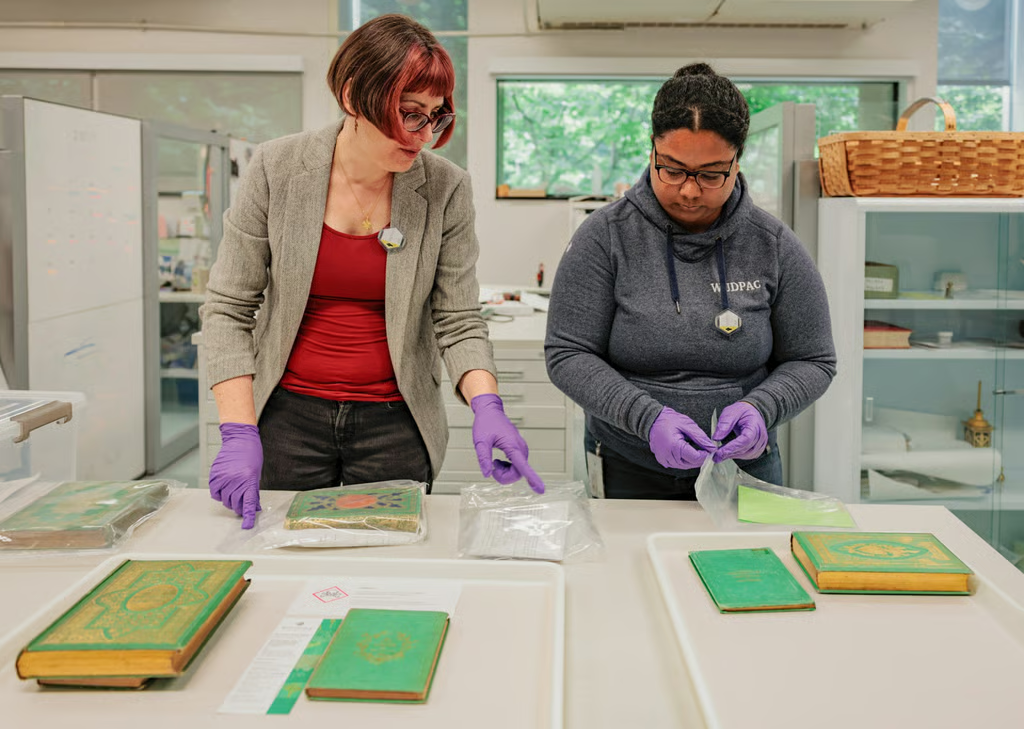
Melissa Tedone (left) and art conservation graduate Brittany Murray place Victorian-era emerald-green bookbindings in protective casing at the Winterthur Museum, Garden and Library in Wilmington, Delaware. Photo: Getty Images

Melissa Tedone (left) and art conservation graduate Brittany Murray place Victorian-era emerald-green bookbindings in protective casing at the Winterthur Museum, Garden and Library in Wilmington, Delaware. Photo: Getty Images

The results justified her fears: the book contained an outrageous amount of arsenic. “I genuinely didn’t expect the results to be positive,” says Tedone. “I knew that if this book had arsenic, there could be many others lurking in libraries and private collections around the world.”