





South Carolina has had exactly one Black representative in Congress since 1897: James Clyburn. A proposal to redraw the state’s political map would dismantle the district he represents.
The state’s sixth congressional district starts on its southern border with Georgia, in the suburbs of Savannah, moving a hundred miles north to wind around the heart of Charleston, before cutting through Black belt farmland to the state capital of Columbia, another 115 miles away.
It contains Charleston’s high-end shopping district on King Street and the state’s ornate antebellum capitol building. It also contains the Gullah Geechee coastal homeland, two of the state’s historically Black colleges and some of the poorest people in the US, in Barnwell and Allendale counties.
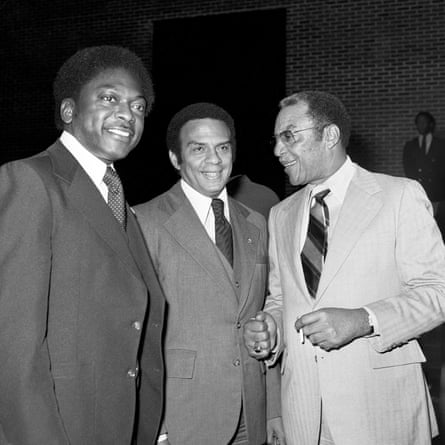
The district is a product of a 36-year-old peace pact between civil rights leaders and South Carolina’s white conservative political apparatus.
Now Trump has urged the state’s Republican lawmakers to effectively tear up that deal, after the US supreme court effectively gutted a major section of the Voting Rights Act that prevented racial discrimination – prompting a Republican scramble to redraw key districts.
While an early effort stalled in South Carolina on Tuesday, the threat remains. The state’s governor, Henry McMaster, called a special congressional session to consider the proposal, which started on Friday.
Back in 1990, Democrats remained in control of South Carolina’s legislature, but had been bleeding white political support for 25 years following the passage of the Voting Rights Act.
“The Black caucus went to the Republican caucus after the 1990 census and said, ‘We’ve been voting for Democrats for 100 years and we’re no better off,’” Eaddy Roe Willard, a Republican activist in South Carolina, recalled of a redistricting debate that year. “We will vote with your map on the condition that you draw one congressional district where an African American can be elected.”
With a census showing a Black population of about a third of the state, and lawsuits looming, legislators crafted a congressional district with a Black majority, but also began breaking up the multiracial coalition that kept Democrats in power at the state level. Many Democratic lawmakers left, or switched parties.
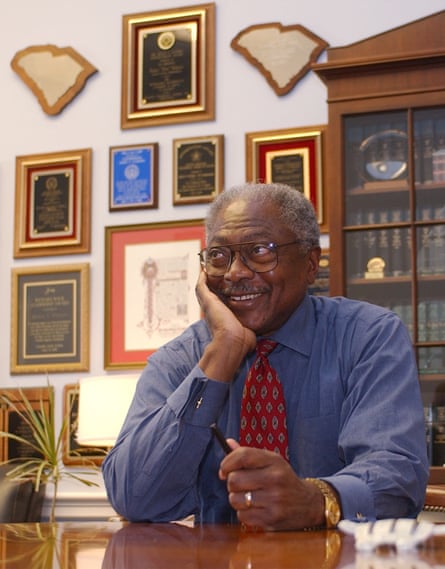
Clyburn took office in 1993, and set out to make a mark on the district, state and country.
A veteran of the civil rights movement, he quickly climbed the Democratic party’s leadership ranks in Washington, serving as majority whip between 2007 and 2011, and 2019 and 2022. He also became a rainmaker for the state, directing spending to improve its famously dysfunctional highway system, pushing money toward rural broadband and backing efforts to alleviate poverty.
Nationally, he has played the role of kingmaker for Democratic presidential aspirants, many of whom flock to his fish fry every four years in hopes of wooing Black voters. In 2020, he was credited with reviving Joe Biden’s flailing presidential campaign with an endorsement that helped Biden win the state’s Democratic primary, and put him on course for the White House.
In Congress, Clyburn advanced a 10-20-30 federal funding formula – that a minimum of 10% of federal investments should go to communities where at least 20% of the population had lived below the federal poverty line for the last 30 years – as a standard for federal spending. Black communities are overrepresented by this framework, but rural white communities across the country also benefit.
“This place has such a rich, deep history of organizing, of social change, of slavery, of harm. And none of it has really been reckoned with,” said Jessica Thomas, an activist in South Carolina. “It sits at the surface, constantly ready to bubble up and it exposes itself in issues like this.
“There are great people here. There are also people who want to keep things the old white boys’ way and control everything.”
All except one of South Carolina’s seven US congressional districts are held by Republicans. Trump’s demands on Republican state leaders to redistrict and pull apart the one seat currently held by a Democrat ignores longstanding political conventions.
Trump’s supporters call it draining the swamp. His detractors describe it as transparently racist.
“I mean, it’s like we’re never, ever going to outlive the accusation, you know?” said Terra Ciurro of Simpsonville, South Carolina, who was visiting the state capitol earlier this week with her husband, a retired soldier. “We’re never going to outrun it. It’s always going to be there because of things like this.”
Clyburn himself suggested the plan was “a comprehensive approach to creating Jim Crow 2.0”, throwing the state back to an era racial segregation and repression. “I’m gonna run no matter what,” he told reporters this week.
But the relative comfort with the current map – and its protection of Clyburn’s electoral prospects – has been criticized by some Black leaders for conceding potentially competitive territory and facilitating a wipeout of Democratic legislative power in the state for decades.
Clyburn has defended gerrymandering for partisan advantage. “Aggressive redistricting efforts, that’s one thing,” he told Ohio News Network Radio in 2022. “To be suppressive of Black voter strength, that’s another thing.”

The congressman has often criticized Republican-drawn South Carolina congressional maps, and aligned himself with the NAACP to challenge the 2020 redistricting on the grounds of a racial gerrymander. He has also been critical of the legislature’s current drive, and dared those behind it to test him, and the state’s voters.
Shane Massey, the state senate’s majority leader, acknowledged as much in a forceful address to his chamber on Tuesday as he rejected a call for redistricting. Pulling Democrats out of the sixth district might imperil the odds of electing neighboring Republicans in a tight year, he suggested.
The district does not have a Black majority today, though it’s close: US Census estimates suggest about 46% of the district’s residents are Black. About a quarter of South Carolina is Black, and about a quarter of those Black people live in Clyburn’s district.
But the state’s booming manufacturing industry has drawn a multiracial influx of skilled labor, while the warm climate and low taxes have attracted relatively conservative retirees from other states. And in time, that might change the political calculus.
“How are we going to be a state that welcomes people from everywhere else?” said Damien Barber, a recent political science graduate from the University of South Carolina. He stood outside the legislative offices in protest on Tuesday as state lawmakers weighed the redistricting plan.

Barber grew up in Richland County in South Carolina’s midlands, which contains the Congaree national park: South Carolina’s only national park, the product of legislation advanced by Clyburn in 2003.
“None of the congressional representatives are, honestly, pretty effective,” Barber said. “He’s the one that everyone talks about. Some people don’t even know who their representative is, but everyone knows Jim Clyburn.”