

惯性聚合 高效追踪和阅读你感兴趣的博客、新闻、科技资讯
阅读原文 在惯性聚合中打开

推荐订阅源

Blog — PlanetScale
Blog — PlanetScale
B
Blog
A
About on SuperTechFans
大猫的无限游戏
大猫的无限游戏
爱范儿
爱范儿
OSCHINA 社区最新新闻
OSCHINA 社区最新新闻
H
Help Net Security
H
Hackread – Cybersecurity News, Data Breaches, AI and More
博客园 - 三生石上(FineUI控件)
有赞技术团队
有赞技术团队
酷 壳 – CoolShell
酷 壳 – CoolShell
WordPress大学
WordPress大学
IT之家
IT之家
D
Docker
Google DeepMind News
罗磊的独立博客
T
The Blog of Author Tim Ferriss
aimingoo的专栏
aimingoo的专栏
博客园 - 叶小钗
Recent Announcements
阮一峰的网络日志
阮一峰的网络日志
D
DataBreaches.Net
博客园 - 司徒正美
Engineering at Meta
Engineering at Meta

The Guardian

New Zealand’s North Island braces for Cyclone Vaianu with thousands ordered to evacuate Artemis II splashdown – in pictures Swalwell denies allegations of sexual assault as calls grow for him to withdraw from California governor race Trump news at a glance: Epstein survivors have words for Melania Trump after surprise statement Multiple people face charges, including murder, in California fireworks blast Rory McIlroy surges into six-shot Masters lead with stunning second-round flourish Roberto De Zerbi targets ‘Ange-ball’ revival to save Spurs from relegation Bath hit back to reach semi-final after stunning Northampton in 11-try epic Australia crash out of BJK Cup after Britain secure upset with doubles win Zebras, wealth and power: Hungary’s election tests Orbán’s grip on power ‘TikTok effect’ brings sellout crowds and younger fans to Grand National meeting King signs up David Beckham to his Chelsea flower show team The war over Omagh’s gold: the £21bn mine plan tearing a community apart Britain’s shadow workforce is paid as little as 65p an hour. Who cares for the carers? Tim Dowling: my wife is on a quest to restore my thinning hair SUVs are making Britain’s potholes worse, say scientists Blind date: ‘She claimed she was usually shy. I wouldn’t have guessed’ I’m a sauna person now: the Becky Barnicoat cartoon ‘I got everything I dreamed of – when I had no ability to handle it’: Lena Dunham on toxic fame, broken friendships and her ‘lost decade’ Six great reads: the man who let snakes bite him, masked heavy metal and the brutal reality for foreign students in the UK Meera Sodha’s recipe for noodles with rose beancurd, spring greens and egg Cuba’s doctors were a lifeline for the world. Now the Caribbean is shamefully complicit in the US drive to expel them An environmental disaster in Moldova has Russia’s fingerprints all over it ‘This is as important as your teeth’: are you skipping this key part of mouth hygiene? Man arrested after four die trying to cross Channel in small boat Ukraine war briefing: doubts linger in Kyiv over Moscow’s promise to uphold Orthodox Easter ceasefire Ichiro Suzuki statue unveiling goes awry as bronze bat snaps during ceremony Arrest of national war hero Ben Roberts-Smith cuts deeply to core of Australian psyche European football: Real Madrid held at home by Girona to extend winless run ‘You come back different’: how rugby players change after motherhood
Worried Britons ‘prepping’ for major disruption with stas...
Rupert Jones · 2026-05-09 · via The Guardian

Millions of Britons are “prepping” for a potential “major disruptive event” by keeping a stash of cash at home, stockpiling tinned goods or ensuring they have a battery-powered torch close to hand, new data suggests.

With war raging in the Middle East and Ukraine, extreme weather becoming more frequent, and warnings that the UK’s critical infrastructure is at risk from cyber-attacks and power outages, many people feel the world has become a more dangerous and chaotic place.

While some are taking steps to make sure they are not left high and dry in the event of a bank IT failure, others are preparing for a possible natural disaster, or even a societal collapse. UK experts recently advised people to have an emergency store of food in their home in case something happens that causes shortages.

Link, the UK’s ATM network, tracks how people are using, and thinking about, cash and, for the first time, its researchers have asked the public about what “contingency planning” they are doing to prepare for an event that would cause “major disruption to normal services”.

Link’s suggestions include a power outage, IT failure, natural disaster or cyber attack. It did not explicitly mention war or conflict.

Asked what they thought they would do if something happened that meant card and mobile payments were not accepted in shops, 54% of those surveyed said they would withdraw cash from an ATM.

Meanwhile: 46% said they would use supplies, such as food, that they had at home; 41% said they would use cash they had on their person to pay for items; 36% said they would use cash they had at home; and 31% said they would shop online.

Notably, 15% said they would raid the supply of banknotes and coins that they had kept safe specifically for this type of scenario.

A Scrabble board spells out key words such as doom and bust
Money and access to it is a big issue for many in a crisis. Photograph: Tony Rolls/Alamy

The researchers then asked what people had already done, or were now doing, in preparation for a disruptive event. Almost half (49%) said they had battery-powered items at home, such as a torch, while 47% said they had a supply of tinned goods such as baked beans and canned fruit, and 37% said they kept a power bank in the house to keep their mobile phone charged.

One in five (20%) said they had access to a portable gas hob such as a camping stove, while 15% said they had an analogue radio. In terms of money, 17% said they had “a stash of cash at home”.

Just over a quarter (27%) of respondents had not done anything to prepare for an event of that type.
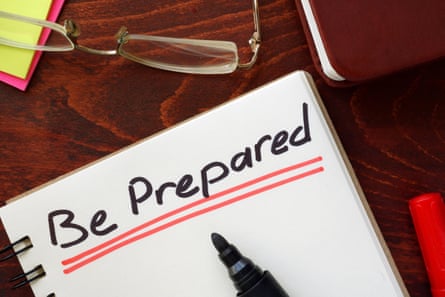
A note underlined in red reads: ‘be prepared’
As the world seems like a far more dangerous place our new red line is ‘be prepared’. Photograph: designer491/Alamy

Of those who had taken any of the above actions, 23% said they had done so recently: within the last three months.

Graham Mott, Link’s director of strategy, said the data demonstrated the growing role played by cash in people’s resilience planning.

“With rising public concern about threats like power outages, cyber-attacks and disruption to card payments, more people are prepping by keeping some emergency cash at home,” he added.

The UK government’s Prepare website outlines steps it says people should consider taking to prepare for emergencies, which include assembling a list of items at home that could include tinned food that does not need cooking, bottled water, a first aid kit, hand sanitiser, a battery-powered or wind-up torch and radio, a portable power bank for phone charging, and spare batteries.

Specialist “prepper” shops have become popular in the UK, with some reporting a boom in the aftermath of the Covid lockdowns.