

惯性聚合 高效追踪和阅读你感兴趣的博客、新闻、科技资讯
阅读原文 在惯性聚合中打开

推荐订阅源

罗磊的独立博客
Apple Machine Learning Research
The Cloudflare Blog
WordPress大学
WordPress大学
钛媒体:引领未来商业与生活新知
钛媒体:引领未来商业与生活新知
奇客Solidot–传递最新科技情报
奇客Solidot–传递最新科技情报
博客园 - 叶小钗
博客园 - 聂微东
阮一峰的网络日志
阮一峰的网络日志
腾讯CDC
博客园 - 三生石上(FineUI控件)
V
V2EX
有赞技术团队
有赞技术团队
V
Visual Studio Blog
小众软件
小众软件
Jina AI
Jina AI
酷 壳 – CoolShell
酷 壳 – CoolShell
博客园 - Franky
量子位
T
Tailwind CSS Blog
cs.CV updates on arXiv.org
P
Palo Alto Networks Blog
Cisco Talos Blog
Cisco Talos Blog
I
Intezer
Project Zero
Project Zero
A
Arctic Wolf
P
Privacy International News Feed
V
Vulnerabilities – Threatpost
L
Lohrmann on Cybersecurity
S
Securelist
C
Cybersecurity and Infrastructure Security Agency CISA
C
CXSECURITY Database RSS Feed - CXSecurity.com
T
Tor Project blog
Hacker News - Newest:
Hacker News - Newest: "LLM"
S
Security @ Cisco Blogs
cs.AI updates on arXiv.org
Threat Intelligence Blog | Flashpoint
Google DeepMind News
N
News and Events Feed by Topic
TaoSecurity Blog
TaoSecurity Blog
L
LINUX DO - 热门话题
G
GRAHAM CLULEY
Help Net Security
Help Net Security
N
News | PayPal Newsroom
W
WeLiveSecurity
G
Google Developers Blog
Microsoft Security Blog
Engineering at Meta
Engineering at Meta
MongoDB | Blog
MongoDB | Blog
C
Check Point Blog

The Guardian

New Zealand’s North Island braces for Cyclone Vaianu with thousands ordered to evacuate Artemis II splashdown – in pictures Swalwell denies allegations of sexual assault as calls grow for him to withdraw from California governor race Trump news at a glance: Epstein survivors have words for Melania Trump after surprise statement Multiple people face charges, including murder, in California fireworks blast Rory McIlroy surges into six-shot Masters lead with stunning second-round flourish Roberto De Zerbi targets ‘Ange-ball’ revival to save Spurs from relegation Bath hit back to reach semi-final after stunning Northampton in 11-try epic Australia crash out of BJK Cup after Britain secure upset with doubles win Zebras, wealth and power: Hungary’s election tests Orbán’s grip on power ‘TikTok effect’ brings sellout crowds and younger fans to Grand National meeting King signs up David Beckham to his Chelsea flower show team The war over Omagh’s gold: the £21bn mine plan tearing a community apart Britain’s shadow workforce is paid as little as 65p an hour. Who cares for the carers? Tim Dowling: my wife is on a quest to restore my thinning hair SUVs are making Britain’s potholes worse, say scientists Blind date: ‘She claimed she was usually shy. I wouldn’t have guessed’ I’m a sauna person now: the Becky Barnicoat cartoon ‘I got everything I dreamed of – when I had no ability to handle it’: Lena Dunham on toxic fame, broken friendships and her ‘lost decade’ Six great reads: the man who let snakes bite him, masked heavy metal and the brutal reality for foreign students in the UK Meera Sodha’s recipe for noodles with rose beancurd, spring greens and egg Cuba’s doctors were a lifeline for the world. Now the Caribbean is shamefully complicit in the US drive to expel them An environmental disaster in Moldova has Russia’s fingerprints all over it ‘This is as important as your teeth’: are you skipping this key part of mouth hygiene? Man arrested after four die trying to cross Channel in small boat Ukraine war briefing: doubts linger in Kyiv over Moscow’s promise to uphold Orthodox Easter ceasefire Ichiro Suzuki statue unveiling goes awry as bronze bat snaps during ceremony Arrest of national war hero Ben Roberts-Smith cuts deeply to core of Australian psyche European football: Real Madrid held at home by Girona to extend winless run ‘You come back different’: how rugby players change after motherhood Human rights groups decry US plan for Guantánamo camp for Cuban migrants Potential US host cities for 2031 Women’s World Cup games mull withdrawal over Fifa concerns Arne Slot insists he is ‘aligned’ with Liverpool board and fans as squad is rebuilt Kamala Harris ‘thinking about’ running for president again in 2028 JD Vance warns Iran against trying to ‘play’ the US in peace talks West Ham double up twice to thrash Wolves and put Spurs in relegation zone Trump administration releases new renderings of so-called ‘Arc de Trump’ Bafta apologises for events surrounding John Davidson’s Tourette’s outburst Cocktail of the week: Bar Shrimp’s la rosita – recipe New drug may extend survival in aggressive ovarian cancer, trial shows One dead and 27 injured after bus with British passengers crashes in Canary Islands OpenAI CEO Sam Altman’s home targeted with molotov cocktail Alarm as acting CDC director delays report showing Covid vaccine benefits Argentina just ripped up its pioneering glacier law. What does this mean for millions of people’s drinking water? ‘Illegal’ forest service overhaul risks causing ‘chaos’ across US public lands, union claims Prince Harry sued for defamation by charity he co-founded Anthropic’s new AI tool has implications for us all – whether we can use it or not Concerns raised about motorbike tourist trail after death of British teenager in Vietnam The Guardian view on Trump’s civilisational threats: the words that fuel war must be condemned The Guardian view on dystopias for our times: the American nightmare Weather tracker: Cyclone Maila batters Solomon Islands with 115mph winds Doctors’ leader claims new reduced pay offer killed chances of ending strikes in England Netanyahu-ism has achieved nothing for Israelis – and come at a monstrously high price Deborah Levy: ‘CS Lewis’s White Witch terrified me – but I wanted to meet her’ How I Shop with Michelle Ogundehin: ‘We grownups have enough stuff already’ ‘Butter Birkin’: popcorn plastic It bag in demand by Devil Wears Prada fans Trump’s war and Melania’s Epstein statement, with US editor Betsy Reed – The Latest Orbán and Magyar trade accusations in last days of Hungary election campaign Reckonwrong: How Long Has It Been? review | Safi Bugel's experimental album of the month Martin Rowson on Middle East peace talks – cartoon Fears of UK and EU flight cancellations as airports warn of jet fuel shortages Peers vote to ban pornography depicting sex acts between stepfamily members Week in wildlife: an ostrich on the lam, a tortoise crossing a road and surfing seals ‘There’s no shortage of terrifying technology’: how AI became TV drama’s new go-to villain Texas court overturns sentence for man on death row for nearly 50 years Power up! Could force be the secret to supercharging your fitness? ‘Irresponsible failure’: Google, Meta, Snap and Microsoft slam EU over child sexual abuse law lapse Blank canvas: what to wear with white trousers Critics assemble! Here’s my list of the greatest superhero movies of all time Amazon to finally launch Leo satellite internet in ‘mid-2026’, says CEO Pete Hegseth’s holy war: the militant Christian theology animating the US attack on Iran Toxic putdowns, brutal zingers ... and an unexpected love story – inside the joyful climax to brilliant sitcom Hacks Add to playlist: the beautifully dazed, countrified indie-rock of Tracey Nelson and the week’s best new tracks ‘I’m worried there’s too much of me,’ says a birch: inside the interspecies council giving nature a voice Dolce & Gabbana says co-founder Stefano Gabbana has quit as chair Why is anyone surprised by the US and Israel’s latest war? It’s only what the world allowed them to do in Gaza Super Mario what?! The seven best obscure Mario games Holly Humberstone: Cruel World review – Taylor Swift fave trades gothic melancholy for pop glow-up Thrash review – cursed shark thriller sinks like a stone on Netflix ‘The biggest, baddest, saltiest chick you would ever see’: why no one sang the blues like Big Mama Thornton Go Gentle by Maria Semple review – a joyfully clever New York romcom ‘Tranquil, natural and barely a tourist in sight’: readers’ favourite hidden gems in Spain Benjamina Ebuehi’s sweet and salty chocolate chip cookies recipe ‘I’m not a commercial director – I’m not even a professional film-maker’: Jim Jarmusch on the seven-year journey to make his new film Malcolm in the Middle: Life’s Still Unfair review – the TV magic they’ve created here is absolutely miraculous The Miniature Wife review – Matthew Macfadyen is wasted in this pointless comedy From soups and greens to roots, how to survive the ‘hungry gap’ From fat transplants to LED mittens: how the fear of ‘old lady hands’ mobilised the beauty industry Anna Wintour’s Vogue cover is more than a cameo – it’s a power play ‘They’re gonna make me cry’: I competed at a speed puzzling championship You be the judge: should my girlfriend stop mixing gold and silver jewellery? Maritime and port workers: how is the Middle East conflict affecting you? How games capture the awe and terror of cosmic isolation Why does alcohol make us both happy and miserable – and what else does it do to our minds and bodies? I never text back – and it’s ruining my relationships The pet I’ll never forget: Beau, the labrador who saved my life Life Is Strange: Reunion review – a decade-long story comes to an impassioned close Why is gaming becoming so expensive? The answer is found in AI Sign up for the First Edition newsletter: our free daily news email Sign up for the Feast newsletter: our free Guardian food email
Has the world grown weary of art biennials? In search of an antidote, a Portuguese festival turns to anarchism
Philip Olter · 2026-04-23 · via The Guardian

If you decide to spend a night at Coimbra’s Monastery of Santa Clara-a-Nova in the near future, do bear in mind that the place is almost certainly haunted. Disembodied children’s voices echo around the first floor of the 17th century convent perched atop a hill in the Portuguese university city, overlooking the medieval centre from across the Mondego river.

In the garages, dry foliage has been arranged in geometric shapes, as if in preparation for a wicca ritual. You need the nerves of a ghost-hunter to walk through the pitch-black ground-floor corridor of the dormitory wing, lit only by a neon strip at either end, where tortured wails ambush you from the monkish cells. Sung in Albanian, Chinese, Kurdish, Kyrgyz and Turkish, these laments are part of an installation by US artist Taryn Simon, but they feel like spectral reminders of the nuns who lived in these quarters for two centuries.

After the last nun died in 1891, Santa Clara-a-Nova served for almost a century as a barracks for the Portuguese army, and since 2015 the nunnery has been the central hub of Anozero, a biennial art festival that sees its 9,650 sq metres filled for three months with works by creatives from around the world. But as the government has recently granted a private company the right to develop the semi-derelict building into a hotel, that arrangement could soon come to an end.
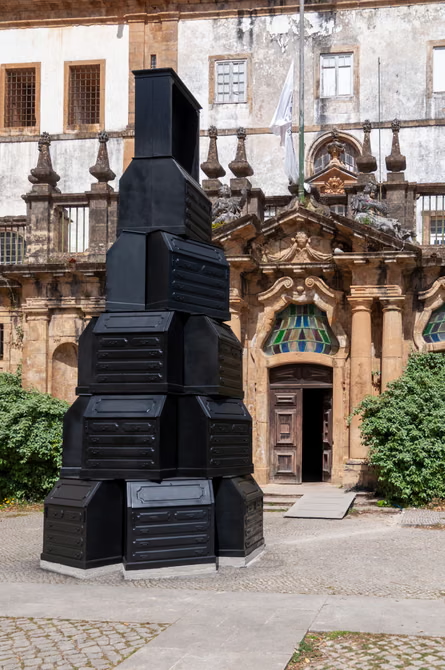
large black abstract sculpture Monument to the Ordinary by KOSMOS at Anozero.
Monument to the Ordinary by Kosmos at Anozero. Photograph: © Jorge das Neves

“You can have people living here, but it should be around art,” Anozero’s co-founder and director Carlos Antunes tells me outside a make-shift bar in Santa Clara’s luscious gardens on the eve of festival’s opening. He threatens to pull the plug on the festival if plans to revamp the convent as part of the Portguese government’s Revive programme go ahead in their current form. “I don’t have a plan B. This is my fight. If the biennale gets cancelled, it will be a huge problem for the city.”

With that in mind, this year’s ghostly edition of the festival can be read as a warning to the developer taking custody of the building: these spirits will give sleepless nights to your investment bankers on their golf holidays, Simon’s installation seems to whisper. But given art biennials’ own complicated relationship to gentrification, it is whispered for a reason.

The concept of a city hosting an international art exhibition at regular intervals goes back to the first Venice Biennale of 1895, when the capital of Veneto sought to rejuvenate the Italian art market after the decline of the Grand Tour tradition. The festival brought in visitors who would later return as tourists, while also granting the local population access to artworks of international renown and giving curators a freedom to experiment that institutions would rarely allow them.

In the 1990s, fuelled by cheap air travel and politicians chasing the Bilbao effect, every city wanted its own biennale. As well as blockbuster events such as Kassel’s Documenta, New York’s Whitney Biennial and the Bienal de São Paulo, there are now more than 200 such festivals across the world, from Andorra to Yokohama.

But with the boom came backlash: the suspicion that biennales were above all an excuse for a tote-bag-wearing international art crowd to descend on a city for a few weeks, leaving behind a large carbon footprint but little meaningful engagement with the local population. “Can the Biennial Serve a City, or Just ‘Big Art’?” Artforum magazine asks in its current issue, dedicated to the biennale identity crisis.

Worse still is the suspicion that art biennials serve as a handmaiden rather than a hindrance to gentrification. In some cases, they have brought to life forgotten spaces that went on to become permanent art institutions, such as the former margarine factory that is now Berlin’s KW. In others, they lent a sheen of cool to buildings that were then pounced on by developers. Squatters living in a disused rail shed in Lagos were evicted after it served as the site of the the inaugural 2017 biennale in the city.

Despite having only been around since 2015 and operating on a relatively modest budget of €800,000 per edition, Coimbra’s Anozero has been at the forefront of art festivals trying to rethink the format. A 2023 manifesto stated that biennales should no longer simply be “places to catapult artists and modes of visual production”, but experiments in communal living and thinking, dreaming up new uses for historical sites. “In Portugal, we have a tendency to live on old glories,” says Antunes. “The biennial is meant to be a door to the future”.
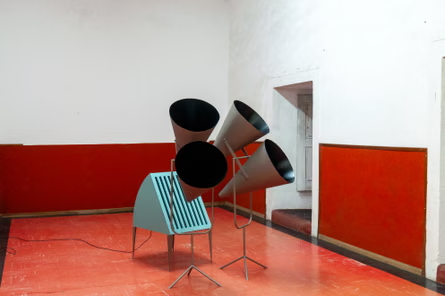
Máquina de Escuta#1, (Listening machine #1), by Vasco Araújo at Anozero.
Making noise for new art … Máquina de Escuta#1 (Listening machine #1) by Vasco Araújo at Anozero. Photograph: © Jorge das Neves

This year, Anozero proposes a new remedy for biennale fatigue: anarchism. Its title, Segurar, dar, receber (“To hold, to give, to receive”), may dip into the jargon of therapeutic healing and expressive fragility so fashionable with contemporary curators. But it turns out to be inspired by Peter Kropotkin, the Russian anarchist philosopher. Anarchism here does not mean anarchy but co-operation: Kropotkin’s big idea was that mutual aid was more central to evolution and civilisational progress than Darwin’s idea of the survival of the fittest.

Anozero receives funding (from local municipalities and Coimbra University), but it also tries to give back. For the opening, Portuguese artist Vasco Araújo led a delegation of 260 singers, all dressed in white and drawn from local choirs and music groups, on a march from Coimbra’s central square to the convent, while singing a chorus from Verdi’s opera Nabucco – a pied-piper march designed to lead the townsfolk up to the temple of contemporary art.

There are works here that could be classified derivatively as “festival art” – variations of Taryn Simon’s installation Start Again the Lament have been put in situ at the Park Avenue Armory, New York, the Cisternerne at the Frederiksberg museum in Denmark and a secret crypt beneath Islington Green, London. But at the Santa Clara nunnery it manages to gain potency through the oppressiveness already inherent in the architecture. It lives up to its manifesto promise to create art “which can only happen here and nowhere else”.
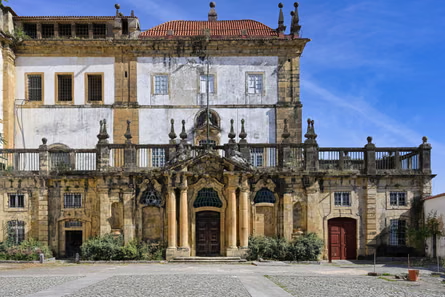
Santa Clara-a-Nova monastery buildings at Coimbra.
This way to the hotel? … Santa Clara-a-Nova monastery buildings at Coimbra. Photograph: imageBROKER.com/Alamy

Once you emerge out of the darkness at the end of the long corridor, you can descend down brittle stone staircases into the gardens, where Amsterdam-based architectural designers Inside Outside have freed from weeds what may once have been a washing area, planted citrus and kumquat trees that will grow over the coming years, and set up chairs as to “encourage conversations with strangers”. “We understand that the biennale is an attempt to keep the convent grounds accessible to the public,” says Inside Outside’s Aura Melis. “So we tried to create something that will still be here in two years’ time.”

The intentions are laudable, but for now all they have to show are a table and some empty chairs, and unless Anozero manages to succeed in stopping the hotel development, the same space could well accommodate a swimming pool before the kumquat trees bear their first fruit.

At times, the biennale seems unsure of how forceful a gesture of protest it wants to strike. In two of the cells, curators have set up twin beds in which visitors can stay overnight and watch two long experimental films, Belgian director Chantal Akerman’s La Chambre and Finnish artist Juha Lilja’s Sleep. A parody of the Santa Clara’s imminent hotelification? Or a trial run for a compromise? The wall text merely calls it an “allusion” to Santa-Clara’s “uncertain future”.

Coimbra is home to one of Europe’s oldest universities and if you walk up or down its steep cobbled streets, you pass students in old-fashioned gowns, some carrying large wooden spoons in keeping with age-old student traditions. But it also has a long history of protest culture. The city is unique in Europe for having more than 20 leftwing and anarchist fraternities, known as repúblicas. With poetic names such as Republic of Ghosts and Palace of Madness, these self-managed communal housing projects offer shelter and food for students from disadvantaged backgrounds, as well as welcoming rites for first-years that are more gentle than the hazing rituals practised by more conservative students. They are places that put mutual care into practice.

Facade of one of the repúblicas in Coimbra.
‘The biennale attracts a certain elite’ … facade of one of the repúblicas in Coimbra. Photograph: Xavier Dealbert/Alamy

Given Anozero’s anarchist theme, there’s an obvious connection to be made here – some of the repúblicas are directly outside the festival’s venues, and many students who live in them work behind the scenes of the biennale. But they are oddly absent from what is put on display. Instead, the curators have filled rooms of the nunnery with books on anarchist town planning in display cases and flow charts showing Kropotkin’s influence on important architects.

On opening day, two república veterans have made the trek up to the hill. Jaime Miranda, 53 and João Paulo Bernadino, 57, stand out amid the stylish art crowd. “The biennale attracts a certain elite,” says Miranda. “Young people who live in the repúblicas don’t usually get invited here.” But they are glad they made the trip. “Now I understand why there are determined to stay here,” he says, marvelling at the building complex. The housing project where they used to live, Real República Boa-Bay-Ela, once too faced an uncertain future. When Portugal’s rental law changed, the students faced eviction. Former inhabitants reacted by clubbing together and buying out the landlord.

For its next edition in 2028, Anozero is teaming up with Manifesta, the nomadic cultural biennale that travels to a different location in Europe every two years. To ensure it won’t be the last one, they could do worse than learning from the locals.