


惯性聚合 高效追踪和阅读你感兴趣的博客、新闻、科技资讯
阅读原文 在惯性聚合中打开

推荐订阅源

Last Week in AI
Last Week in AI
阮一峰的网络日志
阮一峰的网络日志
P
Proofpoint News Feed
让小产品的独立变现更简单 - ezindie.com
MongoDB | Blog
MongoDB | Blog
云风的 BLOG
云风的 BLOG
OSCHINA 社区最新新闻
OSCHINA 社区最新新闻
J
Java Code Geeks
WordPress大学
WordPress大学
T
The Blog of Author Tim Ferriss
V
Visual Studio Blog
小众软件
小众软件
Microsoft Azure Blog
博客园_首页
IT之家
IT之家
Vercel News
Vercel News
C
Check Point Blog
Google DeepMind News
月光博客
月光博客
D
DataBreaches.Net
酷 壳 – CoolShell
酷 壳 – CoolShell
美团技术团队
Y
Y Combinator Blog
Hugging Face - Blog
Hugging Face - Blog

The Guardian

New Zealand’s North Island braces for Cyclone Vaianu with thousands ordered to evacuate Artemis II splashdown – in pictures Swalwell denies allegations of sexual assault as calls grow for him to withdraw from California governor race Trump news at a glance: Epstein survivors have words for Melania Trump after surprise statement Multiple people face charges, including murder, in California fireworks blast Rory McIlroy surges into six-shot Masters lead with stunning second-round flourish Roberto De Zerbi targets ‘Ange-ball’ revival to save Spurs from relegation Bath hit back to reach semi-final after stunning Northampton in 11-try epic Australia crash out of BJK Cup after Britain secure upset with doubles win Zebras, wealth and power: Hungary’s election tests Orbán’s grip on power ‘TikTok effect’ brings sellout crowds and younger fans to Grand National meeting King signs up David Beckham to his Chelsea flower show team The war over Omagh’s gold: the £21bn mine plan tearing a community apart Britain’s shadow workforce is paid as little as 65p an hour. Who cares for the carers? Tim Dowling: my wife is on a quest to restore my thinning hair SUVs are making Britain’s potholes worse, say scientists Blind date: ‘She claimed she was usually shy. I wouldn’t have guessed’ I’m a sauna person now: the Becky Barnicoat cartoon ‘I got everything I dreamed of – when I had no ability to handle it’: Lena Dunham on toxic fame, broken friendships and her ‘lost decade’ Six great reads: the man who let snakes bite him, masked heavy metal and the brutal reality for foreign students in the UK Meera Sodha’s recipe for noodles with rose beancurd, spring greens and egg Cuba’s doctors were a lifeline for the world. Now the Caribbean is shamefully complicit in the US drive to expel them An environmental disaster in Moldova has Russia’s fingerprints all over it ‘This is as important as your teeth’: are you skipping this key part of mouth hygiene? Man arrested after four die trying to cross Channel in small boat Ukraine war briefing: doubts linger in Kyiv over Moscow’s promise to uphold Orthodox Easter ceasefire Ichiro Suzuki statue unveiling goes awry as bronze bat snaps during ceremony Arrest of national war hero Ben Roberts-Smith cuts deeply to core of Australian psyche European football: Real Madrid held at home by Girona to extend winless run ‘You come back different’: how rugby players change after motherhood
Assisted dying bill will not become law after it falls in...
Press Associ · 2026-04-24 · via The Guardian

Assisted dying will not become law in England and Wales after proposed legislation branded “hopelessly flawed” by opponents ran out of time amid claims of a “denial of democracy” from supporters.

The Terminally Ill Adults (End of Life) Bill, which had been making its way through parliament for the past year and a half, fell on Friday with peers speaking passionately on both sides of the argument.

While the bill had successfully passed two votes in the House of Commons, albeit with a narrower majority on the second occasion, it did not face a vote in the Lords.

It instead ran out of time, with Charlie Falconer, who had steered it through the upper chamber, saying he felt “despondent” that a piece of legislation which he said was “so important to so many, has not failed on its merits, but failed as a result of procedural wrangling”.

A supporter of assisted dying with a banner saying the legislation has majority support.
A supporter of the assisted dying legislation makes his case outside parliament on Friday. Photograph: Dan Kitwood/Getty Images

The bill had proposed allowing adults in England and Wales with fewer than six months to live to apply for an assisted death subject to the approval of two doctors and an expert panel.

More than 1,200 amendments to the bill had been suggested in the Lords, with more than 800 of those tabled or sponsored by seven peers.

Lord Falconer described the process of the bill as “horrible”, saying it had not failed to finish its journey through the Lords due to a lack of time, but rather “because a small minority were not willing to cooperate, as we normally do, to ensure that there can be proportionate debate”.
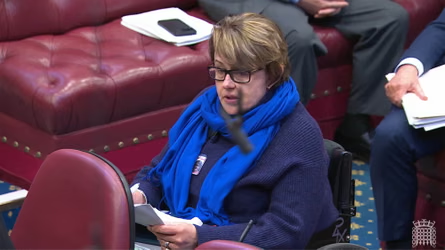
Tanni Grey-Thompson addresses the House of Lords
Tanni Grey-Thompson, the former Paralympian, told fellow peers the legislation ‘had too many gaps’. Photograph: House of Lords/UK Parliament/PA

A Tory former minister and peer, Kenneth Baker, accused opponents of the bill of a “prolonged filibuster”, branding the situation a “denial of democracy”.

Tanni Grey-Thompson, a Paralympian peer who had spoken out against the bill, said it had failed because “there are too many gaps in it” adding she felt there was “a lot of misunderstanding about what people might get” under a law change.

Those opposed to the bill had branded it “unsafe and unworkable” and “bad law”, citing their concerns around potential coercion of vulnerable people and a lack of safeguards for those with disabilities.

Jane Campbell, a former commissioner at the Equality and Human Rights Commission, told fellow peers that disabled people had contacted her to say this “particular bill frightens them, and they want me to explain to your lordships why it is dangerous”.

The crossbench peer, who has spinal muscular atrophy, addressed the chamber remotely to say disabled people “fear unequal access to care shaping their choices, they fear subtle coercion that cannot be easily detected”.

Therese Coffey, a Conservative former deputy prime minister, told the debate she feared “that many peers and many MPs are putting choice for some ahead of concern on coercion for others”.

Falconer said many terminally ill people and their relatives “who have shown such courage and forbearance” have been “utterly bewildered by the way we (peers) have behaved”.

Supporters have vowed to try to bring the bill back in parliament’s next session, with its sponsor in the Commons, Kim Leadbeater, who watched proceedings from the gallery on Friday, saying she would again enter her name in the ballot of private member’s bills.

As the draft legislation fell, Leadbetter stood and held her hand to her mouth, shaking her head. Campaigners have said they could use the Parliament Act to get the bill through if it was selected.

A rarely used piece of legislation, the act allows for bills that have been backed by the Commons in two successive sessions but rejected by peers to pass into law without Lords approval.