


Law enforcement and local government officials across the US have over the last year expressed concerns that immigration operations were interfering with police work and leading to threats to officers, according to internal emails and briefings shared with the Guardian.
The development comes as the US public has become afraid and distrustful of officers in their communities due to the Trump administration’s aggressive and at times indiscriminate immigration crackdown.
Internal emails and memos from law enforcement personnel and city departments in seven states and several federal agencies reveal growing alarm about civilians mistaking local officers for Immigration and Customs Enforcement (ICE) agents. The confusion, they have warned, is creating problems and fear for officers carrying out their regular duties.
The documents show local authorities in Minnesota and Washington state in January and February scrambled to distinguish their cities’ officers and public safety personnel from ICE agents. Law enforcement in other states, meanwhile, have worried that protesters and civilians monitoring ICE might inadvertently target or endanger them.
The files were obtained through public records requests by Property of the People, a government transparency non-profit, which has collected extensive records relating to ICE and law enforcement.
The anxiety among law enforcement is yet another sign that ICE’s strategy of widely deploying masked agents in unmarked cars is causing chaos and confusion, with broader repercussions for policing and public safety. Police across the US have already been grappling with criminal suspects impersonating ICE officers to engage in violence and civilians regularly calling 911 on ICE when they are unsure if masked agents were legitimate.
Although many police agencies have worked closely with ICE to target immigrants, the records show some cities taking steps to differentiate their local officers from ICE.
During ICE’s surge in Minneapolis in January, internal emails show city officials were worried municipal workers could be mistaken for ICE. The Minneapolis city operations officer, who oversees a range of operations, emailed staff to remind them to “exercise heightened awareness” when interacting with community members, instructing them to “clearly identify yourself verbally and, when appropriate, with official city identification”.
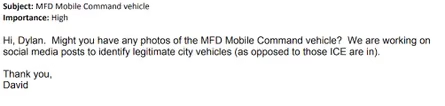
“When safe and helpful, consider describing your clothing or uniform in advance so residents know who to expect,” said the email, sent a day after the killing of Renee Good.
Another internal city memo warned there was a “substantial increase” in community members declining to let fire inspectors in their homes, saying the inspection services division would have to adjust its procedures. Other emails showed city officials rushing to assemble photos and social media posts to share with the public showing how to distinguish city police officers, EMT vehicles and other municipal workers from ICE agents.
In one email, an assistant fire chief expressed concern that the city’s behavioral crisis response unit, which helps people experiencing mental health episodes, used vehicles that look similar to ICE’s vans. In another email, city communications leaders discussed “talking points” to share with the public, saying officials should reiterate that Minneapolis officers will “not hide their identity, always provide identification when asked [and] tell you their name and badge number upon request”.
Jess Olstad, Minneapolis’s media relations manager, told the Guardian city officials were regularly hearing accounts of frightened residents not answering the door for municipal workers, from animal control to firefighters: “Community members felt very unsafe … We wanted to recognize our city employees, what they do and quite literally what they look like, how they sound and what they drive.” After Minneapolis launched its campaign to distinguish city personnel from ICE, other municipalities followed suit, she said.
Minneapolis created a badge for its community safety workers, who are contracted by the city to do unarmed patrols, added Scott Wasserman, the city’s communications director. Authorities also had to spend time fielding 911 calls about potential ICE sightings and dispelling rumors: “Is this ICE? Is this not ICE? … Police and other departments did a lot of work to communicate whether or not they were federal officers.”
Records from Bellingham, Washington, a city near the Canadian border that has faced ICE crackdowns, show that in February, a resident emailed city officials concerned the public might not be able to distinguish local police and ICE.
The Bellingham mayor forwarded the email to police officials saying the department should prioritize social media messaging about how to recognize police officers, in an effort to “ameliorate confusion about which agencies are responsible for immigration enforcement actions when actions are seen and recorded by residents”.
Spencer Reynolds, senior counsel at the NAACP Legal Defense Fund, a civil rights group, said the chaos is “an obvious outcome of ICE running rampant through the country – people will confuse other police with them”. “This confusion is heightened because federal agents are so openly and aggressively out in the streets in a constant way.”
Reynolds, a former intelligence counsel with the Department of Homeland Security, which includes ICE, said the confusion was exacerbated because some police departments were directly assisting ICE or targeting protesters.
The records also show that some fears about officers being misidentified as ICE were rooted in concerns about anti-ICE organizing, with several memos painting protesters and monitors as violent threats.
Police fears of ICE tracking
A January memo from the Idaho Criminal Intelligence Center, a consortium of local law enforcement agencies, was titled: “Local or federal? ICE or not? The potential dangers to all law enforcement.”
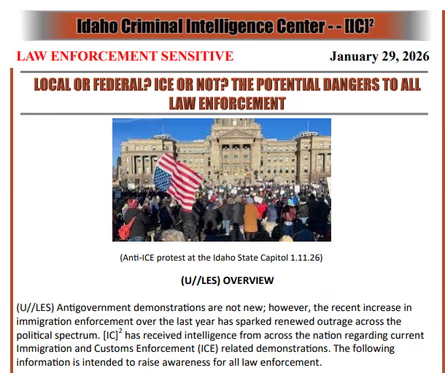
The memo, disseminated to local and national law enforcement officials and personnel, raised concerns about apps and websites built by community organizers to track and report sightings of ICE agents: “Reports locally and nationally indicate that anti-ICE groups have mistakenly identified local law enforcement operations as ICE activities due to unmarked vehicles and plainclothes officers. This misidentification has led to doxxing, harassment, and, in some cases, attacks on local law enforcement personnel.”
One local Idaho police investigator forwarded the memo to patrol officers, saying “misidentification” could be a particular problem for personnel driving unmarked vehicles.
The Florida fusion center, another law enforcement consortium, warned of “officer safety concerns” in January due to the “potential for local law enforcement personnel to be conflated with immigration enforcement personnel”. Social media users, the alert said, had “encouraged and shared guidance on violently targeting immigration enforcement personnel”. The document included an Instagram post with the photo of the officer who killed Renee Good, captioned “FEDERAL AGENT WANTED FOR MURDER”.
In February of last year, the US coast guard sent an alert to law enforcement nationally, raising alarms about a national community website soliciting reports of “sightings of law enforcement activities without identification”. The website could “compromise” ICE and “other law enforcement operations” and would “likely pose a threat to [the coast guard’s] operational security” around the southern border.
The alert noted some people have posted images of local law enforcement when warning of immigration activities.
A Virginia intelligence center, operated by local and federal law enforcement, sent a bulletin to regional law enforcement last year, which similarly warned that online postings about ICE were targeting “local, state, and federal law enforcement officers engaged in routine calls for service or other official duties not tied to [immigration].”
A Vermont law enforcement alert further said “concerned citizens” could misidentify police as ICE agents, which could lead “malicious actors” to target law enforcement doing “standard criminal investigations”. The warning, however, said it was not aware of any specific threats in Vermont.
The broad warnings about ICE monitoring generally included minimal evidence or specific details of threats to police. The memos were disseminated at a time of growing civil rights concerns about the US government criminalizing protesters and labeling anti-ICE activism as “domestic terrorism”.
A spokesperson for the Vermont intelligence center said its warning was based on “open-source reporting” from last year, and it did not have “specific intel” about incidents: “This was to inform officers of the potential dangers.” The coast guard declined to comment. Spokespeople for DHS and the other agencies that disseminated the memos did not respond to inquiries.
Ryan Shapiro, executive director of Property of the People, who obtained the records, said the intelligence alerts revealed anxiety about “hypothetical” scenarios of community members mistaking conventional officers for ICE. The solution, he said, was not for law enforcement to target anti-ICE activists, who have faced surveillance and prosecution across the country – “it’s to shut down ICE’s masked and militarized campaign of terror against our communities.”
Irina Vaynerman, CEO of Groundwork Legal, a Minnesota public interest law firm, said families’ anxieties about potential ICE encounters had significant consequences: “People feared leaving their homes. People with status lawfully in this country were afraid to go outside, to send their kids to school, to go to the grocery store.”
Local law enforcement across the country, she said, should take steps to distinguish their policies and procedures from ICE and focus on rebuilding community trust in police.
Reynolds, who reviewed the records, added: “Local officials concerned about this should condemn these dangerous federal tactics, not recreate them locally in their own police forces, and fully withdraw local support for the ICE crackdown.”