






The Middle East oil and gas crunch will impose as much as a trillion dollars of additional costs on the global economy while petroleum companies rake in spectacular profits from elevated fuel prices, analysis has revealed.
The uneven distribution of risk and reward comes amid rising concern that the US-Israeli attack on Iran is worsening inequality, poverty and hunger across a world that has become dangerously dependent on fossil fuels.
Even if the strait of Hormuz swiftly returns to normal operations, the burden of elevated oil and gas prices will reach about $600bn, according to recent International Monetary Fund figures analysed by the climate campaign organisation 350.org. Should the supply disruption continue, the economic hit to households, businesses and governments could surge above $1tn, it said.
This is likely to be an underestimate because it does not include the substantial knock-on effects of inflation, particularly higher fertiliser and food costs, lower economic activity and rising employment.
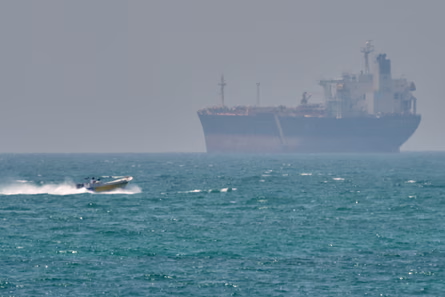
The contrast with the fortunes of US and other non-Gulf-centred petroleum companies could not be more stark. On Tuesday, BP said its profits for the first quarter of the year had more than doubled, after a jump in oil and gas prices linked to the conflict in the Middle East.
Anne Jellema, 350.org’s chief executive, said: “Over the next few days, oil majors will report astronomical first-quarter profits, much of it earned on the back of a war that has already killed thousands and impoverished millions. Even if the strait of Hormuz reopens tomorrow, an obscene amount of money will continue to flow to oil coffers at the expense of ordinary people already struggling to afford fuel, electricity, and food.”
350.org has called for an urgent windfall tax on excess profits, which could raise money for social protection and investments in renewables that are cheaper, cleaner and more reliable than fossil alternatives.
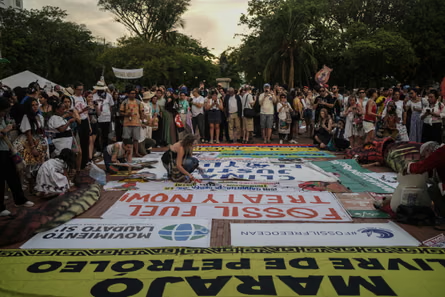
The calls were echoed at the first conference on transitioning away from fossil fuels in Santa Marta, Colombia, where more than 50 nations, dozens of subnational governments and thousands of civil society representatives are pioneering ways to break their dependence on gas, oil and coal.
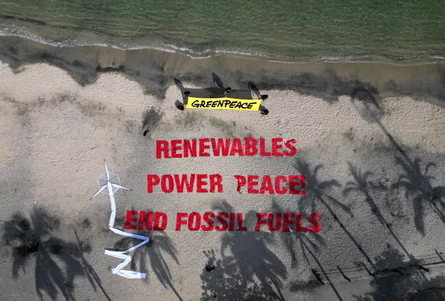
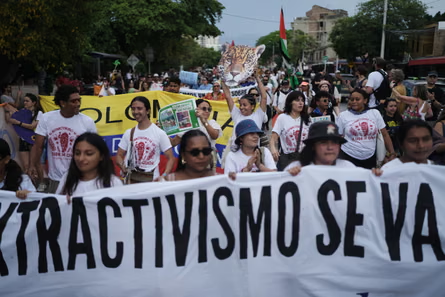
Several hundred Indigenous and civil society activists marched through the streets of Santa Marta on Monday with banners reading: “No more petroleum” and: “Another way is possible”. Activists briefly blockaded the city’s Drummond coal port, one of the largest in South America. Greenpeace, the environmental campaign organisation, created a huge message in the sand on the nearby Caribbean coast that declared: “Renewables power peace. End fossil fuels.”
Many government representatives said their people were already suffering shortages and hardships.
“We declared a 90-day state of emergency back in March because of the fossil fuel crisis,” said Tina Stege, climate envoy for the Marshall Islands. “Government now shuts down at 3pm every day to save energy. And as the crisis continues we are forced to consider further measures to cut back on services, including infrastructure projects focused on resilience such as seawalls and airport upgrades. We want the trillions that go to propping up fossil fuels to be spent on energy secure renewables instead, with support available to the most vulnerable to make the transition.”
Chipiliro Mpinganjira, deputy minister of natural resources in Malawi, said the oil crisis was worsening living standards in his country, where most people already live below the poverty line. As well as raising costs for transport and food, he said the jump in global fuel prices was forcing the government to consider budget cuts for education to meet debt payments. “We hope the debts can be rescheduled.”
In the longer term, he said, the crisis was likely to force a rethink of energy policies in Africa. “Even if the strait of Hormuz reopens, we know that this can happen again at any time. So we must definitely move away from fossil fuels.”
Cedric Dzelu, technical director in Ghana’s ministry of climate change and sustainability, said a protracted oil crisis would bring calamity. “Many countries in Africa are facing collapse if this crisis continues for more than six months. Higher prices will bring protests and this could lead to anarchy.”
Many African nations have countered the oil price rise by cutting fuel taxes, which means lower government revenues for health, education and infrastructure – while in effect giving a subsidy to petroleum companies.
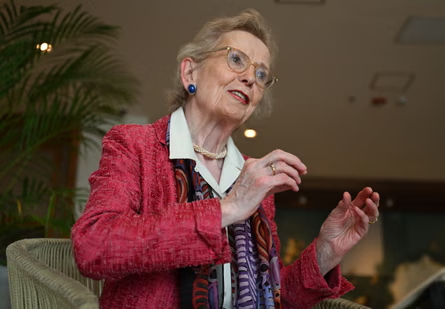
In the longer term, the Planetary Guardians group of former statespeople, scientists and activists warned against propping up industries that were a cause of many of the world’s problems. Even before the Iran war, they calculated governments were spending $1.9m every minute, about $1.05tn a year, subsidising the fossil fuel system. Mary Robinson, a former president of Ireland, said: “Citizens pay for this three times over: at the gas pump, through taxes, and through the damage fossil fuels cause to public health, the planet, and economies.”
The Planetary Guardians estimate that for every dollar spent on direct fossil fuel subsidies, the poorest 20% of households receive just 8 cents, while the wealthiest 50%, who use more cars, air conditioning and planes, capture nearly 75% of the benefits. Ending these subsidies alone would avoid 70,000 premature deaths from air pollution annually, they say.
The Santa Marta conference is exploring better uses of those funds, including more support for countries to transition away from fossil fuels, and debt relief so less of their foreign exchange reserves are spent on interest repayments.
Robinson said: “I hope Santa Marta will be a pivot point for the climate justice movement.”