








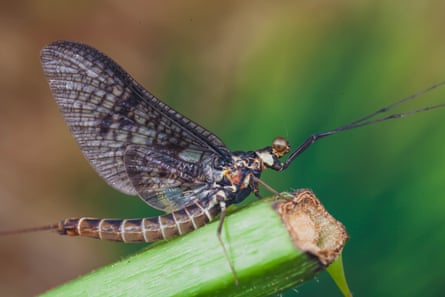
On a spring evening along the banks of the River Thames, thousands of mayflies can be seen engaging in what may be one of the world’s oldest dances. In the fading light, the males make a steep vertical climb, flip over and float back to Earth – wings and tail outstretched in a skydiving posture so as to drop slowly through the sky.
Mayflies are among the world’s oldest winged insects, emerging roughly 300m years ago – long before dinosaurs walked the Earth. Even the Mesopotamian poem the Epic of Gilgamesh, one of the oldest pieces of literature, makes reference to the short-lived mayfly. Over the epochs, the insect’s basic design has changed very little compared with the fossils of their ancestors.
“They have retained these odd characteristics and we can probably assume that they’ve been doing this [dance] for hundreds of millions of years, and yet we don’t really know why,” says Samuel Fabian, a research fellow at the University of Oxford who studies the aerial behaviours of insects.
Now, Fabian and his colleagues think they finally have an answer. In new research published in the Journal of Experimental Biology, the scientists reconstructed the flight behaviour of the common mayfly, filming large swarms in the London borough of Richmond in 3D and analysing the insects’ flight paths.
It turns out that male mayflies rely on this bizarre up-and-down flight pattern to figure out who among the swarm is male, and who is female. By flying vertically, males rarely fly horizontally above the swarm – the signature of their female counterpart.
In further simulations, the scientists found that male mayflies would stop their pursuit of any target that dropped beneath the horizon.
“The problem is that the males have almost no filter,” Fabian says. “You can give them a beach ball – which, as far as I’m concerned, looks quite different from a female mayfly – and males will go right up to that much larger object and try to mate with it.”
Things get even trickier in low-light conditions, as females look almost identical to males even at close range. By staying below the females, males ensure their romantic energy is well spent. This is especially critical because mayflies do not have much time, only living from a few hours to a few days, during which they must pass on their genes.
Acing such reproductive goals is crucial to the species’ long-term survival. There are more than 3,000 mayfly species living in the world’s freshwater creeks, rivers, ponds and lakes. But many of Britain’s 51 species are now in a state of decline – another victim of what scientists call the “insect apocalypse”.
A 2019 global review estimated that 40% of the world’s insects were declining, while another study suggests more than 1 in 10 species could be lost by the end of the century.
From 2015 to 2021, the nonprofit conservation group WildFish carried out a riverfly census of Britain’s chalk streams. These streams are some of the cleanest waterways, fed by cool springs that flow from aquifers through chalk, a form of limestone. The species that live here are often very sensitive to pollution.
The census found that Britain’s chalk streams had lost 41% of their mayfly species on average compared with 1998. “In many lowland catchments, the spectacular hatches that once defined early summer have diminished dramatically, reflecting decades of mounting pressure on freshwater ecosystems,” says Janina Gray, head of science and policy at WildFish. “Pollution, sediment runoff, reduced river flows and rising water temperatures are all eroding the conditions these insects depend on.”
Other research suggests that even modest pollution in many English rivers may be enough to kill up to 80% of mayfly eggs, laid in riverbeds.
For now, Fabian encourages Britons to relish the ancient spectacle while they still can.
“This behaviour is something that pretty much everyone, at certain times of the year, should be able to see,” he says.
“These are quite urban places with lots of traffic, but they’re still hanging on and they’re still doing this dance that they have probably been doing since before Britain was separated from mainland Europe.”
Find more age of extinction coverage here, and follow the biodiversity reporters Phoebe Weston and Patrick Greenfield in the Guardian app for more nature coverage