





惯性聚合 高效追踪和阅读你感兴趣的博客、新闻、科技资讯
阅读原文 在惯性聚合中打开

推荐订阅源

cs.AI updates on arXiv.org
Schneier on Security
cs.CV updates on arXiv.org
Attack and Defense Labs
H
Hacker News: Front Page
Google DeepMind News
雷峰网
雷峰网
C
CXSECURITY Database RSS Feed - CXSecurity.com
Cisco Talos Blog
Cisco Talos Blog
T
Tenable Blog
G
Google Developers Blog
A
About on SuperTechFans
The Cloudflare Blog
S
Securelist
OSCHINA 社区最新新闻
OSCHINA 社区最新新闻
C
Cisco Blogs
H
Hackread – Cybersecurity News, Data Breaches, AI and More
aimingoo的专栏
aimingoo的专栏
云风的 BLOG
云风的 BLOG
Forbes - Security
Forbes - Security
腾讯CDC
Application and Cybersecurity Blog
V
Vulnerabilities – Threatpost
IT之家
IT之家
博客园_首页
P
Proofpoint News Feed
P
Privacy & Cybersecurity Law Blog
C
Cyber Attacks, Cyber Crime and Cyber Security
Project Zero
Project Zero
月光博客
月光博客
NISL@THU
NISL@THU
爱范儿
爱范儿
S
Secure Thoughts
K
Kaspersky official blog
Security Latest
Security Latest
T
Tailwind CSS Blog
博客园 - Franky
D
Darknet – Hacking Tools, Hacker News & Cyber Security
TaoSecurity Blog
TaoSecurity Blog
The GitHub Blog
The GitHub Blog
Microsoft Azure Blog
B
Blog RSS Feed
S
SegmentFault 最新的问题
H
Help Net Security
T
Tor Project blog
L
LINUX DO - 热门话题
S
Security @ Cisco Blogs
N
News and Events Feed by Topic
O
OpenAI News
S
Schneier on Security

The Guardian

New Zealand’s North Island braces for Cyclone Vaianu with thousands ordered to evacuate Artemis II splashdown – in pictures Swalwell denies allegations of sexual assault as calls grow for him to withdraw from California governor race Trump news at a glance: Epstein survivors have words for Melania Trump after surprise statement Multiple people face charges, including murder, in California fireworks blast Rory McIlroy surges into six-shot Masters lead with stunning second-round flourish Roberto De Zerbi targets ‘Ange-ball’ revival to save Spurs from relegation Bath hit back to reach semi-final after stunning Northampton in 11-try epic Australia crash out of BJK Cup after Britain secure upset with doubles win Zebras, wealth and power: Hungary’s election tests Orbán’s grip on power ‘TikTok effect’ brings sellout crowds and younger fans to Grand National meeting King signs up David Beckham to his Chelsea flower show team The war over Omagh’s gold: the £21bn mine plan tearing a community apart Britain’s shadow workforce is paid as little as 65p an hour. Who cares for the carers? Tim Dowling: my wife is on a quest to restore my thinning hair SUVs are making Britain’s potholes worse, say scientists Blind date: ‘She claimed she was usually shy. I wouldn’t have guessed’ I’m a sauna person now: the Becky Barnicoat cartoon ‘I got everything I dreamed of – when I had no ability to handle it’: Lena Dunham on toxic fame, broken friendships and her ‘lost decade’ Six great reads: the man who let snakes bite him, masked heavy metal and the brutal reality for foreign students in the UK Meera Sodha’s recipe for noodles with rose beancurd, spring greens and egg Cuba’s doctors were a lifeline for the world. Now the Caribbean is shamefully complicit in the US drive to expel them An environmental disaster in Moldova has Russia’s fingerprints all over it ‘This is as important as your teeth’: are you skipping this key part of mouth hygiene? Man arrested after four die trying to cross Channel in small boat Ukraine war briefing: doubts linger in Kyiv over Moscow’s promise to uphold Orthodox Easter ceasefire Ichiro Suzuki statue unveiling goes awry as bronze bat snaps during ceremony Arrest of national war hero Ben Roberts-Smith cuts deeply to core of Australian psyche European football: Real Madrid held at home by Girona to extend winless run ‘You come back different’: how rugby players change after motherhood Human rights groups decry US plan for Guantánamo camp for Cuban migrants Potential US host cities for 2031 Women’s World Cup games mull withdrawal over Fifa concerns Arne Slot insists he is ‘aligned’ with Liverpool board and fans as squad is rebuilt Kamala Harris ‘thinking about’ running for president again in 2028 JD Vance warns Iran against trying to ‘play’ the US in peace talks West Ham double up twice to thrash Wolves and put Spurs in relegation zone Trump administration releases new renderings of so-called ‘Arc de Trump’ Bafta apologises for events surrounding John Davidson’s Tourette’s outburst Cocktail of the week: Bar Shrimp’s la rosita – recipe New drug may extend survival in aggressive ovarian cancer, trial shows One dead and 27 injured after bus with British passengers crashes in Canary Islands OpenAI CEO Sam Altman’s home targeted with molotov cocktail Alarm as acting CDC director delays report showing Covid vaccine benefits Argentina just ripped up its pioneering glacier law. What does this mean for millions of people’s drinking water? ‘Illegal’ forest service overhaul risks causing ‘chaos’ across US public lands, union claims Prince Harry sued for defamation by charity he co-founded Anthropic’s new AI tool has implications for us all – whether we can use it or not Concerns raised about motorbike tourist trail after death of British teenager in Vietnam The Guardian view on Trump’s civilisational threats: the words that fuel war must be condemned The Guardian view on dystopias for our times: the American nightmare Weather tracker: Cyclone Maila batters Solomon Islands with 115mph winds Doctors’ leader claims new reduced pay offer killed chances of ending strikes in England Netanyahu-ism has achieved nothing for Israelis – and come at a monstrously high price Deborah Levy: ‘CS Lewis’s White Witch terrified me – but I wanted to meet her’ How I Shop with Michelle Ogundehin: ‘We grownups have enough stuff already’ ‘Butter Birkin’: popcorn plastic It bag in demand by Devil Wears Prada fans Trump’s war and Melania’s Epstein statement, with US editor Betsy Reed – The Latest Orbán and Magyar trade accusations in last days of Hungary election campaign Reckonwrong: How Long Has It Been? review | Safi Bugel's experimental album of the month Martin Rowson on Middle East peace talks – cartoon Fears of UK and EU flight cancellations as airports warn of jet fuel shortages Peers vote to ban pornography depicting sex acts between stepfamily members Week in wildlife: an ostrich on the lam, a tortoise crossing a road and surfing seals ‘There’s no shortage of terrifying technology’: how AI became TV drama’s new go-to villain Texas court overturns sentence for man on death row for nearly 50 years Power up! Could force be the secret to supercharging your fitness? ‘Irresponsible failure’: Google, Meta, Snap and Microsoft slam EU over child sexual abuse law lapse Blank canvas: what to wear with white trousers Critics assemble! Here’s my list of the greatest superhero movies of all time Amazon to finally launch Leo satellite internet in ‘mid-2026’, says CEO Pete Hegseth’s holy war: the militant Christian theology animating the US attack on Iran Toxic putdowns, brutal zingers ... and an unexpected love story – inside the joyful climax to brilliant sitcom Hacks Add to playlist: the beautifully dazed, countrified indie-rock of Tracey Nelson and the week’s best new tracks ‘I’m worried there’s too much of me,’ says a birch: inside the interspecies council giving nature a voice Dolce & Gabbana says co-founder Stefano Gabbana has quit as chair Why is anyone surprised by the US and Israel’s latest war? It’s only what the world allowed them to do in Gaza Super Mario what?! The seven best obscure Mario games Holly Humberstone: Cruel World review – Taylor Swift fave trades gothic melancholy for pop glow-up Thrash review – cursed shark thriller sinks like a stone on Netflix ‘The biggest, baddest, saltiest chick you would ever see’: why no one sang the blues like Big Mama Thornton Go Gentle by Maria Semple review – a joyfully clever New York romcom ‘Tranquil, natural and barely a tourist in sight’: readers’ favourite hidden gems in Spain Benjamina Ebuehi’s sweet and salty chocolate chip cookies recipe ‘I’m not a commercial director – I’m not even a professional film-maker’: Jim Jarmusch on the seven-year journey to make his new film Malcolm in the Middle: Life’s Still Unfair review – the TV magic they’ve created here is absolutely miraculous The Miniature Wife review – Matthew Macfadyen is wasted in this pointless comedy From soups and greens to roots, how to survive the ‘hungry gap’ From fat transplants to LED mittens: how the fear of ‘old lady hands’ mobilised the beauty industry Anna Wintour’s Vogue cover is more than a cameo – it’s a power play ‘They’re gonna make me cry’: I competed at a speed puzzling championship You be the judge: should my girlfriend stop mixing gold and silver jewellery? Maritime and port workers: how is the Middle East conflict affecting you? How games capture the awe and terror of cosmic isolation Why does alcohol make us both happy and miserable – and what else does it do to our minds and bodies? I never text back – and it’s ruining my relationships The pet I’ll never forget: Beau, the labrador who saved my life Life Is Strange: Reunion review – a decade-long story comes to an impassioned close Why is gaming becoming so expensive? The answer is found in AI Sign up for the First Edition newsletter: our free daily news email Sign up for the Feast newsletter: our free Guardian food email
From sanctioned cars to beauty clinics, Russian rubles have flowed into China’s border towns since Ukraine war
Amy Hawkins · 2026-05-19 · via The Guardian

Suited and booted in a navy twinset tracksuit and colourful high-top trainers, Wang Runguo is hustling. Darting across the gleaming floors of his cavernous car showroom, the 45-year-old from one of China’s poorest provinces is closing on yet another deal. It is all in a day’s work for the man whose salary has more than doubled in the past year thanks to a well-timed pivot: from corn to cars; from China to Russia.

This time last year Wang was working for an agricultural company that grew corn and soya beans for the domestic market. Now he is a manager at Xingyun International Automobile Export, a company founded in August 2025 to cater to the booming new car export industry in Suifenhe, a small city in China’s north-east that borders Russia. “Recently, China and Russia have been moving closer together,” Wang says. “As we move closer, more and more cars are going there.”

A manager at Suifenhe Hengchi International Trade, one of the city’s biggest car dealerships, puts it more bluntly: “The Russia-Ukraine war … has been a good opportunity for our business.”

As Russia’s president, Vladimir Putin, visits China on Tuesday, Moscow may be hoping that Beijing continues to see the benefits of a cosy relationship.

Map showing location of Suifenhe

And on China’s border with Russia, where the US is a distant concept but where Russians spend their money, local businesspeople say they are unconcerned by western sanctions.

China rejects western sanctions and says that they do not comply with international law. Earlier this month the Chinese embassy in the UK lodged “stern representations” with London over sanctions that were applied to Chinese companies accused of supplying drones and military goods to Russia. A Chinese government spokesperson said: “Normal exchanges and cooperation between Chinese and Russian enterprises should not be interfered with” by sanctions.

Ever since Russia launched its full-scale invasion of Ukraine in February 2022, weeks after Xi Jinping and Putin had declared a “no limits” partnership, ties between the two countries have deepened. Bilateral trade has soared to record highs, to the chagrin of western leaders who accuse Beijing of providing an economic lifeline to Moscow while it engages in a war of aggression.

Beijing has bought more than €316.5bn of Russian fossil fuels since the start of the full-scale invasion, according to data collected by the Centre for Research on Energy and Clean Air, far outstripping purchases by any other country. And Chinese companies have jumped to fill the gaps in the Russian market left by the retreat of western businesses. Last year exports to Russia from Heilongjiang, the province that includes Suifenhe, increased by 22%.

“The dependency is mutual, but asymmetric,” says Alexander Gabuev, the director of the Carnegie Russia Eurasia Center. China now buys nearly 30% of Russia’s exports, while only about 3% of China’s exports flow in the opposite direction.

a line graph showing the value of trade between Russia and China since 2019

But in certain industries, Russia plays a much bigger role in China’s economic fortunes. One such trade is cars, a sector which in China is struggling with oversupply and a lack of domestic demand. Vehicles are one of Suifenhe’s main exports.
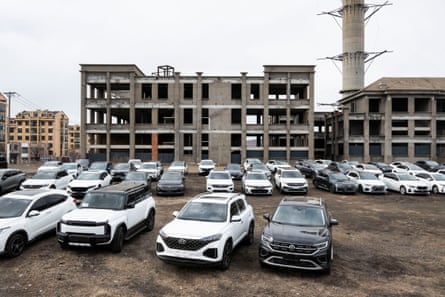
Cars parked outside a  half constructed building
An abandoned construction site has been turned into a car park for secondhand cars to be exported to Russia. Photograph: Gilles Sabrié/The Guardian

Between 2021 and 2024, Chinese brands’ share of the Russian car market increased from 7% to nearly 60%, according to data from the China Passenger Car Association. In 2024, China sold more than 1m vehicles to Russia, making it the biggest destination for Chinese vehicles, although it has since dropped to second place behind Mexico.

A bar graph showing how Chinese cars have been the biggest sellers in Russia

Further volumes have come from the export of China-made, foreign-branded vehicles. Despite sanctions on Russia, tens of thousands of cars from brands such as BMW, Honda and Volkswagen continue to be sold in Russia each year, via third-party Chinese dealerships.

Wang’s BMW, a used model, sold for 120,000 yuan (US$17,600). That is cheap compared with prices in Russia, says the buyer, a Russia-based businessman. And it is too expensive for Chinese consumers, Wang says. It’s win-win.

As much as China has kept the Russian economy afloat, Russian rubles are also sustaining many parts of China, where the economy is heavily reliant on exports and where domestic consumers are unwilling, or unable, to part with their cash.
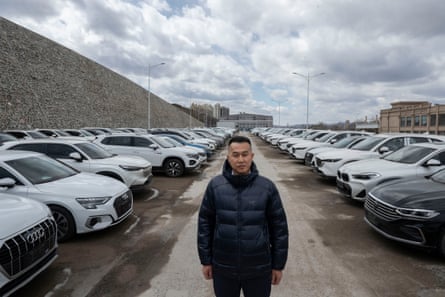
Gao Bin stands in the space between rows of cars parked at either side of him
Gao Bin, the boss of Suifenhe Hengchi International Trade, among a fleet of used vehicles destined for export to Russia. Photograph: Gilles Sabrié/The Guardian

Gao Bin, the boss of Suifenhe Hengchi International Trade, says the company pivoted towards exporting cars to Russia three years ago. The first car they shipped across the border was a black Toyota Camry. “After the war started, there was demand in Russia,” he says. Last year, he sold more than 7,000 cars to Russia, compared with only a few dozen domestically. “Domestic sales have basically come to a halt.”

Suifenhe, a city of just 60,000 people in China’s economically depressed rust belt region, is a microcosm of this relationship. Cyrillic signs are everywhere and prices are advertised in rubles as commonly as in yuan. But most of the shops are boarded up. From certain hilltops you can peer into barren Russian villages (a pair of binoculars helps), although a multistorey observation tower designed to attract tourists has been left abandoned and unfinished for years .
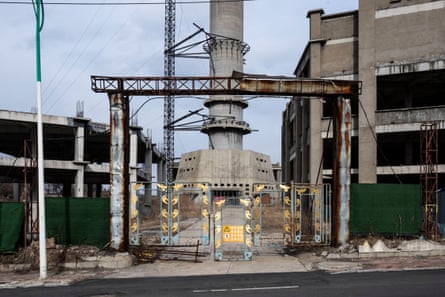
An abandoned construction site for an observation tower in Suifenhe that looks towards Russia.
An abandoned construction site for an observation tower in Suifenhe that looks towards Russia. Photograph: Gilles Sabrié/The Guardian

As the first place in China to allow the use of rubles as legal tender, Suifenhe has long been home to a large community of Russian businesspeople and visitors, boosted by the introduction of a visa-free regime for Russian tourists in September. It is just two hours from Vladivostok by train. And according to local businesspeople, Russians are the only ones spending.

Ning Qiang, who runs a beauty salon catering exclusively to Russians, says the number of customers has increased by about 50% since the visa-free policy was introduced. By 5pm on a Tuesday, he had received three clients. “When China-Russia relations are good, life is better for ordinary people,” he says. “Locals in Suifenhe don’t buy much.”

Heilongjiang got a more than 60% boost in visitors from Russia in the first six months of the visa-free policy, according to Chinese state media. Gabuev says the difficulty in procuring European visas is pushing more Russians to travel eastwards. “And they come back mostly really fascinated and willing to come back again. It’s a net positive for the Chinese,” he says.
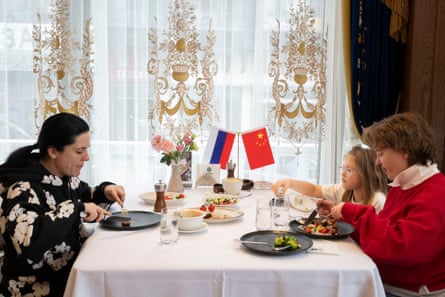
Two women and a young girl sit eating at a table with a white tablecloth and a small Russian flag and Chinese flag placed on it as decoration
Mariia Publichuk (left) having lunch with her mother and daughter at Maksim, a fancy Russian restaurant. Photograph: Gilles Sabrié/The Guardian

One of the Russians spending her money in China rather than Russia is Mariia Publichuk, a 36-year-old from Vladivostok living in Suifenhe with her eight-year-old daughter. Publichuk moved to Suifenhe last year so that her daughter could study Chinese. The pair spend their mornings at a local primary school surrounded by the chatter of Chinese children. Evenings are spent singing and dancing in Suifenhe’s central square, which echoes with competing soundtracks from speakers dotted across the plaza. “English is the first most useful language in the world,” Publichuk says. “And the second is Chinese.”

But for anyone whose livelihood depends on yuan rather than rubles, times are tough. The manager of a local logistics hub which handles cross-border and domestic freight says it has been his worst year since he started the job six years ago. The war in the Middle East has pushed up fuel prices for his trucks, and orders are down. “Even during the pandemic … it wasn’t like this,” says Wang, who declines to give his first name. “This year, in every industry … demand in China is decreasing. It’s simply that people don’t have money in their pockets.”
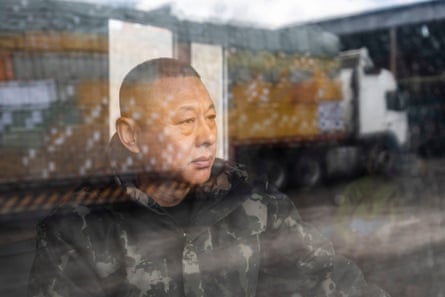
Mr Wang, manager of a logistic hub.
Mr Wang, manager of a logistic hub. Photograph: Gilles Sabrié/The Guardian

National statistics tell a similar story. Despite the US-China trade war which pushed US tariffs on Chinese goods as high as 145% last year, Chinese goods continue to be shipped overseas at astonishing rates. Last year China’s trade surplus reached a record $1.2tn. In the first three months of 2026, exports were up almost 15% compared with the same period last year, while domestic retail sales in March grew only 1.7% compared with 12 months earlier.

The US president, Donald Trump, left Beijing last week after a two-day summit full of pageantry with promises of “fantastic trade deals”. But there has been little by way of public announcements on tariffs. On Saturday, China’s ministry of commerce said the two sides would establish a board of trade to discuss “tariff reductions” but did not provide further details.

China’s long-term goal is to make the economy less reliant on exports. In March, its premier, Li Qiang, said China “must adhere to the strategic basis of expanding domestic demand”.

Structural problems such as an ageing population, a depressed real estate sector and a lack of consumer confidence after the pandemic all make this transition hard to execute. Exporting goods, whose prices are kept low in part because of China’s discounted energy supplies from Russia, is a lot easier.

Despite the economic slowdown, Beijing still holds the cards in the China-Russia relationship. China has options for international trade that Russia does not. Bloomberg recently reported that 90% of Russia’s sanctioned technology is imported from China. And with Trump in the White House, Xi is under less pressure than ever over his relationship with Putin. The war in Ukraine barely featured in last week’s US-China summit. Trump’s “ask to Xi Jinping to contribute to the peace effort in Ukraine is not a very serious push”, Gabuev says. “Not that Xi Jinping feels that he’s on the hook for that.”

In Suifenhe, even the most ardent Russophiles see Russia as a country in decline, notwithstanding their own city’s beleaguered economy.
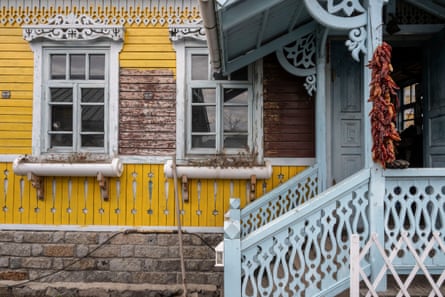
A house with ornamental woodwork
Song Lu’s Russian-style house dates back to the construction of the Chinese Eastern Railway. Photograph: Gilles Sabrié/The Guardian

On the outskirts of town, in a crumbling, barely populated village, a house built in the style of a Russian wooden cottage, painted in bright blue and yellow, stands out from the grey. Its inhabitant is Song Lu, a 67-year-old retired artist whose family has lived in Suifenhe for generations. An enthusiast for Russian arts and crafts, he builds models of traditional Russian wooden carriages in his spare time, and has even built a blue tubular sauna in his front garden. “Russians might find it hard to admit, but in reality, China has already become the big brother,” he says.

Additional research by Lillian Yang