






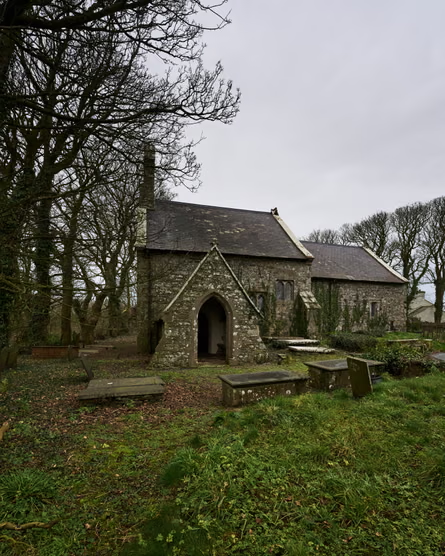
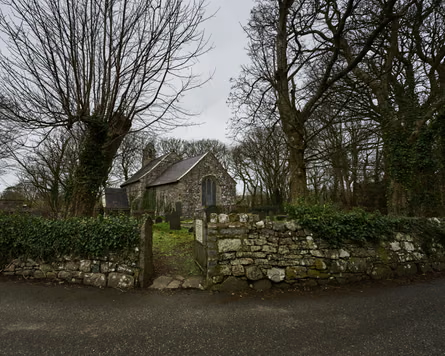
There is a sign on the gate leading through the circular stone wall that surrounds St Tyfrydog’s church on Anglesey (Ynys Môn). Services, in Welsh and English, are held on the first and third Sunday of the month, at 2.15pm, it says. But this is no longer the case: the last service was held here on 22 November 2020.
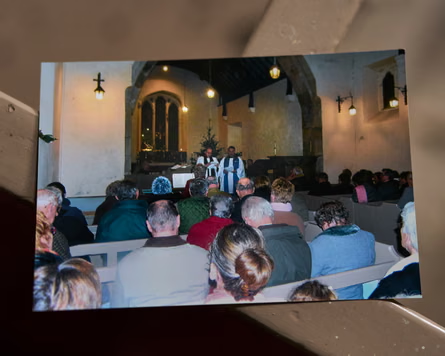
There was a decent turnout that day, to say goodbye to this little medieval church, parts of which date from about 1400 (there has been a church on the site since 450). The problem was that, before then, apart from on big occasions such as Christmas and the harvest festival, the congregation was tiny; five or six people, sometimes just three.
Passing through the gate today, into the churchyard, the first thing I notice is the ivy. It covers the ground and the graves; it creeps inexorably towards the church, where it climbs the stone walls, reaching up and grabbing hold, as if to reclaim the church by dragging it down into the ground.
The sycamore trees around the perimeter of the churchyard are doing nothing to protect it from the wind for which Anglesey is known. It is bitterly cold and gloomy, but also enchanting. I am here with Tom and Jane Bown and Tom’s sister, Peggy Thomas. The Bowns live a mile or so away across the fields on the family farm (sheep and cattle), though these days their sons, Emlyn and William, do most of the farming. Tom is 87 and Jane 78. Peggy, who lives a few miles further away, is 85.
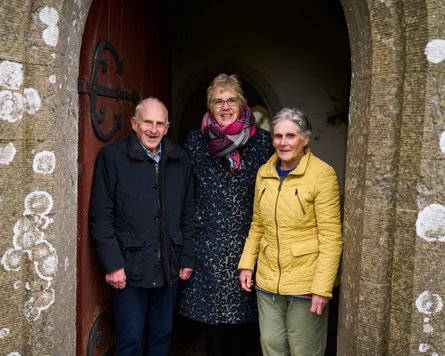
Until the church shut its doors, Tom was the warden of St Tyfrydog’s. He had been a member of the congregation all his life. Obviously, he was sad when the church closed, but he is a pragmatist. “You can’t carry on if people aren’t going; there’s no point sending clergy if there’s no one there,” he says. Jane is nonconformist and attends a Methodist chapel, but she used to come to St Tyfrydog’s services to play the organ. “What upset Tom most when it closed was that the key went, and he was never allowed into the church again.”
Today, however, Tom has the key back – more on why later. It’s chunky, made of iron and a bit rusty. But after some jiggling in the keyhole, it turns and in we go.
****
Churches at risk
According to the National Churches Trust, there are about 38,500 churches, chapels and meeting houses in the UK, approximately half of which are listed buildings. In a survey last year by the trust, in which 3,628 churches took part, one in 20 of those surveyed said they felt they will “definitely” or “probably” not be used as a place of worship in five years’ time. Before coming to Anglesey, I spoke to the chair of the trust, Sir Philip Rutnam, about why this is happening. “The fundamental reason is the number of people going to church has declined,” he says. “It’s not the case everywhere, some are even growing,” but generally, the news is not good.
Two kinds of churches are particularly at risk: those in poorer towns and cities, and those in rural areas. On the first point, Rutnam points to Wigan, where the Anglican Diocese of Liverpool came up with a plan in 2023 to close up to 19 churches. “They haven’t closed all those buildings,” says Rutnam. “But nonetheless, you see in northern towns and cities – poorer towns and cities generally – a big risk of closure. There’s a link to deprivation.”
In rural areas, about 900 churches are in danger of closing by 2030, according to the Trust’s survey. “Particularly rural churches in more isolated, again poorer, parts of the country,” says Rutnam. Places such as St Tyfrydog’s. Rutnam points to another example: the medieval parish church in the village of Burstwick, near Hull. “Not a tiny village – it has a population of 2,000 – but they couldn’t raise the £250,000 to fix the roof. Even with declining attendances, if that was Hertfordshire, the community would probably have been able to rustle up the money,” he says.
Church closures are often triggered by the need for expensive repairs. In the Trust’s survey, one in 10 respondents reported that their church building needed urgent repair within a year. And the responsibility for the upkeep and maintenance lies not with the Church nationally, nor with the bishop if it’s a diocese, but with the local congregation. That’s different from other countries. There are approximately 50,000 churches in France, the vast majority of which are owned by the state. “It’s the same in Belgium,” says Rutnam. “In most of Europe, there are systems of taxes which go towards supporting these buildings. But in Britain, the financial responsibilities rest with the local congregation.” When that local congregation is neither wealthy nor numerous, things become difficult.
****
Old memories
The hamlet of Llandyfrydog is tiny. Apart from St Tyfrydog’s church, there is an old rectory and a former schoolhouse (both now private homes), a couple of other houses, and beyond that fields and scattered farms, from where the congregation used to come. Some are now second homes. Tom points to one that’s owned by someone they hardly ever see. “Total waste of a house,” he says.
The first thing I notice as I go through the church door is the ivy again: here in the porch, it has wormed its way in under the eaves and is making itself at home inside. Also in the porch is a wooden bier. I wonder if it was used to carry the coffins of Tom and Peggy’s parents? But no, Tom says, they were cremated and their ashes were put in the family plot here.
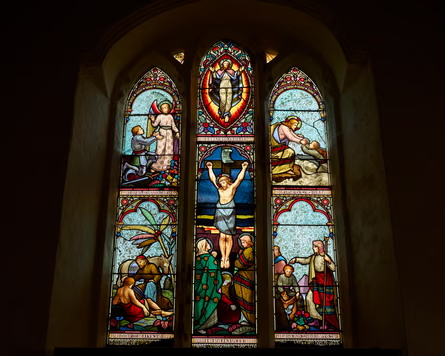
Peggy has a happier memory of St Tyfrydog’s. On 21 July 1962, she got married here. She walked through this porch on her father’s arm on the way to the altar where another local farmer, John Thomas, was waiting. “We had the service, then went up to the steps to have the blessing,” she says. “Quite a lot of relatives came, the church was reasonably full, it’s only a small church as you see.”
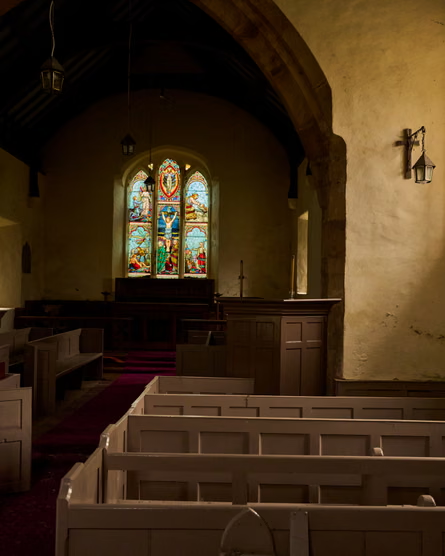
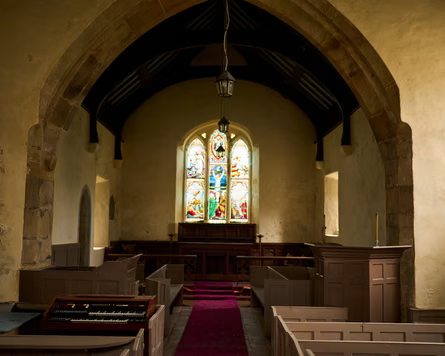
We are in the nave now, which has charming box pews. Peggy shows me where the family used to sit, “and woe betide anyone else who tried to sit there”. Then she laughs because towards the end there wasn’t anyone else sitting anywhere. She and Jane remember some of the vicars they had over the years: Erasmus Jones, Father Dylan (Jane’s favourite, “he was quite jovial, lots of jokes”) and more recently the Rev Kevin Ellis, who took that last service in 2020. “It was a very sad occasion, knowing we would never go back in,” says Jane.
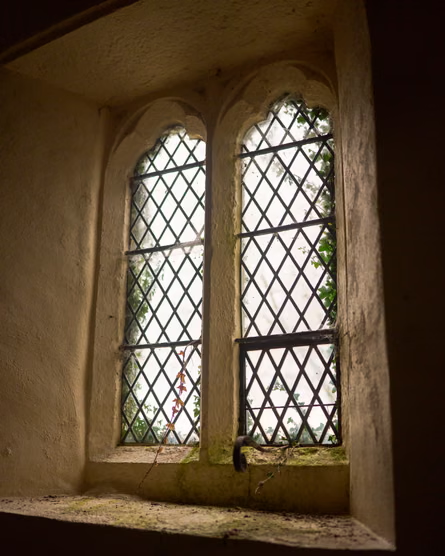
Except today they have. It’s quiet in here, out of the wind, but no warmer than outside. There is crumbled plaster, fallen from the ceiling, on the floor and over the pews. It’s clear the roof is leaking – you can see daylight in a couple of places. The paint on the walls is bubbled and pustulous, some of the floorboards have rotted. It’s particularly bad in the vestry where the whole floor has collapsed under the weight of a table. In among the debris are cups and saucers that must have been on the table before it fell. There are cobwebs over many of the windows, but otherwise there is no sign of wildlife. Tom thought there might be bats here at night-time.
When a church like St Tyfrydog’s closes, it goes into the hands of either the diocese or the national bodies of the Church of England or, in this case, the Church in Wales, which can ultimately sell it. This, Rutnam says, “is often felt to give rise to a financial incentive for the diocese or the church commissioners to close buildings and sell them”. But he thinks it is unfair to claim the Church wants to close buildings to make money. “In my experience, the bigger issue is that the whole process around closing a building and trying to resolve what its future is can mean that it declines and decays for a long time. That then makes it much more difficult to secure a new future for the building.”
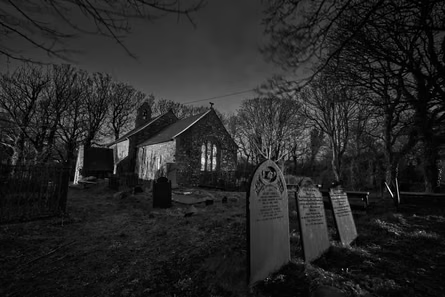
That said, Rutnam is keen to point out that, given the right level of community action, support and, of course, funding, most churches can be turned around. And that, although many fewer people go to them than was the case 50 years ago, churches are still important. For one, they make up “just about half of the country’s most important historic buildings, so it matters if you care about the country’s history and cultural inheritance, not just because of the buildings but because they contain vast collections of stained glass and sculpture, many times the size of any museum collections”.
But churches also matter in the lives of the communities that surround them, says Rutnam. “The symbolism, the identity, the sense of place they give, and in many cases the kind of social provision and infrastructure,” he says. He points out that 85% of food banks are based in a church, and a great deal of support groups such as Alcoholics Anonymous, parent and toddler meet-ups, choirs and theatre groups, take place in churches and church halls. “Look at when there’s a flood or other local disaster, what building does the local authority or police open up and use? Often it’s the church.”
Despite its poor state of repair, the cold, the echoey interior and the marauding ivy, St Tyfrydog’s does still feel like a church, not yet a ruin. We talk, if not in whispers, then with a sort of hushed reverence. “I was expecting it to be worse than it is, and the ceiling to have come down completely,” says Tom.
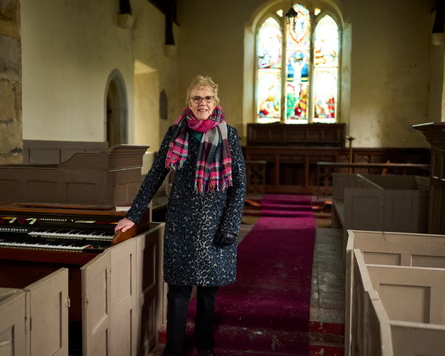
He, Jane and Peggy walk around quietly, reacquainting themselves with old friends. The font was presented to the church by Tom and Peggy’s grandfather in 1898. Tom and Jane’s youngest grandchild, Martha Jane, was one of the last to be baptised here, in 2011. Jane finds some string hanging from the pulpit; she tied it here before the church closed, to hang sunflowers and grapes at harvest festival. And here is the organ she used to play, covered in plaster, but still with a hymn book in Welsh and English. Oh go on, give us a blast. “There’s no electric, it’s an electric one,” she says.
At the western end, a single bell rope hangs. One of Tom’s jobs, on a Sunday, was to ring this bell. As we leave, he gives it a tug – although not too hard, in case the roof falls down on us. Nothing happens: he thinks the clapper inside the bell has rusted and fallen off.
Answered prayers?
But in a down-to-earth kind of way, Tom, Jane and Peggy’s prayers have been answered. Rachel Morley is director of Friends of Friendless Churches, a charity that rescues and protects historic places of worship in England and Wales. Its funding comes from its 3,500 members, donations, plus grants, legacies and a bit of government funding via Cadw, the Welsh government’s historic environment service. Guess which church it has just agreed to take on? That’s where the key came from.
Speaking to Morley after my visit, she talks passionately about how she became involved and why churches need to be rescued and protected. “When I moved to the UK from Ireland, I didn’t know anybody, and I loved that I could go around the countryside and anywhere I went there was going to be a church and more often than not it would be open. I could go in and I didn’t have to buy anything or pay to get in.”
Morley was brought up Catholic, but isn’t religious. “I just love that they are there, they belong to the landscape and the nation. Anyone can go in, for spiritual succour, or if you’ve been on a walk and you want to sit down and eat your lunch.”
She echoes Rutnam on the architectural importance, plus the carvings, paintings and tapestries. Also – especially – on the importance of churches to communities. She is perhaps less generous towards the church institutions that sometimes sell them off. “Those buildings weren’t put there by Church institutions, they were built by local people, even if it was the lord of the manor.” It was local communities “that would have paid their pew rent, over generations, to have the privilege of being a Church of England or a Church in Wales church. So it feels morally wrong that a building can be plucked out and sold to an individual for profit that goes to the national church body. It seems shortsighted and transactional, and goes against what these buildings are for.”
St Tyfrydog’s is a Grade II*-listed building and was vested to Friends of Friendless Churches by the Church in Wales. Now, the charity will have to find the funds to rescue it, which Morley estimates will cost about £350,000 (including VAT, which the government doesn’t exempt).
Obviously, the charity can’t save all closed churches, so I wonder what it was about St Tyfrydogs? “People often ask what the killer thing is. Is it a fantastic rood screen or whatever,” says Morley, “but though we do really like St Tyfrydog’s – I go on about the box pews all the time – we’re the Friends of Friendless Churches, not the Friends of Listed Buildings. So a good way of prioritising is to ask: ‘If we didn’t step in, what would happen here?’ And in this case, it would just sit there, the holes in the roof would get bigger, the ivy would take over, it would still be a problem in 10 years’ time – just a bigger problem.”
So what happens now? The charity will fix the place up, put a new roof on, sort the drainage, halt the advancing ivy, all of which it hopes to get done this year. Then the deal is that it will preserve the building as a monument, and it can be used for Christian activities and community activities. Morley says there will be a community consultation to find out what people want when they get their old church back. “From our work elsewhere, just having the building in good condition and having the door open, you invite opportunities – and for people to think about how they can use the space. It might take a few years, but ultimately people do get interested again.”
****
I call Tom, to tell him the specifics of the plan, that the church is going to get a new roof and new drains. He’s out working – lambing has begun, it sounds windy. “That’s wonderful, I’m over the moon, sounds like it’ll cost a fortune.”
He wonders how much use he’ll get out of the building now. “I won’t be around much longer. I’m 87,” he says. But, given that he is out lambing today, I think he is going to be around for some time yet. He intends to visit the church afterwards, too. “Jane’s in charge of that, but I think we’re going to be cremated, then the ashes put in the family plot” – to join his and Peggy’s parents within the circular stone wall of St Tyfrydog’s. “Not that I believe in the afterlife or anything like that, I’m quite modern-thinking about that. Once you’re gone, you’re gone.”
He has to get back to work, but has one final message: “I hope the Friends of Friendless Churches will fix the bell. Somebody who understands bells could probably do that fairly easily.” Hopefully, Tom will get to ring it once again.