









Tee Fabikun is sitting in an armchair in her cosy, homely flat, surrounded by her things – papers and letters, family photos, a few Nigerian handicrafts, a forest of houseplants by the window. She is telling me about her neighbours here on the fifth floor of Lund Point, a tower block on the Carpenters estate in Stratford, east London. Next door there’s “a grumpy old man”; well, she thought he was a grumpy old man, but then she saw him in the lift with his granddaughter and he was sweet with her, so maybe he’s not so bad. “There’s always two sides.”
In the next flat along is a young couple who met in the building, maybe in that lift. She was living on a higher floor, but moved down and in with him when they got married, and rented out her place. Then there’s a Bangladeshi family who only speak a little English. Fabikun’s first contact with them was when their daughter knocked on the door holding out an exercise book and just said “homework”; after that Fabikun would often help with her studies. And so on. And it’s not just her immediate neighbours on the fifth floor that Tee knows; she knows pretty much everyone in the 21-storey block.
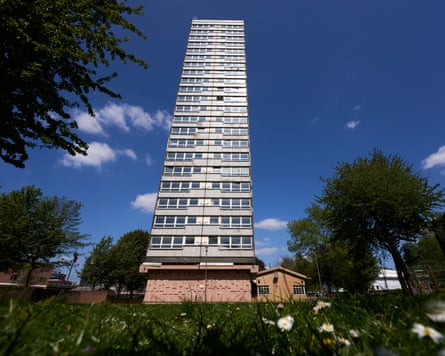
Correction: make that knew, and ex-neighbours. Because today outside Fabikun’s flat on the landing it is neither cosy nor homely. It is cold, echoey, dirty, the paint is peeling, and the entrances to the seven other flats on the floor have been closed off with steel security doors. Fabikun’s flat is the only occupied one on the fifth floor. And it is the same throughout the building. Of the 168 flats in Lund Point, only four still have residents.

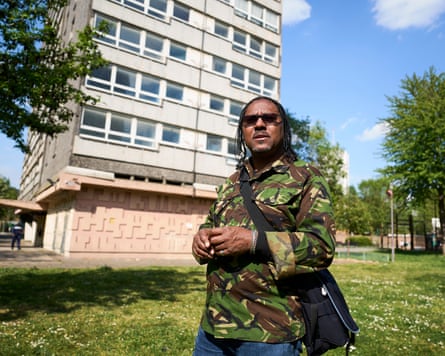
Warren Lubin lives on the 20th floor (one lift is working, thankfully). He says it is a mess at the moment, so he’ll come down to Fabikun’s. They moved into the building around the same time, in 1997, and have been friends ever since.
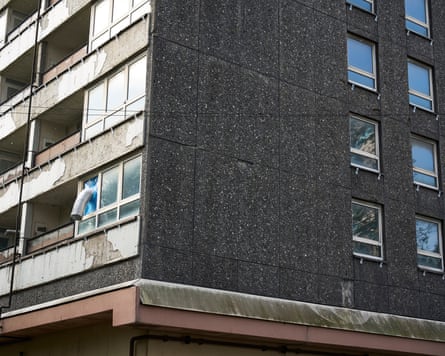
From outside, it is hard to believe anyone lives in Lund Point. Rubbish-filled supermarket trolleys have been dumped at the entrance. The tower itself is grubby and shabby, some cladding is missing, a couple of windows look broken. There is netting over most of the balconies, to stop the pigeons getting in – though they still do, says Lubin. Rats too. He doesn’t have netting – the council told him it doesn’t do that any more. So he has pigeons nesting on his balcony, and kestrels after the nestlings; he doesn’t mind the kestrels. Nor does he mind the 20-floor views. “It’s one of the reasons I’ve liked living here, the afternoon sun, the view facing westwards of London. Canary Wharf, the City, on a clear day all the way to the Wembley Arch.”
But Lubin isn’t a massive fan of tower block living. He didn’t get to know many people when he moved in, in his 20s, instead keeping to himself. “I don’t know why people think we want to live in towers, or that they make communities. They don’t. It can be quite insular. People talk over the fence – that’s how they get to know their neighbours.” Later he got involved with various residents’ organisations and steering groups (he’s a tenant, Fabikun’s a leaseholder) and through their dealings with Newham council, Lubin became something of a spokesperson for the estate.
Fabikun, on the other hand, has always been happy in Lund Point. “I knew everyone. If you got into the lift with someone you didn’t know, by the time you got out you knew each other.”
Isn’t it scary, and lonely, rattling around in this nearly empty tower? Lubin says at least it means he can blast out his music as loud as he wants. Fabikun says she still feels safe. “It’s been my home for so many years, I love it. And once you’re inside your own flat, you don’t know what’s going on outside.”
It’s true: sitting in Fabikun’s home, watching her watering her plants, you wouldn’t know that we were in a largely empty building. Or at the centre of what Chris Bailey of the campaign organisation Action on Empty Homes describes as “a scandal, an example of everything that’s wrong with estate regeneration”.
In order to understand how Fabikun and Lubin got to this sorry place, it is necessary to look back at the history of the Carpenters estate, which began before Fabikun arrived from Nigeria, and before Lubin was born. Built in 1967-8 by Newham council as part of the postwar expansion of council housing, the 9.3-hectare (23-acre) estate consisted of three tower blocks – Dennison Point, James Riley Point and Lund Point – as well as low-rise housing: 710 homes in all. There was some apprehension about the towers, says Prof Paul Watt, of the London School of Economics and Political Science, and author of Estate Regeneration and Its Discontents: Public Housing, Place and Inequality in London, “particularly after the partial collapse of the Ronan Point tower in the same borough in 1968. But it was better than living in privately rented, overcrowded, slum-like conditions.” Which is what most of the new residents had come from.
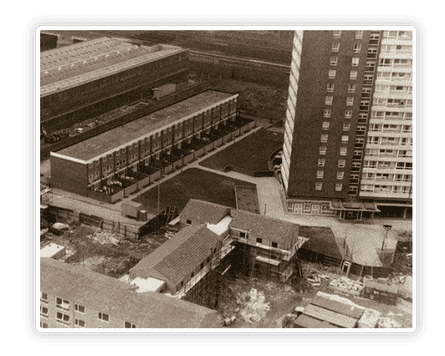
Little council housing maintenance was carried out between 1979 and 1997, and the incoming Blair government inherited a £19bn backlog in council housing repairs. At the Carpenters, Watt says, “there was a lot of criticism coming from tenants about the condition of the properties.” That was Lubin’s experience; he moved in around then and found there was no insulation on the outside wall and his flat was freezing.
“From 2004 onwards, the council begins this long-running ‘regeneration’ programme for the Carpenters, which goes through various iterations,” says Watt. It was to be refurbished and redeveloped, then that was going to be too expensive and the towers were to be demolished; the process of emptying them began.
Something else happened in 2005: London was awarded the 2012 Olympics, to be largely held in Stratford. The whole area was going to be developed and this land was suddenly going to be seriously valuable real estate. In 2011, Newham council entered into a deal with University College London (UCL) to build a new campus on the site, which would mean the total demolition of the Carpenters estate. Eighty per cent of the footprint would be used for UCL, the remaining 20% for rehousing the existing population, according to Watt. Understandably, residents wondered how they were going to fit into a fifth of the area they had previously occupied. They formed a campaign group, Carpenters Against Regeneration Plans (CARP), to push back and fight the demolition of their homes.
It was, says Watt, essentially an attempt at “a form of state-led gentrification, displacing working-class tenants”. And he points out the irony that the term “gentrification” was coined by the sociologist Ruth Glass while working at UCL.
Watt says that while the estate had its issues, including poverty and deprivation, “that’s pretty widespread among social housing in the country. And often the negative reputation of an estate – that it’s this terrible place to live, we’re going to take you out of your misery – doesn’t reflect people’s day-to-day reality.”
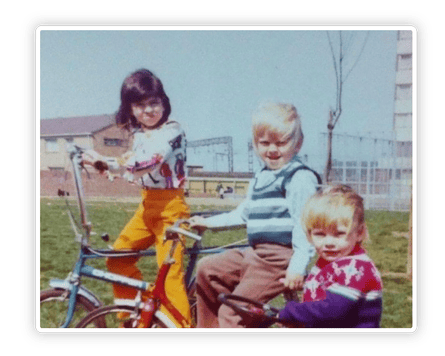
“It was a beautiful community,” says Fabikun. “We were our brothers’ keepers.” She tells me about a single mother who had triplets, “and all the grannies came together, made a rota, made sure the lady was supported throughout. It was not a question of: it’s a black woman, a white woman – everyone came together. If someone was ill the people would check on them, take them food. We were very mixed, but we didn’t fight, there were no gangs or gang wars.”
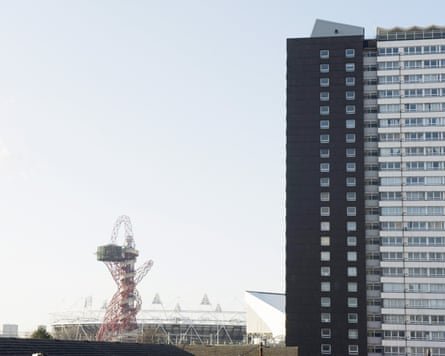
In the beautiful new stadium, a stone’s throw from the Carpenters, the London Olympics opened with a celebration of everything that is great about Britain, including protest and dissent. The BBC set up on Lund Point’s roof for the Games, while beneath it the building – and the surrounding ones – continued to deteriorate and empty. Watt’s 2013 study on the effects of the Olympics on regeneration in east London noted that more than half of the residents had been decanted from the Carpenters estate by September 2012.
“It wasn’t good: friends got separated,” says Fabikun. A lot of the younger people with children were willing to start again somewhere else and moved out. She’s still in touch with some who moved away, including the Bangladeshi family from her floor. The little girl who used to come for homework help is now married.
Fabikun, now 77, said she doesn’t want to start again. “It’s best to be where I feel comfortable and I know people.” They offered to buy her out. “I said, ‘I can’t buy anything in this area for that.’ They said, ‘Go to Southend.’ I don’t know anyone in Southend. If I’d wanted to live in Southend I would have done so when I was young so I could go to the beach.”
“It’s a big area of contention,” adds Lubin. “If you’re decanting people and giving them the right to return, that might be in 10 years, 15 years. They’ll have new lives.”
Managed decline
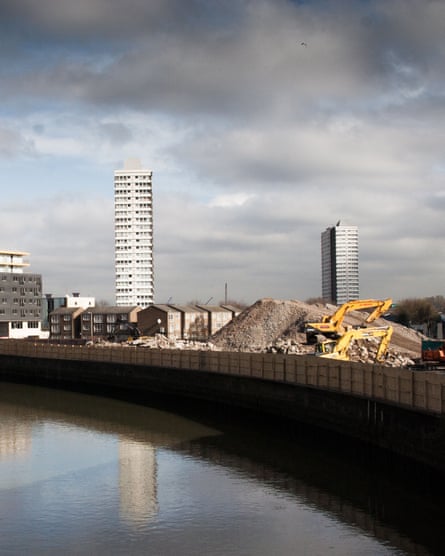
Watt says estate regeneration involves, in reality, deterioration before anything new is built. “It’s managed decline: existing services go down, neighbours move out, you get empty properties, they become worse-looking. The irony of these long-running regeneration schemes is the estates wind up looking much more like the sink estates they were unjustly accused of being.” At Lund Point you can see what he’s talking about.
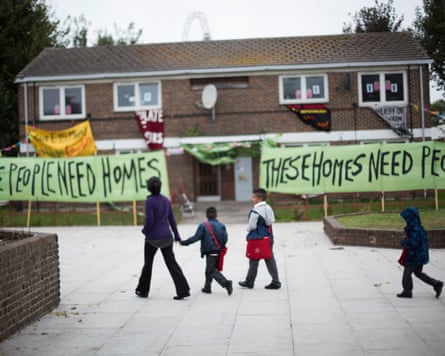
UCL pulled out of the deal after the two parties failed to reach a commercial agreement, and Newham started seeking alternatives. The Carpenters hit the headlines in 2014, when the group Focus E15 occupied a low-rise property on the estate. Twenty-nine homeless single mums had been kicked out of their hostel and told by Newham council they would have to go to Birmingham or Manchester to be rehoused. When they found out there were about 500 empty homes at the Carpenters, they moved in.
“It was outrageous what they were trying to do to vulnerable homeless young women,” says Hannah Caller, who helped organise the occupation and continues to campaign on housing. “This seemed like a good way to show the council up. I think we shone a spotlight on the fact that they were trying to socially cleanse people from Newham – as were boroughs all round London, but Newham had one of the highest rates of chucking people out.”
The occupation certainly got a lot of media attention. Watt says it was “probably the single most catalysing incident in relation to the London housing crisis”. It is a crisis everywhere but it is really bad in the capital. Chris Bailey, director of policy and campaigns at the charity Action on Empty Homes, says that there are more than a million empty homes in England alone, a figure that includes holiday lets, second homes, investment homes etc – a whole other (though connected) issue. The current figure for long-term empty homes in England is 303,185, which is up 51.5% since 2016. In London it’s 47,287, up 138%.
London is the centre of the crisis. “People don’t like talking about it because it’s not fashionable for London to be a place full of poor people,” says Bailey. “Everyone’s always moaning that it gets more transport investment, all that kind of thing, but nearly 60% of homeless families in England are Londoners.”
According to the most recent figures, there are 34,635 empty council homes (long- and short-term) in England, of which nearly 11,000 are in London. Plus another 6,803 housing association homes. In terms of households looking for somewhere to live, there were 1,340,000 for England in 2025 and 341,000 for London. In Newham, incidentally, 41,223 households are looking for somewhere to live. You can see the scale of the crisis.
It is all going to be OK, though, isn’t it, because the government is investing £39bn on building, to boost social and affordable housing? “That’s over 10 years,” Bailey points out. “Shelter says to rebalance our housing economy we need to build 90,000 social homes a year. The government is offering 18,000 a year, so in five years they will have what Shelter says they should have built in the first year, and a four-year shortfall.”
The Carpenters, Bailey says, is one of many examples, “where they decided the time was ready to knock it down and started asking people to leave, finding them new places, offering to buy them out and then it hasn’t happened, because there have been breakdowns in plans, in government funding, inaction by the local authority.”
His assessment of the situation at the Carpenters is blunt: “It’s an awful lot of housing to keep intentionally empty when you’re, frankly, pissing away vast amounts of public money to private landlords on keeping people in really shit accommodation, which is going to diminish the educational achievements of the children and cost us all more as a society in future – as a direct result of the fact that you’re taking social housing out of use.”
A Newham council spokesperson said: “By their nature estate regeneration schemes are long-term and complex. Existing residents rightly feel strongly about the kind of change they want to see in their area, and since 2021 the council has worked closely with them to develop the current masterplan which reflects these aspirations. At the same time, in common with the wider development sector, the programme has faced external shocks and pressures which have impacted on pace of delivery.”
In Newham, nearly 6% of households are in temporary accommodation, a figure that now includes Fabikun and Lubin. In November, residents of Lund Point were given hotel accommodation in a Stratford B&B. “They’re now saying the building is structurally unsafe to get me out,” says Lubin. Which doesn’t make any sense, because if it is, why are they allowed in at all? Anyway, he still stays in Lund Point most of the time and still pays rent – it is still his home. Plus he hates the hotel. “Just looking at the same four walls.”
Fabikun does go to the hotel, not because she wants to – she also doesn’t like it, and is fed up with the same breakfast every day – but because she no longer has hot water in her flat. She comes to Lund Point every day, to be at home, and to work in the food bank she still runs on the estate, but at night she goes to the hotel. She was offered a place on the other side of the high street, “but it had no toilet downstairs. I said: ‘I’m an old woman, I need to go to the loo often, you want me to be going up and down stairs so I could fall and break my neck.’”
We’re outside the building now. Fabikun has to go to the food bank for a delivery. Lubin takes me on a wander, past the pub, now only busy when West Ham play at home. In the central square he points out the building that was occupied by the Focus E15 women. It is currently occupied, he thinks, used as temporary accommodation, but a lot of the other low-rise buildings are boarded up.
Stratford transformed
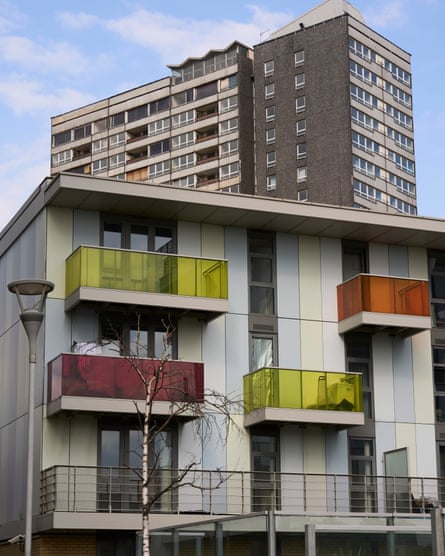
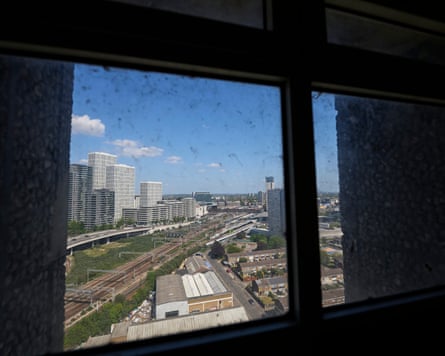
The estate feels tired, forgotten. More so when you look up at everything that has happened all around it. Since getting the Olympics, Stratford – once partly an area of marshy wasteland – has been transformed beyond recognition. As well as everything connected to the 2012 Games – the London Stadium, Zaha Hadid’s manta ray aquatic centre, Anish Kapoor’s twisty slide – there’s the vast Westfield mall. Fancy the ballet? Sadler’s Wells is just over there. Or something to eat? Try the beef wellington at Gordon Ramsay’s Bread Street, £125 (for two). And don’t forget the excellent high-speed transport links.
The starkest contrast of all is with the six or seven shiny glass and steel towers that surround the estate, pointing skywards menacingly, like a circle of well manicured middle fingers pointing inwards. Screw you, poor people.
There is a plan – a £1.5bn regeneration plan for the Carpenters estate. It’s for Newham-owned Populo Living to create 2,300 new homes – 50% of them at an “affordable” social rent, meaning half of the full rent – through both new buildings and retrofitting existing ones. Two of the towers, including Lund Point, will survive, but will get some serious cosmetic surgery. The difference between this plan and previous ones is that it is under way; James Riley Point, the other tower that will remain standing, has been fenced off and work to strip it down to its bare bones has begun (all residents having been moved out).
I’m looking at a big artist’s impression of how it should turn out with Lubin. It looks pretty good, more in keeping with the surroundings, perhaps. And in 2021, 73% of the (remaining) residents voted in favour of the redevelopment. Not Lubin. “I’ve always objected to it. I don’t like the numbers: 2,300 homes on 23 acres of land. You wouldn’t put that many cattle on 23 acres, there are laws about how many chickens you can put in a cage, but we don’t say how many people you can squeeze into an area. Just because you go up higher and higher doesn’t make it OK.”
He doesn’t know, hasn’t been told, how he fits in the plan. He’ll have to finally move out, but where to, or whether he’ll have the right to return, he doesn’t know. And there’s the uncertainty about the timescale, how long this is all going to take. “Well into the 2030s,” says Populo. Is that 10 years? Fifteen years? Fabikun’s going to be in her 90s.
That’s one of the biggest parts of the scandal Bailey was talking about: that a regeneration that supposedly began around 2004 took 20 years for anything to happen and might go on for another 15 years or more. By which time many of the people waiting won’t be around.
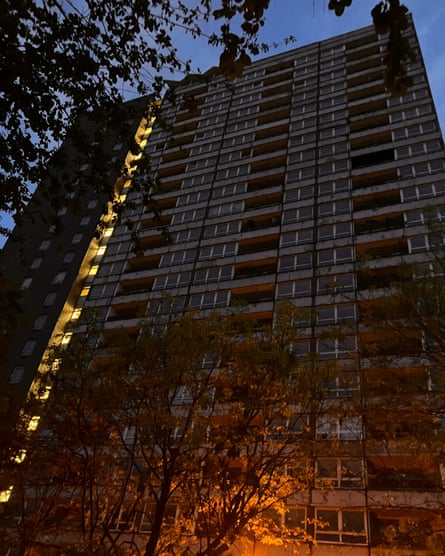
After dark on the Carpenters estate the contrast with the surroundings is even starker. Coming from the station, with all those brightly lit towers, the Carpenters is almost invisible; it’s like approaching a black hole.
A fox dashes across the central square, otherwise there’s no life on the street. But there are lights on in one window. Lubin was right: the house occupied by 29 homeless single mums 14 years ago is occupied again, even if it’s only temporary. James Riley Point, the tower on which work has begun, does have one light on, worryingly, about half way … did someone get left behind?
And finally Lund Point, looming out of the night sky. On Fabikun’s side the staircase lights are on, but nothing else. I didn’t expect her to be in. Going round to the other side, I’m hoping for one light at least, on the 20th floor, loud music blasting out … but again it’s dark, and silent. Shame: maybe Lubin would have tidied up and invited me in, for the night views looking west over London.
I’ll have to make do with my own music. Walking back to the station I put a tune on my headphones, the Specials: This town, is coming like a ghost town ….