








Willie Mae “Big Mama” Thornton exuded uncompromising intensity. Her voice conveyed struggle and defiance, fury and hurt, like few others. Standing at 6ft 2in, with an imposing physique and a razor-scarred face, she was a Black, gay multi-instrumentalist who refused to let a racist society or a rapacious industry confine her.
Thornton should be ranked alongside the likes of Billie Holiday and Nina Simone, but instead she is little more than a footnote in the histories of Elvis Presley and Janis Joplin as the original voice behind songs they would make famous. A new documentary, Big Mama Thornton: I Can’t Be Anyone But Me, aims to right this wrong.
“She was unique,” says Robert Clem, the documentary’s director. “A female artist who lived by her own rules in a very reactionary era. And fearless – she stood up to men who tried to rip her off, sang in maximum security prisons, learned to play drums because she got tired of drunk drummers. There’s so much to admire about Big Mama.”
Thornton’s death in 1984, at 57, was barely noted, perhaps because, in the eyes of the music industry, she was a one-hit wonder. Hound Dog would later be defined by Elvis, but it was written for Thornton and she topped the R&B charts with it in 1953 – then never had any further commercial success. This year is the centenary of her birth and Clem thinks it’s time for Big Mama’s resurrection. Even he, having grown up in her native Alabama, didn’t know her music until he immersed himself in the era for his 2018 gospel documentary How They Got Over. “Willie Mae died too soon,” he says. “If she had lived longer, she would have got a new audience.”
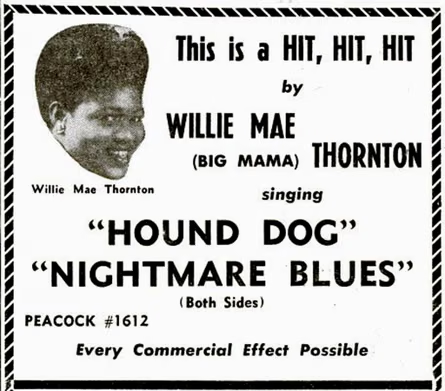
Thornton was born in 1926 in Alabama. Her mother died when she was three; her preacher father transported his children by horse and cart as he sought out congregations. Thornton had a piecemeal education that ended when she was 12 and forced to seek work, initially cleaning bars, then collecting refuse on garbage trucks. Aged 14, she was overheard singing while she worked by blues singer “Diamond Teeth” Mary McClain. She began performing alongside comedians, dancers and musicians in the touring Hot Harlem Revue, which featured predominantly gay and lesbian performers (a young Little Richard, born Richard Penniman, also cut his teeth here). This suited Thornton, who preferred menswear and never hid her sexuality, yet the revue paid so poorly she had to shine shoes prior to performances.
Settling in Houston, Texas, in 1948, Thornton attracted the attention of Don Robey, a pioneering African American entrepreneur (and gangster) who owned Duke and Peacock Records. He signed her in 1950 and, when the Johnny Otis Orchestra came to town, Robey suggested Otis recruit Thornton. Otis, a Greek American bandleader dedicated to championing Black musicians, gave her the “Big Mama” stage name, and asked aspiring songwriters Mike Stoller and Jerry Leiber to write a song for her. “She looked like the biggest, baddest, saltiest chick you would ever see,” Stoller said.
They wrote Hound Dog, and Thornton’s recording duly topped the Billboard R&B chart for nearly two months. Robey kept Thornton singing animal-themed comedy songs, which failed to chart: she would claim $500 (£370) was the only payment Robey gave her for Hound Dog. (Leiber and Stoller also weren’t paid; Robey was renowned for fleecing writers.) Later, she recalled ringing Robey and asking for $50 (£37) to stop her car from being repossessed – he refused to help, her car was taken and Thornton was again forced to shine shoes outside the clubs she sang in.
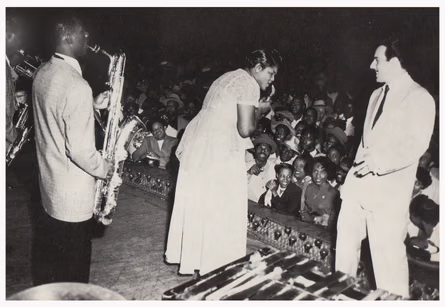
Those hardships are etched in her voice, says Black British blues singer Dawnette Fessey: “She has a punch – the rawness in her voice. There’s real nuance and real pain. She’s fearless, a survivor. She lost her mother when she was young, as I did, and that is a challenge, one that toughens you up.”
Thornton then had to endure seeing Elvis’s huge success with Hound Dog: his bowdlerised 1956 version spent 11 weeks at No 1, and she held a lifelong grudge towards Presley. “I never got a dime,” she said in 1968 when asked if he had shown any largesse towards her. “He refused to play with me when he first come out and got famous.”
As Presley’s fortunes soared, hers faltered: by 1960, Thornton was performing as a one-woman band in bars in Oakland, California, singing while playing drums and blowing harmonica. But word got out to white jazz and blues fans in the Bay Area; eminent music journalist Ralph Gleason ensured she performed at 1964’s Monterey jazz festival, while Chris Strachwitz, founder of Arhoolie Records, located Thornton playing poker in a park – he recalled she kept a loaded pistol on the table in case anyone tried to cheat her – and persuaded her to join the American Folk Blues festival’s 1965 European tour.
Here, she shared the stage with Buddy Guy and John Lee Hooker, and captivated audiences. “We make a bigger hit over there in Europe,” Thornton told historian Studs Terkel in a 1970 interview. Her then manager Jim Moore would recall: “You really couldn’t believe the reception. Big Mama cried, really cried.” So potent were Thornton’s performances, that Strachwitz recorded her in London. Released in 1966 as In Europe, her debut album is masterly, as is 1967’s Big Mama Thornton With the Muddy Waters Blues Band.
“She didn’t suffer any fools,” says 82-year-old Memphis blues musician Charlie Musselwhite, who regularly toured with Thornton. Musselwhite tells me how Thornton, once you won her trust, could be warm and kind. “She would invite me to her room and we’d drink and talk – she was intelligent, nice. She was also happy being a loner – I only remember her being with a girlfriend once.”
Like many blues musicians, Thornton relied on alcohol. “Mama always had a bottle of Old Grand-Dad, and she and I would take snorts along the way,” says Musselwhite. “She liked to drink and drive – which could be terrifying – but we always got to the motel in one piece.”
Janis Joplin regularly attended Big Mama’s Bay Area performances. Having requested her permission to record Ball and Chain, a song Thornton had written but not yet released (“don’t fuck it up”, was Thornton’s advice to the young singer), Joplin sang it as a psych-rock howl of frustration on Cheap Thrills, Big Brother and the Holding Company’s chart-topping 1968 album. Joplin, who regularly championed Thornton on stage and in interviews, ensured she received royalties. “When I got a check for Ball and Chain off Janis, I got a ball and chain off me,” said Thornton.
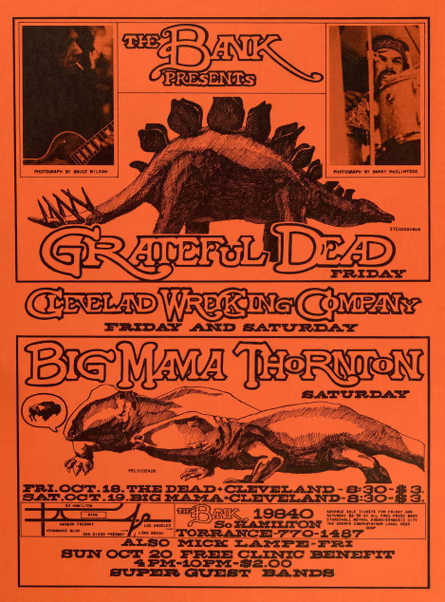
The Joplin connection also won Thornton a huge hippy audience: Bill Graham regularly booked her to play Haight-Ashbury’s Fillmore theatre and she appeared at rock festivals, backed by members of the Grateful Dead on occasion. On YouTube, there’s a 1971 concert in Eugene, Oregon, where Big Mama, trim and self-assured, commands an appreciative audience of hirsute white youths. While Thornton enjoyed the spotlight, her confrontational manner – this included punching promoters and musicians who demeaned or didn’t pay her – meant she often self-sabotaged; and Clem’s film details her rejecting work offers from the likes of Duke Ellington and George Benson.
“She was a really obstinate person,” says Clem. “She dismissed Duke as ‘not blues’. John Hammond called her the greatest blues singer since Bessie Smith but, again, they came to loggerheads and couldn’t work together. She hurt her career through actions like this – she also split from manager James Moore to take up with former boxing champion Archie Moore. James sued her and won.”
From 1970 on, Thornton lived on the road; recording only occasionally, shuttling between boarding houses and sofa-surfing, whiskey her constant companion. A car crash in 1976 hospitalised her for several months. Interviewers regularly asked if she resented not earning a fortune like her famous disciples. Elvis, she once replied, “is making a million. I’m making a zillion nothing, you understand? But I’m still living. Gonna keep living.”
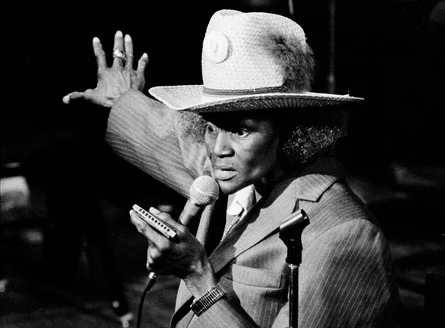
Aretha Franklin invited Thornton on to her 1980 TV special and they duetted on Bessie Smith’s Nobody Knows You When You’re Down and Out. Here, Big Mama is no longer “big” – while it went unmentioned, cancer was stripping her bulk. Clem’s film features her final performance on 14 April 1984; Thornton is now skeletal, yet continues to sing with conviction while, dressed in cowboy boots, a man’s suit and a huge Stetson hat, she swaggers across the stage. Dying alone, Thornton was buried in a shared pauper’s grave.
Sad as this ending is, Thornton is now being celebrated by generations of Black female singers. Jazz vocalist Dee Dee Bridgewater tells me she was inspired by Thornton as a child, as “she was Black and beautiful and strong”. Valerie June says: “I certainly see her as an ancestor. Last summer I had the opportunity to go to Willie Mae Rock Camp for Girls in Austin, Texas, and to work with students there. It’s organised by LaFrae Ski, a drummer, and she’s doing this wonderful thing teaching girls instruments in Big Mama’s name.”
Thornton’s pride, musicianship, courage and determination to go her own way are what should define her. “Blues was music made by people who came from the very bottom of American society,” says Clem. “There are not a lot of Buddy Guys out there living long, well-remunerated lives. I hope my film helps get her some recognition, at least.”