






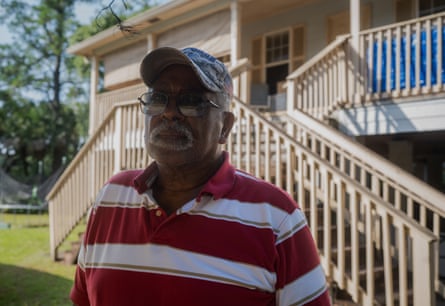
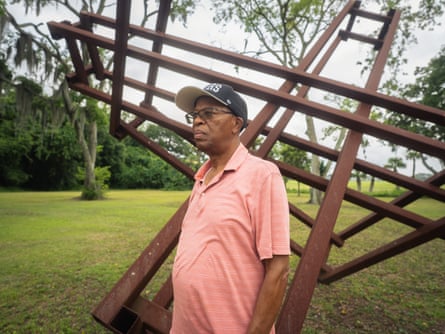
On Arthur Champen’s half-acre property in Hilton Head Island, South Carolina, a thicket of southern live oaks, palmettos and pine trees muffle the roar of cars on nearby highway 278. His haint blue house, lightened by the sun, sits on stilts to protect it from flooding that comes with the high tide. During the spring, it is common for the marshland adjacent to his land to turn into a muddy soup. “Other than the cars,” Champen, 81, said, “you hear how peaceful it is?”
About a decade ago, Champen’s family nearly lost the grassy marshland next door that their family bought several generations ago.
In 1892, Champen’s great-great-grandparents, civil war veteran Richard White and his wife, Amelia, bought 24.2 hectares (60 acres) of land for $600. For nearly a century, the land was heirs’ property – family-owned land passed through generations usually without a will – until Champen’s grand uncle hired a surveyor and divided a portion of the land between the Whites’ descendants in 1983. More than 10 family members remain on about 4 hectares (10 acres) of land, while a few sold their shares. For Gullah Geechee people, the descendants of formerly enslaved West Africans who remained in the islands of the south-eastern US and retained their distinct culture and customs, it is common to live among several generations of family on a compound.
Champen peered out at marshland that remains heirs’ property because severe flooding rendered it unusable. For several generations, the nearly 16 hectares (40 acres) were farmed for corn, cotton and potatoes that were sold at the market. That was until a hurricane hit the area in 1940, causing $9.9m of property and crop damage throughout South Carolina.
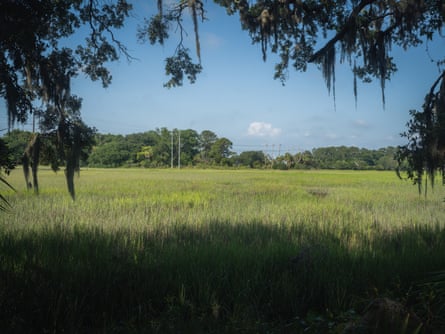
The family wasn’t clear on who would pay the property taxes after some members moved away or died. It went up for delinquent tax sale, an annual auction held by the Beaufort county treasurer’s office, where a defaulting taxpayer’s property is sold. They contacted the non-profit Pan-African Family Empowerment and Land Preservation Network (PAFEN), which helped them pay the bill so that they could retain their land. Although his family doesn’t use the marshland, Champen doesn’t want to sell it. “It’s part of our heritage,” he said.
While Champen’s family kept their land, many Gullah people in the coastal counties of South Carolina and Georgia aren’t as fortunate. Throughout Beaufort county, South Carolina – which includes Hilton Head Island, St Helena Island and the city of Beaufort – Gullah property ownership has been threatened in myriad ways, with delinquent taxes rising to the top of the list. Issues related to clouded or tangled titles, which are heirs’ properties without the current owners’ names on the deeds, family disputes, predatory development, gentrification and the climate crisis are also contributing factors in land loss. The loss of property can be seen in the dwindling Gullah Geechee population: in 1940, most of Hilton Head’s 1,100 residents were the descendants of freedmen, while in 2020, only 6% of the island’s population was Black, down from 8% in 2000.
In Beaufort county, it is impossible to say how many Gullah Geechee people have lost their homes in recent years, said Josh Walden, the chief of operations at Center for Heirs’ Property. It would require significant research and money to go through partition actions in civil courts and to figure out which ones were owned by Gullah Geechee families. A study from Auburn University in the Journal of Rural Social Sciences showed that there were more than 41,000 heirs’ properties throughout South Carolina that totalled more than 167,500 hectares (414,000 acres) and was worth more than $3.42b in market value in 2019.
Beaufort county treasurer’s office data showed that the amount of properties sold at the annual auction for delinquent taxes on St Helena Island has largely remained the same, despite an increase of properties that had fallen behind in their payments. Between 2019 and 2023, 38 properties were officially sold after the previous year’s auction on St Helena Island. During that same period on Hilton Head Island, 19 properties were sold at the delinquent tax sale. While the average amount of taxes owed on either island was no more than $700, it can reach up to more than $4,000, which can be difficult for older Gullah people on fixed incomes to pay. And when multiple people have claim to an heirs’ property, it is sometimes unclear who will pay for the taxes, and the bills are overlooked.
Maria Walls, Beaufort county’s treasurer, said she was unaware how many heirs’ properties were represented in the data. But she said the county had worked to minimize Gullah land loss by creating an online payment platform to streamline the payment process and by partnering with local advocacy groups such as the Lowcountry Gullah Foundation.
Based on observations from their advocacy work in South Carolina, Luana Graves Sellars, the founder of Lowcountry Gullah Foundation, and Theresa White, PAFEN’s CEO and founder, say that Hilton Head has experienced the greatest amount of Gullah Geechee land loss of all of the state’s sea islands due to its popularity. St Helena Island, 45 miles east of Hilton Head, has also experienced significant loss. Between 2015 and 2021, White said, her organization spent more than $160,000 paying Gullah people’s property taxes in Hilton Head and St Helena islands. In 2024 alone, Graves Sellars said her organization spent more than $38,000 saving 10.2 hectares (25.4 acres) of historical land in Beaufort county, with 59% of the properties in the city of Beaufort and 35% in Hilton Head.
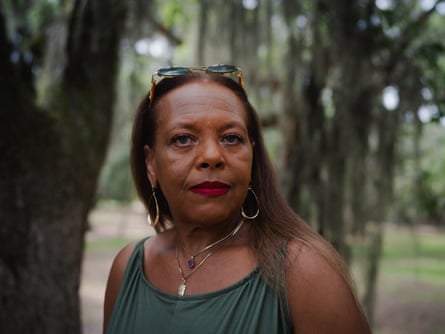
Dozens of interviews with Gullah residents, attorneys, organizers, non-profit heads, city and state leaders, and environmental advocacy groups reveal that land loss poses an existential threat to the Gullah community. Champen would like the state government to compensate his family and others’ for what they lost on the unusable marshland that they continue to pay taxes on. Others who lost or were at risk of losing their family homes said they would like the property taxes to be reduced for heirs’ properties. Ultimately, residents and their advocates have addressed the crisis by banding together to pay off each other’s property taxes, educating one another on estate planning and tax-payment plans, and applying pressure on state and local officials to make it easier for Gullah people to stay in their homes.
“There’s been a renewed emphasis now on Black people helping each other, because of all the stuff that Trump and them are doing and all the discrimination that’s going on,” White said. “People are realizing that they might have to come back here to live on the property that their families have owned.”
‘A big, unwieldy problem’
As he leaned on a tangled grape vine on his property, Champen recalled climbing up the spindly plant as a child and eating its grapes. In the decades since growing up in the historically Gullah neighborhood of Stoney, Champen said the area had significantly changed. The nearby highway has expanded from two to six lanes, and some of the Gullah people in the area have died or moved away. Still, he wants his way of life to be passed on to future generations.
“My hope is that my children and grandchildren will continue to keep the property, but you never know,” Champen said, adding that youth often choose to live in the city when they mature.
The trend of people moving away is partially reflected in the Lowcountry Gullah Foundation’s survey of heirs’ properties. According to Graves Sellars’ count, Gullah land ownership decreased from 1,400 hectares (3,500 acres) before 1956, when the first bridge connected Hilton Head to the mainland, to 390 hectares (963 acres) in 2023.
On Hilton Head and St Helena during the civil war, the Union army occupied the area, resulting in white residents fleeing and enslaved Black people in the area becoming free before the emancipation proclamation.
Gullah people were given land on the sea islands because it was once considered undesirable, said Graves Sellars. “No one wanted to live here because it was too hot, it was too humid, it was too bug-infested,” she said. “The government was just like, ‘Well, the enslaved people are already there. So, let’s just give them that land, because nobody really wants it anyway.’”
Due to their remoteness, Gullah people had difficulty accessing probate courts, so the owners would often die without a will. As a result, the state’s estate laws required that the properties’ interests be divided between surviving spouses and their children. As families grew further from the original certificate holder, the amount of people who held interests in the land multiplied. “What you have over time is a geometrically increasing problem,” said South Carolina Senator Tom Davis, “with, in some cases, hundreds of heirs having an interest in real property.”
Hilton Head and St Helena remained mostly inhabited by Gullah people for nearly a century until bridges erected in the early to mid-20th century made them accessible to vehicle traffic. Developers followed soon thereafter.
Walden, of the Center for Heirs’ Property, said his Gullah clients had shared that their families began leaving their land beginning with the great migration in 1910. During that time, Black people fled the south in droves to escape racial violence, settling in the north-east, mid-west and the west.
“The great migration led to, not only the sale or forced sale of land, people leaving and selling because they were in fear for their life,” said Walden, “but it also made the property vulnerable because the majority of the family left, and maybe it just lay fallow, or maybe one person stayed there, and when they died, it was lost.” As development began to rise in the 1970s and 80s, waterfront properties were assessed for higher values and property taxes increased, said Davis.
Heirs’ properties are also vulnerable to predatory developers. Tenants-in-common ownership, which is when more than one person owns a property, causes issues when one owner sells their part of the land to a developer and the developer sues the other co-owners in a forced sale to assume full ownership.
For one Gullah family, an out-of-state relative who had no interest in the South Carolina property triggered the loss of more than 8 hectares (20 acres) of ancestral land. Long before the family lost the communal land, Herbert Ford’s great-great-grandparents had bought the Hilton Head property in the early 1900s. But since it was heirs’ property without a living owner on the title, a relative in New York who had partial interest in the land sold his portion to the town and a developer in the late 2010s. As a result of the tangled title, the family members who remained on the ancestral land were forced to sell their remaining portion.
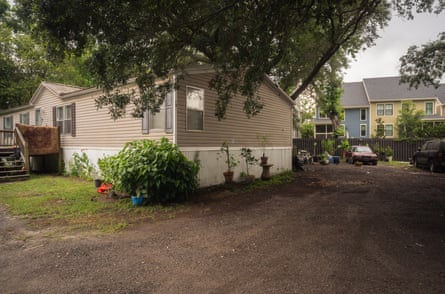
In late March 2025, Ford, a fifth-generation Hilton Head resident who is Gullah, drove to the entrance of the 8-hectare (20-acre) property that the out-of-state relative sold to the developer James Moore in 2018. It is now a subdivision called Old Stoney Village with large town homes worth half a million dollars. As part of an agreement with the developer, 0.8 hectares (2 acres) next door were set aside for the remaining family members. A gray fence separates the village from his family compound, a stark dividing line between the new wealthy residents and the former inhabitants who reside in about 10 mobile homes.
While the sale didn’t personally affect Ford since he lived on his own property, the 73-year-old was upset on his family’s behalf.
“I don’t think the entire family should be penalized because one or two persons decide they want to sell their particular interest. And if that means the developer can’t do anything with that small interest, then don’t purchase it,” Ford said as he sat in his truck, overlooking the highway. “Allow it to remain in the family and allow the family to take advantage of it.”
In 2016, South Carolina’s general assembly passed the Clementa C Pinckney Uniform Partition of Heirs’ Property Act to help prevent the loss of heirs’ property by allowing co-owners the option to buy out other co-owners who no longer want their share of the land. Walden sees the mechanism as beneficial when families have the resources to pay, but co-owners don’t always have the funds to buy out their co-owners, which can lead to predatory development. “If I’m a developer and I find one of those 30 heirs,” Walden said, “I can purchase the interest of one of those heirs, and then I fall into that tenancy in common group, and I have the ability to force a sale of the property the same way any of the heirs would.”
If family members are unable to buy out their co-owners, the act also allows courts to consider family legacy when deciding whether to divide up the property so that those who want to keep their interests can retain their shares. If the court does not order the property to be divided, then the land must be sold at market value with all co-owners receiving proportionate proceeds from the sale.
In 2022, the South Carolina general assembly produced a list of recommendations to further protect heirs’ properties. One of the suggestions included a commission consisting of attorneys, members of local government and non-profits to address the economic and legal concerns of heirs’ properties. The following year, legislators introduced a bill to create the Heirs’ Property Commission to do just that, though the bill stalled in a House committee. Another House bill proposed last year would allow heirs to claim a deceased family member’s property to prevent it from being sold at a tax sale, though it has not seen any movement.
In perhaps the most promising development, House members passed a bill in April that would prohibit counties from reassessing property values and potentially increasing the real estate taxes when heirs clear property titles. The bill is now working its way through the legislature.
The climate crisis also poses a threat to Gullah land ownership, say environmental advocacy groups. Documented increased sea-level rising in recent years has made some land uninhabitable, according to Jenny Brennan, a Southern Environmental Law Center climate analyst. And studies show that future increases in flood risks are expected to disproportionately impact Black communities in the south. “So many of these communities are in really low-lying coastal areas that flooding is either getting directly into people’s homes, or causing problems where you can’t get in and out of your home reliably, or you can’t grow vegetables or have a garden in the same place because that’s now salty,” Brennan said.
Communities also aren’t able to use their septic tanks for portions of the year due to increased flooding. “These are real problems that people are having to deal with on top of these other big threats from increased development and more and more people moving to the area; it’s really layering on to what was already going to be a big, unwieldy problem to deal with,” Brennan said.
Eminent domain, the power of the government to seize private property, is another problem that causes land loss, said Faith Rivers James, the former executive director of Coastal Conservation League. When officials determine the sites for highways and road expansions, “they often go to the areas which they say are of lower economic value,” James said. “And more often than not, those roads run through Gullah Geechee communities, be they rural or in downtown.”
‘They’re losing history’
In the city of Beaufort, about 35 miles north of Hilton Head Island, 69-year-old Anita Singleton Prather recalled the communal nature of growing up in the Northwest Quadrant neighborhood among her extended family and other Gullah people in the 1960s. On Saturday mornings, she and her best friend would talk in their adjoining yards. Across the street was a football field where children played and she learned how to braid hair by practising with the long grass. Everyone she knew was Gullah.
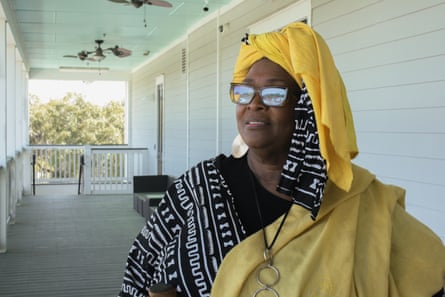
Now, Singleton Prather is the founder and artistic director of the Gullah Kinfolk Traveling Theater, where she preserves and promotes Gullah Geechee heritage through storytelling, musical theater, workshops and tours. The Northwest Quadrant, where she still lives and works, was the freedman’s village during Reconstruction. “We were the first to be free beginning after the civil war,” Singleton Prather said. “Unlike a lot of other places in the south, we became landowners.” But in recent decades, the area has drastically changed with gentrification. Now, the entire city is 67% white and 20% Black. She has watched her Gullah neighbors sell their properties in delinquent tax sales because they couldn’t afford to pay their property taxes.
Her family almost lost one of their heirs’ property homes in the Northwest Quadrant. One of her cousins neglected to pay the property taxes on a family home he lived in, and it was nearly sold at the delinquent tax sale multiple times. The first year, PAFEN paid more than $14,000 so that the family could keep the house. When her cousin didn’t pay the property taxes again a couple of years later, Singleton Prather’s friend gifted the family $15,000 to pay off the debt. Now, Singleton Prather and a few of her family members pitch in to pay the property taxes on the heirs’ property every year so that they don’t fall behind.
“A lot of times, as Black people, we don’t like to do wills, and that’s one of the first steps to decide who you’re going to will this property to, or specified in such a way to try to save it,” Singleton Prather said. Her mother learned from watching others lose their homes to heirs’ property issues and wrote a will where she divided all of her assets among her children before she died.
For those whose family didn’t teach them about estate planning, the Hilton Head Island-based organization Lowcountry Gullah Foundation hosts workshops with the Center for Heirs’ Property and the Beaufort county treasurer’s department. They educate people about how to ensure that their descendants gain legal access to their assets after their death. The organization also hosts free sessions with attorneys who help people write their wills in 45 minutes.
Most of the people whose property taxes Lowcountry Gullah Foundation helps cover are senior citizens on Hilton Head who often don’t learn that they have a tangled title until they face a crisis, said Graves Sellars. One person her organization has helped since it launched in 2019 was a 96-year-old woman whose deceased husband was the only person named on the deed of their Hilton Head Island home. After her husband’s death, her property taxes jumped from $440 to $2,200 a year due to reassessment and increased development in the area. That’s when the Lowcountry Gullah Foundation stepped in to help her keep her home by paying off the property taxes through donations.
When it comes to what causes a dwindling Gullah population on Hilton Head, Graves Sellars said heirs’ property issues were like the egg, “which leads to the omelette of land loss”.
Disagreements among family members about whether to sell or keep the land are common. It’s also expensive to hire a lawyer to solve tangled title issues, and sometimes Gullah people distrust the legal process. “The greatest hindrance to heirs’ property issues are fear of the unknown, fear of dealing with the legal system, fear of dealing with the government,” said Graves Sellars. “You have people who may not have ever dealt with an attorney. What I found is that there’s just a lack of information and resources that people get frustrated over. And essentially they just wash their hands and say, ‘I’m done. I can’t take it any more,’ and then they just kind of walk away from the situation.”
Along with paying property taxes and hosting workshops on writing wills, the Lowcountry Gullah Foundation also helps track down the heirs’ properties on Hilton Head that are on the delinquent tax sale list. The team goes door-to-door to inform people that their taxes are unpaid. It is particularly difficult to count heirs’ properties, since the county does not categorize properties as such.
Heirs’ property could be solved through changes in state law, said Walls, Beaufort county’s treasurer. A South Carolina law called the Bailey bill that provided property tax relief for historic properties, she said, could be used as a model to put a pause on heirs’ property taxes for five years. Taxpayers could then spend that money clearing the tangled title.
“Even at the macro level, as a county, as a community, we’re stronger when people own their property … How can we be a thriving community when the people who’ve been here the longest are losing their legacy, are losing their part of the community they’ve been in for so long?” Walls said. “They’re losing history; this is not a situation that anyone alive asked to be in, but I think there’s room for those of us who are here to come up with a solution.”
For Singleton Prather, the key to generational wealth-building and preserving Gullah history is in investing in youth. Last year, she created a six-week training program to teach 17- to 30-year-old Gullah people how to launch a career in the culinary arts or theater to carry on their cultural traditions.
In the future, she envisions paying off the house passed down from her mother and renovating it before she dies so that it remains in the family for a long time to come. “I want to set up some kind of an endowment,” she said, “so that the taxes will be taken care of, and it can produce generational wealth for my children and my children’s children.”