




“You’re not a man!” screams Cassie Howard in the latest episode of Euphoria, HBO’s hedonistic, no-longer-high-school drama. “Men provide.” Cassie, who is brilliantly played by the human discourse magnet Sydney Sweeney, is furious with her new husband, Nate Jacobs (Jacob Elordi). She’s just found out that Nate, the all-grown-up high school jock, has been borrowing huge sums of money to fund their luxury lifestyle. In the middle of their wedding reception – a soiree she now realises has been paid for using illicit means – she is loudly berating him as their guests awkwardly pretend not to hear.
The wedding of Cassie and Nate was, somewhat unconventionally, revealed months ahead of Euphoria’s third season by Sam Levinson, the show’s equally unconventional writer and creator. As expected, it was a cinematic and expensive-looking spectacle that descended into disaster. Yet for much of Euphoria’s first three episodes, I’ve been wondering what the show – now picking up five years after the last season, with the cast navigating their early 20s – is trying to say. Episode three, like its predecessors, continued a portrayal of women that feels both old-fashioned and eerily prescient, projecting a shallow, manosphere-inflected fantasy of their motives. In a confusing jumble of plots, the only constant is an overarching disdain for the young women who made the show great.
In Euphoria’s third and likely final season, the cast have been freed from the confines of the American high school – probably because there is only so long that even the most genetically blessed cast can realistically play teenagers. (The season was subject to numerous delays, and Levinson took time out to make the controversial HBO show The Idol – described by the Guardian as “one of the worst programmes ever made”.) Now in their 20s, most of the young women are at the behest of men. Cassie is disempowered in her relationship with Nate, who seems to want her to fulfil some sort of tradwife fantasy. Jules Vaughn (Hunter Schafer) dropped out of art school to be a full-time “sugar baby,” where she goes on dates with older men who give her money to fulfil their sexual fetishes. (In episode three, we see her being mummified in cling film by a horny plastic surgeon.) And Rue Bennett? Zendaya’s character is now working as a drug mule for Alamo Brown, a ruthless strip club boss.
Euphoria has always been a show that has objectified its female characters and pitted them against each other. After all, it was originally set in a high school – a backdrop that is universally portrayed as ferociously misogynistic, from Mean Girls to 13 Reasons Why and Gossip Girl. But for the first two seasons, we rooted for these fierce young women because it felt like they were more in control of their own destiny. But now that these characters are out in the “real world”, where they’re tasked with making their own money, the misogyny that they are subjected to no longer blends in with the lockers and jocks and cheerleaders that furnished the halls of their high school. Now, it feels much more confronting.
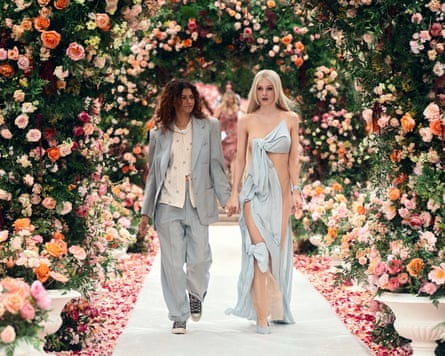
That wouldn’t necessarily be a bad thing if the show was exploring the nuances of female subjugation in an interesting way, like the HBO drama Industry, where the leads navigate the machismo-fuelled worlds of finance, politics and Britain’s archaic social class system. So far, Euphoria is falling far short of that mark. Instead, it comes across as a manosphere-tinted fantasy of how young women behave, glamorised with gorgeous costumes and the stunning cinematography that has become signature to Levinson’s work.
In Louis Theroux’s recent Netflix documentary, Inside the Manosphere, I was struck by how his subjects – each of whom created male-focused (and highly misogynistic) content – spoke about women. These men viewed women as manipulative creatures who, in their mind, only interact with men in order to extract their most valuable resources: clout and cash. This thesis runs through Euphoria, where Cassie – a character who was once motivated by love, so much so that she risked everything to steal Nate from her best friend – now seems totally obsessed with money and material things. When Nate initially objected to her launching an OnlyFans, he eventually agreed to it when Cassie insinuated that he couldn’t afford the wedding of her dreams, deviously denting his masculine pride for her own benefit. And at the end of their wedding night, when Nate is attacked by the gangster he borrowed money from to pay for the wedding, she seems more concerned about getting blood on her white dress. Cassie has always been vain, but she was once a sympathetic character. Now she’s empty and shallow.
There is also a “gamified” version of life that is central to both Euphoria and the manosphere. Theroux told me about this himself when I interviewed him last month. “A big part of their message is that life is a video game, and you need to win the game by scoring high in various metrics – how many people you have sex with, how much money you have, how big your muscles are, how big your privates are,” he said. “And if life is the ultimate game, then they’re pretending or alleging that they can teach you how to win it.”
Euphoria offers a feminised version of this narrative. “Throughout the history of America, there have been windows of time where anyone could get rich,” narrates Rue in the opening scenes of episode three, as we see Jules lathering red paint over a canvas. “The gold rush, prohibition, cryptocurrency – it’s all about timing. And Jules had found her window of opportunity.” Sadly, this “opportunity” turned out to be getting wined and dined by wealthy men who use her as a sexual object. It’s particularly bleak that Jules – a trans woman who has been fetishised since she was a teenager, who yearned to start her life beyond high school and find “her people” – would drop out of art school to follow this path. And while it’s not realistic to expect these characters to make “good” decisions, plots like this feel nihilistic and lost.
Another downstream effect of leaving the high school setting is that the American teen drama is a genre that justifies itself. There is something intrinsically fascinating (and relatable) about watching characters navigate adolescence – even if they’re driving sports cars and engaging in the type of hedonism that makes Skins look practically innocent. And once the show is taken out of there, you’ve got to figure out what it’s actually exploring.

I wonder if the difference here is that, unlike the previous two seasons, Euphoria’s final turn exists in the “attention economy”, where algorithms reward controversial, polarizing figures. The show has always had extreme, discourse-sparking moments, but it now feels like it’s going for the most provocative thing with the sole aim of dominating the social feed. Much of the dialogue and imagery now feels like engagement bait, tailored for an Instagram meme carousel, like when Cassie dressed up as a puppy and Nate told her: “You’ve been a bad, bad dog.” And to Levinson’s credit, this formula seems to be working for viewing figures, which are up significantly on previous seasons.
In season three, there is a glimmer of hope in Maddy Perez (Alexa Demie), who is one of the only characters who has anything close to resembling a direction. In episode two, we saw her getting a job as the assistant to a ruthless talent agent, which practically makes her a normie compared with drug smugglers and sugar babies. But we soon learn that Maddie is unfulfilled and believes that her 9-to-5 is getting in the way of her true calling: teaching women how to make millions on OnlyFans. Yawn. Once again the limit of Euphoria’s fantasy is catering to a male one.
-
Euphoria is on HBO Max