


Iranian journalists working in London say they fear for their lives after a recent spate of threats and physical attacks, which they blame on a Tehran regime intent on silencing Persian-language news media such as BBC Persian and Iran International.
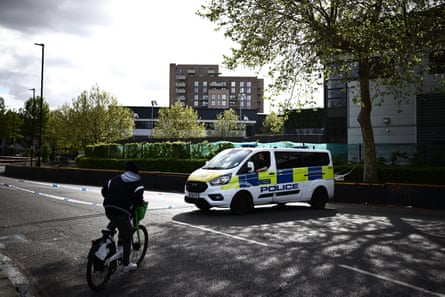
On Wednesday, the London offices of Iran International, a news channel that opposes the regime in Tehran, were the target of an attempted arson attack, with an “ignited container” thrown into the car park of a neighbouring building, according to the Metropolitan police.
Speaking after the attack, one journalist at Iran International says violence had become normalised to staff. “Our minds are ignoring these ugly things automatically.
“Today, our British staff said to us, ‘How brave you are, bravo!’ But to tell you the truth, what really happens is that we are fucked up. We’ve tricked our brains into normalising these threats and not fearing at all because otherwise we will need to go to the mental hospital.”
Transnational repression is the state-led targeting of refugees, dissidents and ordinary citizens living in exile. It involves the use of electronic surveillance, physical assault, intimidation and threats against family members to silence criticism. The Guardian’s Rights and freedom series is publishing a series of articles to highlight the dangers faced by citizens in countries including the UK.
Another Iran International journalist says Iranian security forces once showed a photo of his home balcony in London to his family back in Iran, warning them that “we are so close to him”. They then threatened the journalist and told him in a message, “we will cut you into pieces and send each separately to your family.”
Journalists from Iran International have been subjected to a number of attempted assassinations and abductions, and in 2024, TV presenter Pouria Zeraati was stabbed by a group of men outside his home in Wimbledon, south London, and was later forced to relocate abroad for his safety.
An Iranian journalist working for BBC Persian in London says the threats against her and her colleagues have escalated since the Israel-Iran war in June 2025 and again after the start of the mass street protests in Iran in December and early January. She says security forces in Iran told her family that she would be charged with moharebeh, or waging war against God, and sentenced to death.
“As soon as there is a crisis that’s when they [the Iranian regime] start to create fear, with more arrests, more executions and more threats and attacks on journalists. They just want their narrative to be the only one that people in Iran hear.
“I was crying for three days after the calls [with my family] because I was so worried about them. [As for myself in London] as much as you can be careful, you no longer feel safe. You are here living and working in the UK and then suddenly you find [the violence] has reached here. It’s really scary.
“I take it seriously because they can hire someone and hurt you here in London.”
Counter-terrorism experts have spoken before of foreign states using criminal proxies to carry out violence in the UK. A large number of Iranian journalists based in London have already been targeted.
An Iranian activist supporting people under threat in London says a number of journalists have told her that they have been told to “stop their work or their life would be in danger”.
“The threats have gone off the scale. It has become normal for journalists to be looking over their shoulder when outside and the ones who send their kids out to school suffer even more. They tell me they are not getting the support and protection in line with the level of threat they are receiving.”
Dr Lucia Ardovini, founding member of the Tackling Transnational Repression in the UK Working Group, says attacks were frequently carried out by members of the diaspora who “act as informal agents of the state fuelled by a deep-seated belief in official narratives that frame dissenters as national traitors or threats to stability”.
“The recent attack on the offices of Iran International in London is a clear example of these dynamics, as this followed a longstanding campaign by the Iranian state to label the outlet a ‘terrorist organisation’, a narrative that trickles down through community channels and online forums.
“Since the start of the war [between the US, Israel and Iran] the Iranian community has been targeted. There has not been a satisfactory response from the government. They [Iran International] are directly challenging the narrative of the Iranian regime and have a very big following in Iran,” says Ardovini, also a lecturer at Lancaster University.
For the journalists, the threats to life come on top of a traumatic period covering what they describe as “horrific footage” from the violent crackdown on the street protests in January when an estimated tens of thousands died.
“Imagine what we have been through with the January suppression … we saw two wars with corpses, damaged brains and a sea of blood from our own people in Iran.”
此内容由惯性聚合(RSS阅读器)自动聚合整理,仅供阅读参考。 原文来自 — 版权归原作者所有。