






The Hungarian election winner, Péter Magyar, is eyeing a special relationship with Poland’s prime minister, Donald Tusk to draw on the neighbouring country’s experience of repairing relations with the EU after years of illiberal rule.
Since 1989, the two countries have seemingly shared parallels in their paths. Now the two centre-right, pro-European leaders preside over the tricky task of restoring the rule of law and improving state institutions after years of democratic backsliding and clashes with the EU.
The leaders spoke on election night, with a jubilant Tusk calling Magyar from Korea: “I’m so happy. I think I am even happier than you, you know?”
Tusk told reporters the next morning: “First Warsaw, then Bucharest, Chișinău, and now Budapest. This part of Europe is showing that we are not condemned to corrupt and authoritarian rule.”
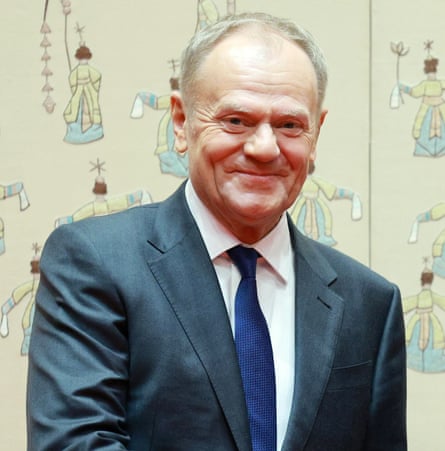
Visibly relieved, he added: “A weight has been lifted off my shoulders, because I was worried until the very end.”
Magyar swiftly repaid the compliments. Speaking at a press conference with Hungarian flags flanked by EU flags, he spoke about a “special relationship” with Poland, and picked Warsaw for his first foreign trip in office.
He also confirmed plans to move quickly against two former Polish ministers hiding in Budapest from prosecution over alleged abuses of power, saying they should not “go and buy furniture in Ikea, because they are not staying long”. The ministers had served in Poland’s rightwing Law and Justice (PiS) government, which lost power to Tusk’s Civic Coalition in 2023.
On Friday, it emerged the new parliament could be inaugurated and Magyar sworn in on 9 May, which is celebrated by the EU as “Europe Day”.
The partnership between the two leaders could play a pivotal role in bringing Budapest back to the main fold of European politics.
Once Magyar replaces the outgoing leader, Viktor Orbán, at the European Council, Tusk will become the most experienced leader at the table. His support and counsel could prove helpful in talks with the bloc.
On Friday, EU officials held their first informal talks with the incoming administration in Budapest. Brussels will want Magyar to drop Hungary’s block on a €90bn loan to Ukraine and to agree new sanctions against Russia as an early signal of political realignment.
Hungary will also be expected to meet several conditions related to its institutions, judiciary system, checks on corruption, asylum laws and academic freedoms.
Behind the scenes, Polish and Hungarian officials are already talking about how Poland’s recent efforts to reverse years of illiberal rule could apply to Hungary.
In 2023, the Civic Coalition ousted the rightwing populist PiS, and managed to successfully unlock billions in frozen EU funds.
The informal talks, launched in early 2026, months before the election, were “essentially about salvaging as much as possible of what would be otherwise lost under Orbán”, said one senior Polish official involved in the process.
But the clock is ticking as Hungary will have to hit its “super milestones” by the end of August to access the first tranche of €10.4bn. About €2.12bn has already been lost permanently.
The Polish officials, granted anonymity to talk about the confidential process, said they hoped swift progress could be made, but told their Hungarian partners “promises will not be enough; they will have to actually change things - and quickly”.
One source said: “There is always a political element to these talks, but there is no way around the fact that their paperwork will need to be in order.”
Magyar’s landslide win and constitutional two-thirds majority in the parliament should make the process smoother than in Poland, where changes were thwarted by looming veto power of opposition presidents, but will still “require work 24/7 to get it done on time,” they said.
While the Hungarian president does not hold similarly far-reaching prerogatives, Magyar has already urged Tamás Sulyok, a close Orbán ally, to resign or face being removed from office as he does not wish to take risks and wants a symbolic break from the regime.
Magyar’s pledge to join the European public prosecutor’s office and investigate the corruption and fraud of Orbán’s 16 years in power is also seen as a key element of the changes. Poland drafted its application to join the EPPO on the first day of new government.
Adam Bodnar, Poland’s justice minister until July last year, said the fact talks were taking place before Magyar’s government was sworn in was not surprising.
“You don’t really wait for day one of the government,” he told the Guardian at his Warsaw office. “We had some relations with the commission essentially for two weeks before the cabinet was formed, so I bet that Magyar’s people are already on the line … wondering how this can be done.”
With the two-third majority, “when they present an action plan, they will be actually able deliver on all of it. We could not … and that is why we are left to look for sometimes quite acrobatic solutions.”
But some of Poland’s problems could still be relevant to Hungary as officials sought to overhaul systems rife with illiberalism, Bodnar said.
“You can reform institutions, put in new judges, or hold competitions for top jobs, but in the end there still will be people who have been part of the system for these 16 years and cannot be replaced overnight,” he said. “So there is always a question of what effect [the Orbán era] will have on the mentality of state officials, prosecutors and judges.”
此内容由惯性聚合(RSS阅读器)自动聚合整理,仅供阅读参考。 原文来自 — 版权归原作者所有。