


Despite Donald Trump’s frequent bluster, Nadine Firmont said the US president’s move to pull American troops out of Germany had hit her town like a bombshell.
“I have to tell you I was honestly shocked,” said Firmont, 45, who works at a high school in Landstuhl, south-west Germany, the heart of the largest American military community outside the US.
Even with previous drawdowns and discussions of US redeployments, Trump’s angry outburst carried a blunt menace that startled Firmont and her neighbours.
Late on Friday, the Pentagon announced it would reduce its troop numbers in Germany by 5,000 personnel – just under 15% of its presence in the country – in part by not deploying a battalion the Biden administration had planned to relocate there later this year.
Ever since the march of Gen George Patton’s Third Army into the nearby city of Kaiserslautern in spring 1945, Americans have been woven into the fabric of life here.
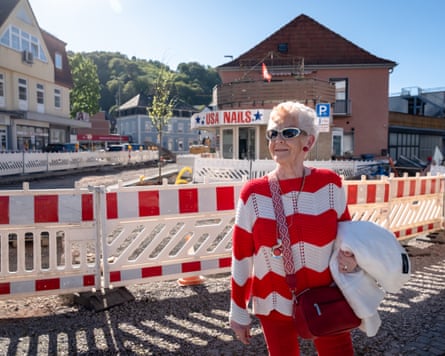
“We love our Americans – they enrich the community in every sense and make life more colourful,” said Firmont, who spoke before the Pentagon announcement. “Not everyone likes things like the noise of their military planes overhead, but it would be such a pity if the Americans left. It would hurt.”
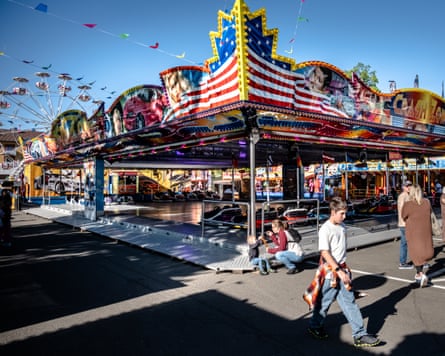
Firmont spoke as Americans and Germans, soldiers and civilians, young and old formed a winding queue to take part in the Landstuhl spring carnival in brilliant late afternoon sunshine.
The fairgrounds with children’s rides and stalls selling cheeseburgers and sausages were decorated with images of Uncle Sam and the stars and stripes, as revellers inside a marquee sipped beer and white wine, their pet dogs snoozing at their feet.
Beyond the restaurants and shops that live or die by American patronage, Firmont said generations of Germans had formed friendships and even families with their US guests – a singular identity for the region that now felt under siege.
Landstuhl hosts the largest overseas US hospital, an integral part of the Kaiserslautern military community of about 50,000 soldiers, support staff and family members.
The US had 68,000 active-duty military personnel assigned permanently in its overseas bases in Europe at the end of last year, with just over half – about 36,400 – stationed in Germany.
A vast network of German suppliers and staff working for the Americans in the area created a web of economic dependence and cultural cross-pollination that local people such as Marie, 30, a caregiver to elderly people, said made her feel special growing up.
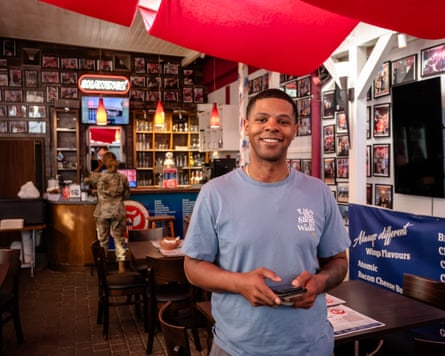
“It’s all I’ve ever known, it’s part of us,” she said, waiting with Joshua, her German-American husband, the son of a GI, for their order at Shawingz, a fried chicken chain catering to the US military community.
The menu, emblazoned with a mock presidential seal, boasts 50 sauces ranging in spiciness from mild sweet raspberry to “atomic”, with fried Oreo cookies for dessert.
Restaurant manager Karl Mazur-Rekowski, 48, who moved to the area as a child from Poland, said Landstuhl drew people who wanted to live with “the American feeling”.
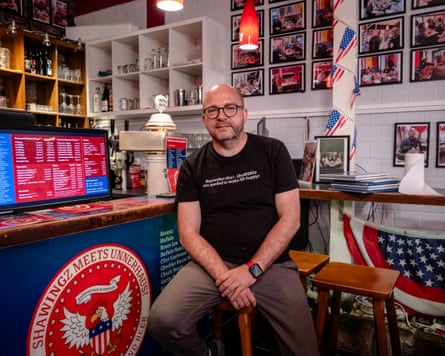
“They want contact with the Americans, to improve their English,” he said. “It’s obvious that if they pulled out, they would take a lot of jobs and businesses in a radius of 30km to 40km with them. We would fall on hard times.”
Mazur-Rekowski called for a return to the dialogue between Americans and Europeans that had smoothed over rough patches in the past, from the Vietnam war to the Iraq invasion and the NSA spying scandal.
“Diplomacy is the most important thing,” he said. “You don’t have to threaten, you can talk. Better to talk than to start something that leads to something terrible.”
Americans in the town spoke with affection about their German hosts, describing an unforgettably rich experience abroad that they would hate to leave behind.
Jeremy Cole, 31, who arrived with the US army from Kansas last year to work in logistics, said Landstuhl had welcomed his family with open arms.
“We’ve met a lot of good friends here – immediately, within like the first 30 days,” he said. “A local family showed us around and really exposed us to the businesses and lingo and food.”
Kahlen, his seven-year-old son, looked up from a dinosaur video on his dad’s phone to show off his German skills to a visitor including “danke”, “bitte” and counting to 11. “They do a lot here in the school system to make everyone bilingual,” Cole said. “And he’s a sponge for it.”
However, Leon Wilson, 38, from Florida, was less sentimental about the bond between the two countries. Born at a US base in Wiesbaden, Germany – “one of those soldier loves”, he said of his parents’ relationship in the American army – Wilson now fuels military trucks in Landstuhl.
He questioned whether all the US investment in Germany was paying off for Americans at home. “I feel no ill will, it’s great, there’s cohesion,” he said of US-German ties. “But it’s not fair that we keep boosting your economy so y’all can make money off us.”
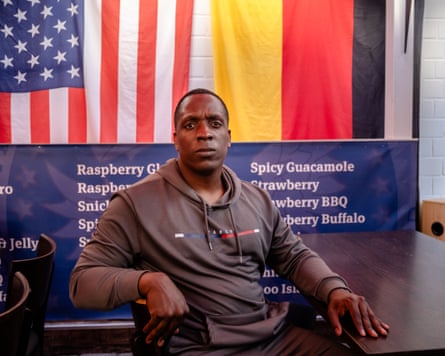
Chance Miller, 20, comes from a military family stretching back to the US civil war, when an ancestor from the north fought for the Union. He came to Landstuhl just over a year ago straight out of high school in Colorado to work in logistics, following in the footsteps of his GI grandfather, who was stationed here in the late 1960s.
“He loved it too and did the same things I like to do now,” Miller said, especially exploring the region that is just a 30-minute drive from the French border.
“I’ve got great friendships with Americans and Germans. I’d be really unhappy to go but would have to follow orders. I wouldn’t want to have to pack up and move and leave all of my friends though, I’d be so bummed.”
Asked how he saw the latest friction between the US and Nato, Miller admitted he was concerned. “The alliance is really under pressure now,” he said. “I’d prefer it if President Trump worked to protect the alliance.”