





More than 25 years after the existence of one of the Amazon’s most vulnerable nomadic hunter-gatherer communities was confirmed, the Brazilian government has begun demarcating the Pardo River Kawahiva Indigenous territory, giving greater protection to the uncontacted people.
The demarcation of the 410,000-hectare (1m-acre) territorylocated between the states of Mato Grosso and Amazonas in north-west Brazil, was confirmed by the National Indigenous Peoples’ Foundation (Funai) last week. But the process remains fraught, with legal challenges from groups linked to the country’s agribusiness sector, and the forthcoming presidential election in October.
Although highly threatened by armed groups linked to the expansion of farming, land grabs, illegal logging and mining in the region, some isolated Indigenous peoples are showing signs not only of surviving but even thriving in the Amazon.
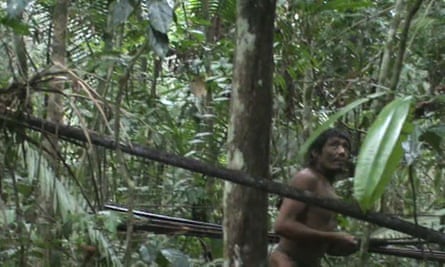
Yet anthropologists and experts say the Kawahiva’s survival relies on land being clearly mapped and physically marked to establish protected natural sanctuaries, which will help shield them from economic exploitation.
The go-ahead for demarcation of the Kawahiva do Rio Pardo Indigenous territory, home to about 290 Kawahiva people, has taken 27 years, after specialists first proved the existence of the uncontacted community in 1999. Campaigners say progress has only been possible thanks to Funai agents such as Jair Candor, whose expeditions into the forest have been crucial to identifying and protecting the Pardo River Kawahiva.
“Funai needs to be valued by Brazil as a body responsible for about 14% of the national territory,” Beto Marubo, an Indigenous leader from the Javari valley, said of the foundation’s work and the environmental reserves under its control.
Indigenous lands have recorded the lowest rates of deforestation in the Amazon in recent years, he added. “Kawahiva Indigenous land is an example of a region which, despite very high levels of rural violence, has not suffered any deforestation for two years.”
Political, legal, economic and logistical obstacles delayed the new boundaries, while agribusiness-linked groups opposed to demarcation have launched repeated legal challenges to stall progress.
“The entire region where the Pardo River Kawahiva Indigenous people live is under pressure from a clear push to expand the agricultural frontier,” said Renan Sotto Mayor, the federal public defender responsible for the National Office for Isolated Indigenous Peoples. “There is a great deal of economic interest in that region.”
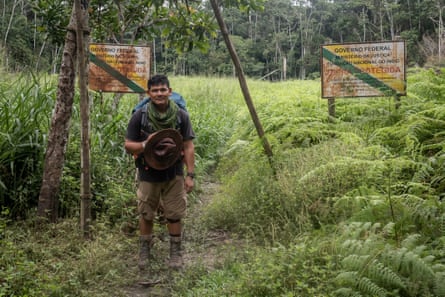
Indigenous leaders warn of the difficulties faced by Funai and federal police forces in ensuring the safety of isolated Indigenous people, agency staff and geodetic markers – permanent, physical reference points – during and after demarcation.
“Within this Indigenous territory, there has already been a massacre of landless workers, as well as other deaths linked to land disputes,” said Elias Bigui, former general coordinator for isolated Indigenous peoples at Funai, now an Indigenous affairs specialist at the Observatory of Isolated Peoples (OPI). “We need to strengthen Funai’s workforce so it can protect isolated Indigenous peoples.”
Funai said it was planning buffer zones to prevent environmental degradation at the edges of the territory. “A buffer zone extending beyond the territory’s boundaries creates a protective area between the Indigenous land and deforested areas,” said Lúcia Alberta Baré, the president of Funai.
Sotto Mayor and campaigners are continuing to seek to accelerate the demarcation of other lands inhabited by uncontacted peoples, such as Piripkura, Ituna-Itatá and Jacareúba-Katawixi.
Priscilla Oliveira, senior research officer at Survival International, said the Brazilian government should speed up demarcations until the Pardo River Kawahiva lands are formally recognised, which requires the president’s signature. It should also convert land-use restrictions into full demarcations in other regions and strengthen the identification and protection of isolated peoples who do not yet have formal safeguards.
“According to the government, there are 115 isolated groups, but only 29 have been confirmed. There is a long list of groups that may be there, or may no longer be there, and who need territorial protection,” said Oliveira.
In October, Brazil will hold presidential elections. Opinion polls suggest a dead heat between the leftist president, Luiz Inácio Lula da Silva, and Flávio Bolsonaro, a senator and the son of the former president, Jair Bolsonaro, who was convicted of attempting a coup d’état.
“The protection of Indigenous lands must be a state policy,” says Baré. “There should be no backsliding from whichever government takes office in our country.”