





As Yáng Shuāng-zǐ accepted the 2026 International Booker prize at the Tate Modern on Tuesday night for Taiwan Travelogue, alongside her translator Lin King, she used her speech to speak frankly about the political questions at the centre of her novel, set in 1930s Japan-occupied Taiwan. “Some people believe that art and literature must be kept far from politics,” Yáng told the audience. “But I believe that literature cannot be separated from the soil in which it has grown.”
When we speak the following morning, the 41-year-old writer returns quickly to the same theme. “Taiwanese people are suffering from an identity crisis,” she tells me. “Some of us believe ourselves to be Chinese and then others believe that we are Taiwanese, and I wanted to express that somehow through my book. As Taiwanese people, we need to ask ourselves now – do we want to go back to being colonised? Do we want to have to live like that again? Be second-class citizens in our own land? I refuse.”
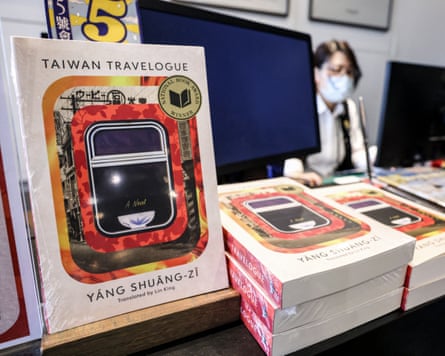
Those anxieties lie at the heart of Taiwan Travelogue, the first book originally written in Mandarin to win the £50,000 prize. Presented as the translation of a rediscovered travel memoir from 1938, the novel follows Aoyama, a Japanese novelist with a “monstrous appetite” touring Taiwan on a government-sponsored culinary trip. There she meets an enigmatic Taiwanese interpreter, Chizuru, with whom she becomes infatuated. Each chapter is named after a Taiwanese delicacy – braised minced pork, sliced raw fish, melon tea – creating a synaesthesia of taste, texture and longing. “Research for the novel’s central themes of travel and food changed my life in two obvious ways: my savings went down; my weight went up,” Yáng has previously joked.
Although it is set in the 30s, Taiwan Travelogue feels unmistakably modern in the questions it asks about national identity and colonialism. Taiwan remains one of the most politically sensitive territories in the world: a self-governing democracy claimed by Beijing as part of China, with the constant threat of military escalation hanging over it. Just last week, Donald Trump warned Taiwan against declaring independence, in some of the strongest language a US president has used thus far on the subject.
Born Yáng Jo-tzu, the writer adopted the pen name Shuāng-zǐ, meaning “twins”, as a tribute to her late twin sister, Yáng Jo-hui, who helped research the historical background of Taiwan Travelogue before her death. The novel is Yáng’s first to be translated into English but it has already had an extraordinary trajectory, becoming a literary sensation in Taiwan after its publication in 2020, then winning the National Book Award for translated literature in the US in 2024, and now the International Booker prize – an honour she describes as “surreal”.
The novel’s structural playfulness is central to its appeal. When Taiwan Travelogue first appeared in Mandarin, some readers believed it really was a rediscovered Japanese colonial-era text. In English, King leaned even further into that hall-of-mirrors effect, preserving and expanding the footnotes and competing narrative voices. The book’s fictional translators’ notes and editorial interventions create what International Booker judging chair Natasha Brown described as an “intriguing metafictional layer”.
“I appreciate that it’s a really hard book to read,” King says, laughing. “It’s been really heartening to see people willing to put in the work, when we’re constantly being told everyone’s attention is divided, nobody can do anything for more than two minutes at a time.”
The novel’s slipperiness in form echoes its emotional core. Aoyama and Chizuru’s relationship unfolds through interpretation and misinterpretation. Chizuru, the Taiwanese-born daughter of a concubine, feels herself socially inferior to Aoyama, an acclaimed Japanese novelist travelling under the protection of the colonial government. “It’s a story about love, but it is also a story about how love cannot overcome power dynamics,” Yáng says. “Love doesn’t overcome the differences between ruling-class and second-class citizens.”
Like Yáng, 33-year-old King, who is Taiwanese-American, is bracingly candid about the inextricability of art and politics. After Russia’s invasion of Ukraine in 2022, she saw echoes of Taiwan’s own geopolitical precarity, prompting her to pledge to translate only Taiwanese writing for the foreseeable future.
“My goal for myself and my fellow translators is to bring so many voices from Taiwan into English that no one can reduce Taiwan’s literature to a monolith,” she said on stage at the Tate. “Because we are not a chorus but a cacophony, self-contradicting and unruly, just like any healthy, robust democracy.”
The novel’s queerness is also central to that vision of Taiwan as a democratic society. Aoyama’s fascination with Chizuru is constrained by social convention. Yáng, who is in a relationship with a woman, sees the novel as part of a “rich heritage of queer literature” in Taiwan that emerged in the 90s. “But what I specifically wanted to write about is relationships between women in every form. Love between women.”
Taiwan has long occupied a distinctive position within Asia on LGBTQ+ rights. In 2019 it became the first Asian territory to legalise same-sex marriage, and remains one of only three in the region to do so. “I believe we are the most progressive state in the whole of east Asia,” Yáng says. “Whether that’s LGBTQ+ rights or women’s rights, we’re setting an example.”
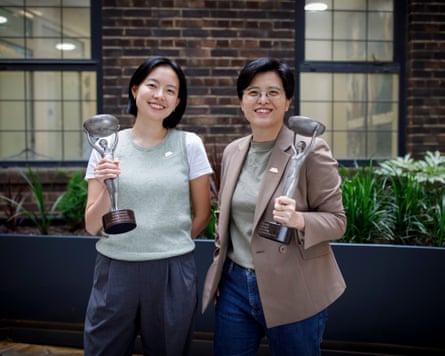
The International Booker uniquely splits its award equally between author and translator, highlighting translation as part of the creative process. And the success of Taiwan Travelogue comes amid growing anglophone interest in translated fiction, sales of which have surged in recent years. In 2023, UK readers spent £23m on translated fiction books, up by 12% from the previous year, and the largest purchase group was 25-34-year-olds.
While Taiwan Travelogue was published in the US in 2024, it took two more years for it to be released in the UK because no publisher was willing to put King’s name on the front cover as well as Yáng’s. That is until independent publisher And Other Stories came along, which is now celebrating its second consecutive International Booker prize win – last year’s award was won by Indian author Banu Mushtaq for Heart Lamp, translated into English by Deepa Bhasthi.
For King, the importance of translated fiction is self-evident. “The beauty of reading is that you’re being transported to a reality that is not your own, and learning about it, and that is epitomised by translated literature,” she says. “Whenever I look at prizes like this one, I feel so ignorant going down the longlist and thinking, ‘Wow, I didn’t even know that dictatorship existed, I didn’t know about that genocide or that change of regime or that dialect and how it’s been oppressed.’ There is just so much to learn.”
Not only has Taiwan Travelogue opened Taiwan up to readers unfamiliar with its history, King tells me that it has also resonated deeply with younger Taiwanese readers and the diaspora abroad.
“A lot of people have told me that it was their first time seeing Taiwan featured in such a way in an English-language book, and that it’s reinvigorated their interest to learn more about Taiwan,” she says. “That is one of the things I’m most happy about.”