







On a Monday evening in the upstairs room of Dishoom Permit Room in Notting Hill, the atmosphere is already crackling before the games night begins. Chai is poured and passed around, chalk is dusted across wooden boards, and the sharp click of counters striking the surface cuts through the noise of conversation.
At one table, Uneeb Khalid, 39, and his friend Varun Solan, 43, are deep in conversation about artificial intelligence while flicking small counters across a wooden board. Later, they reach the final round – and finish in second place.
Around them, the room is constantly shifting: players rotate between tables, conversations overlap and games restart in quick succession. Initially, it seems like a casual game night, but for many here, it’s a community in a city where it feels increasingly hard to come by.
The game is carrom, a centuries-old board game that originated in south Asia and is described as “playing pool with your fingers” and compared to draughts. Players flick a striker with their fingers to pocket small counters into corner pockets in the board, aiming to clear their pieces before their opponent. It is a game that has been played for generations across south Asia and within the diaspora, and is now at the centre of a growing grassroots revival in the UK.
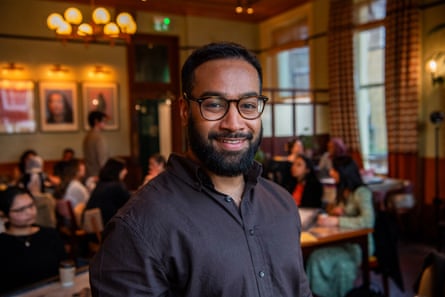
Behind its resurgence in the UK is Abdus Khan, 31, the founder of Karrom, a community built around the game that has now grown to about 12,000 people in the UK.
Demand for events such as this one has surged. For this night alone, 800 people tried to buy tickets, but only 44 managed to secure a place. A recent superleague tournament held at Boxpark Wembley drew 600 people, including players and spectators, in what Khan hopes will be the start of a recurring circuit.
For Khan, the appeal of the community and game can be traced back to his first memory of visiting family in Bangladesh as a child. “It was the first time I played [carrom] and one of the most fun experiences that I ever had as a child,” he says. His family later brought that exact board, which he still owns today, to the UK.
“It’s synonymous to some of the most cherished memories that I’ve ever experienced,” he says. “At the centre of all that happiness, laughter and community was that board.”
While its origins are widely disputed across India, Bangladesh, Pakistan and even as far west as Yemen, Khan says the game has always meant more than geography. “It’s a great celebration of bridging communities and cultures, and bringing people together,” he says.
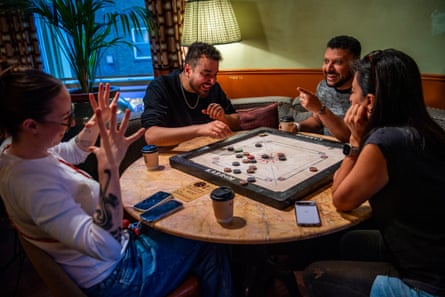
That sense of connection is visible at the games night. Uneeb, who first learned how to play from his grandmother, says this revival was surprising. “I thought it was dying a slow death,” he says. “I would have thought pool would be more popular with the younger generation. I’m pleased to see so many young people interested … it’s a refreshing change from our screens.”
Others have come to the game more recently. Zara Chechi, 29, first came across the community on Instagram last autumn. “A lot of us miss the community aspect of going to people’s houses, being around multigenerational families,” she says. To make up for this loss, Zara says she used social media to find events and like-minded people that she wants to “connect with in person rather than online”.
For Ala El-Kurd, 30, who first played carrom at a tournament at Boxpark Wembley and came to the games night alone, the appeal lies in its accessibility. “The barrier to entry is just ‘can you show up and play?’” he says.
He also describes a wider shift in behaviour, particularly among young people. “Less people are drinking nowadays, people are tired of endlessly scrolling social media. People crave friendship,” he says. “What’s been missing in my life is a sense of community … here, it feels so organic.”
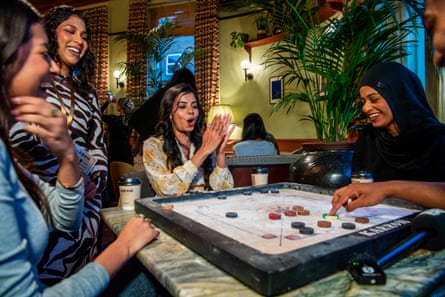
Now, Khan wants to reimagine the game entirely, with aims to take the superleague across the UK and the world, to San Francisco, Karachi, Riyadh and more. He draws parallels between darts, football and the Indian Premier League. “There’s no reason a game with such a global footprint and history can’t be reimagined,” he says.
For now, the focus remains on nights like this, where strangers of all backgrounds and ages are brought together for some friendly competition. The boards are cleared, biryani and chai is served, and the initial strangers continue conversation.
“People just want to come together and have a good time,” Khan says. “In a fragmented world, we need some unity.”