


Most people have made up their minds, and nothing you can say will change them: that’s the credo of parties such as Labour and the Democrats. Don’t challenge voters on the doorstep. Use focus groups to find out what they want, and give it to them. Follow, don’t lead. But all that’s on them, not us.
It’s true that conventional attempts at persuasion fail. A meta-analysis and original experiments by the political scientists Joshua Kalla and David Broockman found that “the best estimate of the effects of campaign contact and advertising” in US general elections “is zero”. But this says nothing about voters and everything about the useless approach of the parties trying to reach them.
Further work by the same scientists along with other people’s studies show that persuasive methods do exist. They don’t change everyone’s minds, but they can make enough difference to win elections and build a kinder, fairer, greener country. These techniques are known as “deep canvassing”.
Deep canvassing works only if you have a large army of volunteers, ideally from the community you’re trying to reach. Instead of delivering a message then scuttling away, as conventional canvassers do, their role is to connect and listen. Across conversations that might last for 10 or 20 minutes, they let people discuss their feelings. Then, without arguing or judging, they share their own experiences and ask questions (“have you ever been treated unfairly?”) that might reveal common ground.
The technique was developed by LGBT activists in Los Angeles after same-sex marriage rights were not voted into law in a state referendum. They wanted to find out why and to see whether people could change their minds. They were amazed by the response, and asked researchers to study the technique. The effects turned out to be significant.
Not only is deep canvassing persuasive but, by contrast to almost all other approaches, the change appears to be durable, at least over the course of months. It seems to have been a decisive factor in the election of Zohran Mamdani as mayor of New York.
What makes the difference is the listening. There’s a solid rule in life: if you don’t listen to other people, they won’t listen to you. I’m often told that people are “too exhausted” to engage in politics. That can mean they’re overwhelmed by work and family life. But it can also refer to the exhaustion of being unheard. The sense that no one is listening is alienating and demoralising.
Another benefit is that deep canvassing allows people to change their minds without losing face. A study in the journal Political Communication found that when someone is heard attentively and without judgment, “they are more likely to become more open-minded and process information in a less defensive manner”. Active listening creates “a sense of shared social identity”, which can build “faith in wider democratic processes”.
All this is compelling enough, but there may be an even more effective means of connection (though it awaits quantification). I’ve been following the work of a remarkable group in my own constituency, South Devon, called Common Ground. It’s not attached to any party, but seeks to prevent the far right from gaining power, to counteract division and create what it calls “a longing for kindness”. Its annual budget is under £400. Instead of going to people’s doors, the volunteers set up a board in a busy street and begin by asking people to put stickers on a chart.
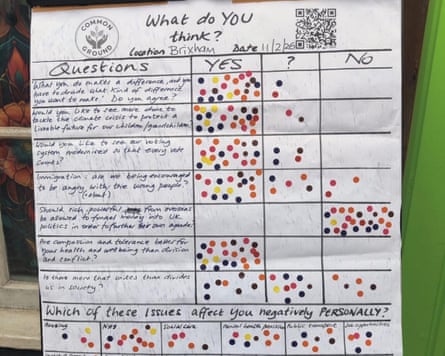
That’s another solid rule in life: people love stickers. On the board are questions designed to provoke conversation on issues such as the NHS, climate, the voting system, immigration, social media, Brexit, public services and polarisation, and boxes in which you can agree or disagree by adding a sticker.
The board is handwritten. Anthea Simmons, the driving force behind Common Ground, tells me this provides a reason to read out the questions to people who may be illiterate without embarrassing them. It’s also a way of starting a conversation. Then the volunteers ask people why they’ve made their choices. They listen attentively, occasionally saying something that connects their experiences, or gently correcting disinformation. It might be quick, it might go on for half an hour.
I’ve watched them at work in two places with high levels of deprivation and social crisis: Paignton and Brixham. These are prime targets for Reform UK, as alienation can easily be channelled into fury at immigrants and other out-groups.
In both places, a small crowd quickly formed around the board and people began chatting to each other as well as the volunteers. “Climate?” one person said. “It’s not affecting us very much yet.” Another replied: “My allotment disagrees. It’s a swamp.”
What leapt out immediately was that most respondents were far to the left of their own voting intentions. The distribution of their stickers suggested a very strong commitment to the NHS, action on climate, compassion, tolerance and an end to billionaire power. But many of the same people have voted or intend to vote for Reform, which would deliver the opposite. This discovery seemed to be equally startling to the participants.
Another thing I witnessed, especially when interviewing people just after these conversations, was a sense of relief, even exhilaration. People were buzzing. Some hardly seemed to hear my questions, but carried on talking about the issues that bothered them: the lack of NHS dentistry, the state of the harbour, corruption, AI, litter, the care crisis. It was as if a bottle had been uncorked.
Being heard is valuable in its own right. Loneliness and alienation, as well as being the feedstock of fascism, are major causes of human misery. The volunteers have been told by some people that it’s the only conversation they’ve had all week. Their overwhelming conclusion? People do care about the lives of others, even when influencers and algorithms push them towards hate and fear.
It wouldn’t be quite right to call this deep canvassing. The volunteers don’t have a script and they’re engaging across a range of issues rather than focusing on one. Perhaps it could be called “radical listening”. To judge by what I witnessed, they seem to have found a way of tearing down the walls dividing us. Do this everywhere, and who knows? We could have a very different country.
-
George Monbiot is a Guardian columnist