


When I ask Iron Maiden bassist and founder Steve Harris about the fact his band have lasted for more than half a century, he sounds bewildered, as if he’s put something down then forgotten where he’s left it. “It’s gone so quick. You go on tour for a few months and it seems to fly, but so much happens. Our whole career is an extension of that – for 50 years.”
He’s looking back on how he steered one of the most influential – and deeply idiosyncratic – British bands in history. Catapulted to the premier league of 80s metal on the back of galloping, theatrical, multi-platinum LPs including The Number of the Beast, Powerslave and Seventh Son of a Seventh Son, Iron Maiden not only survived the mid-90s slump that befell many metal bands, but got even more heavy and ambitious.
Last year they celebrated that 50th anniversary with the Run for Your Lives tour, which continues till this November and includes their biggest UK headline shows to date at their own two-day EddFest at Knebworth in July. Next month there’s also the cinema release of Burning Ambition, a through-the-decades documentary featuring rare archival footage spliced among talking heads including Tom Morello, Chuck D, Lars Ulrich and – less expectedly – Javier Bardem.
“Diehard Maiden fans will be saying: why isn’t it 10 hours long?” laughs ebullient singer Bruce Dickinson when I meet him alone in a hotel in London’s Soho. “But hopefully it’s an entertaining romp.”
Formed in London in 1975 by Harris, Maiden went through multiple lineup changes before settling on Paul Di’Anno as vocalist in 1978, and clawing to the forefront of the new wave of British heavy metal (NWOBHM) via constant gigging. A roughshod movement typified by eccentric theatrics and DIY ethics, the NWOBHM played out in backstreet pubs to crowds in customised denim and leather, all during the heyday of punk. Because of the band’s velocity and East End roots, critics sometimes made comparisons between punk and Maiden, but “I would’ve rather swept the roads than play that shit,” Harris says in Burning Ambition.
Dickinson was entrenched in the NWOBHM with his band Samson, who recorded in the studio next to Maiden when the latter were making their 1981 album Killers. “The NWOBHM! It was like: OK, if you can spell it you might as well say it,” Dickinson says. “But at ground zero, we were all: what are you talking about? This has been around for years.” He cites the Marquee Club in Soho and Music Machine (now Koko) in Camden, north London, as being “the pinnacle, where you wanted to be. Before then you were doing a bit of carpet in the corner of a pub.
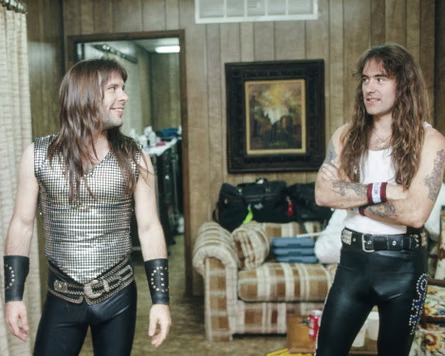
“The one thing metal did adopt [from punk] was the idea of ‘Let’s just do it ourselves’. People released their own singles, got deals with indie labels. Then punk kind of morphed into new wave and new romantic, but we didn’t morph into anything – we just cracked on.”
Maiden’s self-titled debut went into the UK charts at No 4 in 1980. However, by the time they released Killers, Di’Anno was burnt out. A wild figure partial to booze and drugs, he left the band in 1981 after a long, high-pressure tour. Dickinson joined after a comically blatant “clandestine chat” with Maiden manager Rod Smallwood, conducted under a vast floodlight in the middle of the hospitality area of Reading festival. A markedly different proposition to Di’Anno, Dickinson had what was soon to become one of the most instantly recognisable trademarks in metal: an octave-shattering, vibrato-laden beast of a voice, built to put blood on the walls. He was also disciplined, with the fortitude needed for months on the road.
“It was like being a striker for the Conference and they say: go and play front and centre for Man City,” he says. “But I was grossly overconfident because I was 21 years old: ‘Of course I’m going to get the gig, because I can do exactly what you want and a whole lot more.’ I knew how ambitious Steve was, and where he wanted to go with the music. It was obvious the band could be absolutely immense. I loved the fact that they were technically so accomplished as musicians … there were no limits, musically.”
Dickinson’s visceral narratives – what he describes as “theatre of the mind” – became the vital hallmark of Iron Maiden. He unleashed ceaseless literary references, from Samuel Taylor Coleridge’s Rime of the Ancient Mariner to Aldous Huxley’s Brave New World, and even 1950s social realist Alan Sillitoe with The Loneliness of the Long Distance Runner. Equally numerous are historical battles, epic political struggles and violent set pieces, as heard on songs such as Paschendale, Alexander the Great and The Trooper.
Iron Maiden hunkered down to record The Number of the Beast (1982). Containing three bona fide classics off the bat – the title track, Run to the Hills and Hallowed Be Thy Name – as well as slightly deeper cuts such as The Prisoner and Children of the Damned, the album did what Maiden had hitherto hinted at, but not definitively nailed: theatrical and thematically epic heavy metal that was as melodically soaring as it was raw, aggressive and immediate.
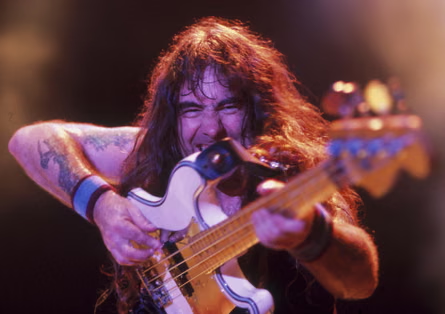
“When you go in with a batch of songs, you don’t necessarily think you’ve made a classic album,” Harris says in typically understated fashion. “I just think: well, we’ve made a bloody good album and people will either like it or they won’t.”
For all his Coleridge-quoting, Charge of the Light Brigade-evoking songwriting, Harris has a steadfast manner, like a stoical football manager – very different to the swashbuckling Dickinson, whose perspective on The Number of the Beast is almost diametrically opposite. “Did we know it was special? Yeah, we did! We’d stay in the studio afterwards listening back. We’d sit there drinking Watneys Party Sevens” – the era’s instantly recognisable cheap seven-pint mini-keg. “We built a wall of those bloody things and we’d get home at four in the morning after we’d stopped recording at eight or nine. The rest of the time we were just sat there pinching ourselves going: fucking hell, isn’t this great?”
Throughout the early 80s, a routine was set: write and record an album every year, tour, and then – if they were lucky – get a few weeks off for Christmas. For follow-up album Piece of Mind (1983), they went for broke. Smallwood took the gamble of booking arenas, rather than theatres, throughout the US – Madison Square Garden included. It paid off. Maiden were now a platinum-selling arena act, albeit one that operated outside music industry norms: no glossy videos, scant radio play and even less mainstream media coverage.
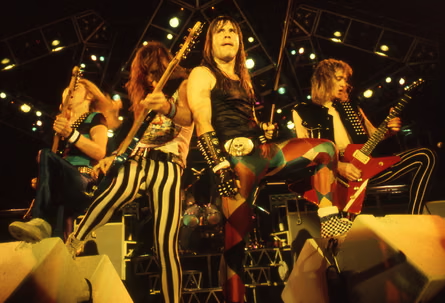
“When you’re in your 20s it’s amazing how much punishment your body can take,” says guitarist Adrian Smith, over a video call. “But a band like Maiden had to do that kind of schedule, because we’d never have a massive hit single and wait for royalty cheques landing on the mat. We went out there and took the music to the people. It pays back later on, though, because people remember that. But we got to the stage where we should have had a break … it does catch up with you.”
The gruelling and grimly named World Slavery Tour in support of 1984’s Powerslave was a case in point. By the end of it, the band were fried, Dickinson in particular.
“That was definitely a wobble for me,” he says. “I had no life. It started to feel like a golden cage. And that can’t be right. I started to think: is it worth it? Because I’m young enough to do something else. I was thinking of packing it in to become a fencing teacher. I wanted to walk away, because that’s preferable to losing your soul and everything else that goes with it.” He was worried he was getting disconnected from “the reason why I got into music in the first place: because it was a form of dramatic storytelling”.
While the Maiden faithful may be well versed in what amounts to a hefty reading list, does it ever grate that the lay listener may have no idea as to just how deep they go? “I wouldn’t say annoy, that’s too strong,” says Dickinson. “But it is irritating if people go, ‘You’re just a bunch of shallow idiots and that’s why you do the kind of music that you do, because you can’t do anything else.’”
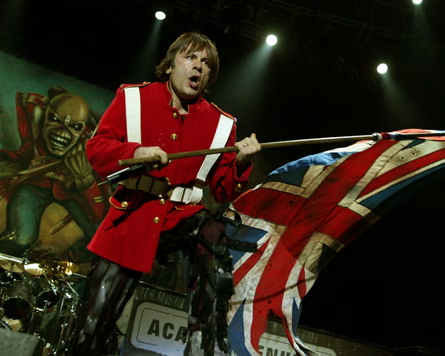
By 1990, heavy music was changing. Hard rockers such as Guns N’ Roses and thrash metallers such as Metallica were huge, and Maiden’s bombastic storytelling was in danger of seeming outdated. After 1988’s concept LP Seventh Son of a Seventh Son, 1990’s No Prayer for the Dying was to be a return to the roots of the Maiden sound, and a rickety mobile studio once used by the Rolling Stones was set up in the grounds of Harris’s Essex country house. The album included Bring Your Daughter … to the Slaughter, which became one of the only heavy metal songs to ever top the UK singles chart. But all was not well, and Smith, one of the most fleet-fingered and melodically intuitive guitarists of the era, decided to leave.
“These things are never clean cut,” he explains, “but I was in a kind of turmoil. I just couldn’t seem to come up with anything … Seventh Son, I was happy with that and it was getting bigger. But I wasn’t into getting back to a more garage sound. They said, ‘We can tell you’re not happy because of your body language.’ We had a meeting. That was it.”
At the time, Dickinson was a big fan of Alice in Chains and the “edgy and musical and emotional” Soundgarden. “There’s this huge chunk of talent and I was looking at it going: are we still on the zeitgeist, or is the Iron Maiden furniture looking a bit faded at this point? And nobody seemed bothered about it.” So he also left in 1993. “It was a period of reflection and self doubt. Realising that I had been in an institution since my early 20s and that I didn’t know how to do anything else outside that institution – I found that absolutely terrifying.”
Harris remembers lack of communication in the band at the time as a serious limiting factor. “It was almost: ‘All right, I’m leaving.’ ‘Oh, OK – well that’s it then.’ We didn’t really talk about it. It could’ve been avoided but you could argue that people needed to go away and find their own space.”
After the explosions of grunge and then nu-metal, the 90s became even more difficult for many 80s metallers, Maiden included. They soldiered on without Dickinson and Smith – both of whom had embarked on various solo and band projects, sometimes working together – recruiting Janick Gers (now one of three guitarists in 2026’s lineup alongside Smith and the long-serving Dave Murray) and singer Blaze Bayley, formerly of Wolfsbane. The albums they recorded in this period – The X Factor and Virtual XI – were strong, but Maiden’s star was waning, particularly in the US where, for the first time in decades, they were struggling to sell out theatres, let alone arenas.
“It was difficult in America,” says Harris. “Metal was struggling everywhere, though. With a long career you learn to go up and down with the waves, but you carry on regardless.”
Dickinson and Smith rejoined the band in 1999 and recorded the majestic Brave New World. Dickinson recalls a secretive meeting between himself and Harris that had been set up by management. “I just found the whole thing ludicrous,” he laughs. “The degree of paranoia lest me and Steve be seen together in public – I mean, it was like a bloody Len Deighton novel. I said: why don’t we just get together and have a talk? And Rod Smallwood said: no, no, no! So we ended up doing it in a yacht club in Brighton marina, where Rod cleared everybody out.”
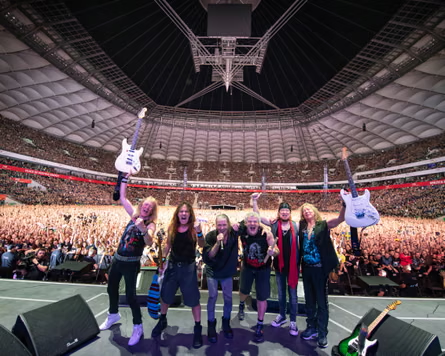
It led to a tight, energised Iron Maiden headlining the 2001 Rock in Rio festival in front of 250,000 people. Since then the albums have come at a less frenetic pace than in the 80s, but the quality bar has remained high, with a notably progressive, slow-building element coming to the fore: both Harris and Dickinson are long-time prog rock heads, namechecking bands such as Jethro Tull, Van der Graaf Generator, the Crazy World of Arthur Brown and Genesis. But though the songs may be longer and more complex, they are often heavier, too. Post-millennial albums like 2015’s The Book of Souls and 2021’s Senjutsu proved that combining their heat-off-the-valves intensity with unabashedly proggy theatrics could make them as vital – and in demand – as ever.
The eternally chipper Harris seems almost sorrowful at the prospect of the current tour coming to an end. “It looks like we’re taking next year off,” he says. “Personally, I didn’t want to, but that’s me. I’m just one of six people, despite what people might think. They don’t just all do as they’re told,” he says with a laugh. “Otherwise we’d be doing stuff next year, too.”
As for new music, “anyone can harp on about the early stuff, but what’s the point in doing Run to the Hills Part Two or The Trooper Part Two?” But he won’t be drawn on details of a possible next album. “We tend to get together in rehearsals and have a chat and see what everyone wants to do and go from there.”
Dickinson, meanwhile, gives off the same waves of confidence that he had as a 21-year-old, even as he sips coffee in a posh hotel. “Any song on the planet, if you give it to Iron Maiden it’ll always sound like Iron Maiden,” he says. “That’s incredible. You give the Rolling Stones something and ‘oh my God, it’s the Rolling Stones!’ – well, Maiden is like that, too. Don’t ask me how, don’t ask me why, don’t ask me where the magic comes from – at that point my analysis skills go in the dustbin. It just is.”