







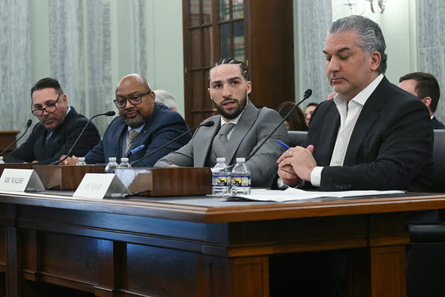
A US Senate hearing on the future of boxing laid bare a sharp divide over the sport’s direction on Wednesday, as longtime boxing figures including Oscar De La Hoya warned of proposed changes that could erode fighters’ rights while executives aligned with an Ultimate Fighting Championship-backed push for a centralized model argued they would bring structure and investment.
“When one system controls access, choice becomes theoretical, not real,” professional boxer Nico Ali Walsh told lawmakers, framing the stakes of a debate that could dramatically reshape boxing’s economic model. “When that happens, you fight who you’re told to fight or you don’t fight at all.”
At issue is a House-passed overhaul of the Muhammad Ali Boxing Reform Act that would allow the creation of centralized “Unified Boxing Organizations” (UBOs) operating alongside the current fragmented system. Supporters say the approach would simplify matchmaking and attract investment. Critics counter it would concentrate power and weaken fighter protections enshrined in federal law.
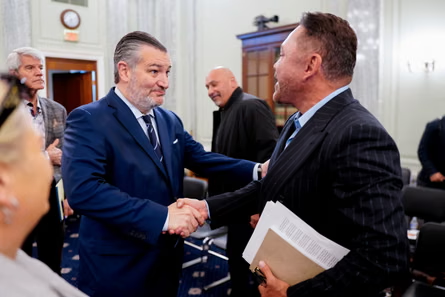
The hearing, convened by Texas senator Ted Cruz, who chairs the commerce, science and transportation committee, comes as the bill moves to the Senate, where lawmakers are weighing whether the current framework has kept pace with an evolving combat sports landscape.
“This is a fundamental shift in power that … would put corporate profits first, fighters second,” said De La Hoya, the former world champion turned promoter and a vocal critic of the proposal.
Decorum prevailed throughout Wednesday’s hearing, but the clash of perspectives was sharply drawn.
“The current state of the sport [is] difficult to witness,” said Nick Khan, a board member of TKO Group Holdings, the parent company of the UFC and World Wrestling Entertainment (WWE), which is backing the new Zuffa Boxing venture expected to operate under the proposed framework.
Khan pointed to a system in which multiple fighters can claim to be champion in the same division.
“There is no middleweight champion … there are at least four different people who say they are,” he said. “It would be like if Major League Baseball went to the Dodgers after they beat the Blue Jays and said, ‘No, we’re going to take this title away from you because you didn’t pay us money.’”
Walsh, the grandson of Muhammad Ali and a fighter with 15 professional bouts, rejected the premise that boxing is fundamentally flawed.
“Boxing is not broken,” he said. “If it were, UFC champions … would not be actively targeting boxing fights because of the fair pay.”
Underpinning the debate is a deeper structural question: whether boxing should remain a decentralized marketplace or move toward a single, top-down system backed by major investors.
The bill would sit alongside the existing law rather than replace it, allowing fighters to choose between competing under the traditional framework or within a unified system. But critics argue that distinction may prove more theoretical than real if the new model consolidates power.
Under the proposal, UBOs could act as both promoter and governing body, breaking from the Ali Act’s fundamental firewall between those roles and aligning more closely with the structure used in mixed martial arts. In practice, that would give a single entity significant influence over rankings, title shots and matchmaking, shaping both who fights and the terms of those fights.
That shift is widely seen as paving the way for ventures such as Zuffa Boxing, a joint enterprise backed by TKO Group Holdings and Saudi Arabia’s Public Investment Fund. The effort reflects a broader push by Saudi-backed entities to expand their influence over boxing, following heavy investment across sports that has often prioritized scale and visibility over short-term profitability.
The effort is being led in part by Dana White, the UFC president and longtime Donald Trump ally who has been tasked with building the new promotion and has promoted a league-style model in which “the best fight the best”.
TKO has sought to expand into boxing through Zuffa Boxing and a partnership with Turki al-Sheikh, the figure behind Saudi Arabia’s General Entertainment Authority and a close confidant of Crown Prince Mohammed bin Salman.
As previously reported by the Guardian, proposed changes to the law would allow exclusive, long-term contracts and reduce financial disclosure requirements, potentially limiting fighters’ ability to negotiate freely and understand the revenues generated by their bouts. The proposal also includes standards for fighter pay, medical coverage and drug testing, measures supporters say would bring greater consistency and safety to the sport.
Documents reviewed by the Guardian show some proposed agreements granting promoters broad control over a fighter’s career, including the ability to assign opponents and restrict participation in outside competitions. In some cases, contracts would allow promoters to count a bout as fulfilled even if a fighter withdraws due to injury, without paying the full purse. Fighters who choose to leave a unified system could forfeit their standing within it, including rankings or title status, diminishing their leverage in negotiations elsewhere.
The debate is unfolding against the backdrop of scrutiny over similar business models in combat sports.
In 2024, the UFC agreed to a $375m settlement with several hundred fighters to resolve an antitrust lawsuit alleging the promotion used its market power to suppress wages and limit competition. The company denied wrongdoing and related claims remain at issue in a separate, ongoing case.
Critics say the proposed boxing model mirrors key elements of that system, including unilateral control over matchmaking and long-term, exclusive contracts. The legislation would allow such structures to operate legally in boxing, where current federal law was specifically designed to prevent them.
For critics, that history bypasses the original spirit of the Ali Act. The law was intended to curb the influence of powerful promoters and sanctioning bodies, mandating financial transparency and separating business roles to protect fighters from coercive contracts and conflicts of interest.
At the heart of Wednesday’s hearing was whether that model would expand opportunity or restrict it.
“Give boxers the freedom to choose a better system,” Khan said, describing the proposal as an additional pathway rather than a replacement.
But Walsh warned that such choice could prove illusory.
“They say we have a choice,” he said. “But once they control everything, we won’t have a choice.”
De La Hoya echoed that concern, arguing that fighters’ bargaining power would erode over time.
“If this bill passes, fighters will have fewer choices, less leverage and less control over their careers,” he said. “Fighters deserve real protection and real opportunity, not have to fight the system as well.”
The divide was particularly pronounced on questions of pay and transparency.
Walsh said UFC fighters typically receive “under 20% of the revenue” compared with as much as 80% in boxing, warning that the proposed changes could push boxing toward a similar model.
“This proposed act is made for billionaires, not boxers,” he said. “It will certainly give more money to the shareholders, not the fighters.”
De La Hoya, who has accused backers of “begging for these changes” in order to gain greater control over fighters and the sport’s structure, also cast the proposal in geopolitical terms, describing it as part of a broader Saudi-backed push to reshape boxing through deep-pocketed investment.
Pointing to the Saudi-funded LIV Golf breakaway league, now imperiled after funding cutbacks, he cast it as a cautionary tale for boxing.
“Zuffa Boxing is fully funded by the Saudis,” De La Hoya said. “We’ve already seen how that kind of investment reshaped another sport through LIV Golf. We should be honest about what is happening here. That was sportswashing – a clear effort to use sport to reshape reputation. It should serve as a warning.”
Backers of the legislation, including executives tied to TKO Group Holdings’ Zuffa Boxing venture, say such investment is necessary to modernize boxing and compete with other global sports properties. Supporters also argued the current system has already driven fans and broadcasters away, citing long delays in making major fights.
“How many fans were lost in those six years?” Khan said, referring to the protracted negotiations for the 2015 super-fight between Floyd Mayweather and Manny Pacquiao.
Lawmakers appeared to be considering whether to preserve a fragmented system built on competition between promoters or open the door to a more unified structure modeled on other major sports leagues.
Summing up the case in blunt terms, Cruz framed the proposal as part of a broader push toward consolidation in sports, where centralized organization is seen as a pathway to generate more revenue. Drawing a parallel to ongoing debates over college sports, where lawmakers have explored allowing conferences to collectively negotiate media rights, he said the logic was similar.
“That is the argument,” he said. “A crap ton more money.”