







The Trump administration has long tried to wrap itself in Christianity, with Pete Hegseth, the defense secretary, invoking warfare “in the mighty and powerful name of Jesus Christ”. Trump even recently posted an AI image of himself as a Christ-like figure (later claiming he thought it was a doctor) and streamed himself reading the Bible.
But in reality, faith leaders have been some of the loudest and most consistent voices organizing against the administration’s policies.
Since the first time Trump was in office, Christian and Catholic groups have protested the militarization of ICE in American communities, provided physical shelter to migrants, hosted vigils and coordinated mutual aid. They are outraged by the administration waging war in the name of Christianity and are mobilizing “as an expression of their faith”, said Rev Dr Liz Theoharis, founder and executive director of the Kairos Center for Religions, Rights and Social Justice.
According to Theoharis and others heralding the efforts of progressive and social justice-motivated Christians, more people are joining them. They want to stake a claim to a version of Christianity that’s in opposition to Trump’s and Hegseth’s.
“One of the things that was pretty stunning and pretty clear from the very beginning of this Trump administration is how hungry people are to hear faith voices and to see faith leaders pushing back against this heretical theology and the weaponization of faith,” said Theoharis. “People are demanding both – to push back against this horrible theology and to live their faith in the public square.”
In the second Trump administration, faith-based resistance has been perhaps most visible in protecting immigrants.
In the fall, imagery of clergy and faith leaders thrown to the ground and handcuffed while protesting at a detention center outside Chicago made international headlines. During the January “economic blackout” organized by residents of Twin Cities residents, 99 faith leaders from across the country were arrested at the Minneapolis airport while protesting ICE operations. After Trump ended immigration enforcement protections for places of worship, Christian, Jewish, Sikh and other faith denominations, representing thousands of churches, sued the administration.
Christian leaders are also hosting continuing events in their local communities, such as Good Friday marches to ICE detention facilities. In El Paso, Texas, two Scalabrinians Sisters, Leticia Gutiérrez Valderrama and Elisete Signor, coordinate a migrant accompaniment program that has supported over 1,000 people in immigration court and more than 300 in ICE detention. They are also undertaking symbolic efforts of solidarity: in Harrisburg, Pennsylvania, Catholic Workers made themselves wearable “ankle monitors” in support of local migrants in an ICE “alternatives to detention” program.
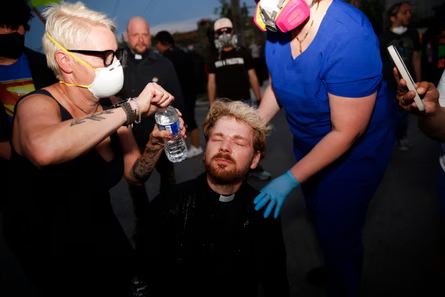
Many of these traditions are decades, if not centuries, old. Just look to the 1960s civil rights movement, led in part by Black Christians – from Dr Martin Luther King Jr to Bayard Rustin.
“Christians that are interested in social justice now and want to confront the Trump administration are not inventing something novel,” said Jonny Rashid, a pastor with West Philadelphia Mennonite Fellowship and a national organizer with Mennonite Action. “Christians have been navigating against injustice for a long time … we stand on their shoulders.”
Dorothy Day, co-founder of the Catholic Worker movement in 1932, was arrested dozens of times protesting against war and marching with farmworkers. The Berrigan brothers – two Catholic priests federally convicted as part of the Catonsville Nine, who burned nearly 400 draft cards in 1968 amid the Vietnam war – later helped launch the Plowshares, an anti-war Christian movement that damaged nuclear weapons in factories and led to arrests and jail time.
Over the last two centuries, houses of worship have provided shelter – from their role in the Underground Railroad to those resisting the Vietnam war draft. The first sanctuary city was established in Berkeley, California, in 1971, after an organizing effort by local churches to protect draft dodgers. The sanctuary movement later kicked up in the 1980s when US proxy wars in Central America led to a crisis for undocumented migrants seeking asylum and churches took them in.
Generations of organizers have been guided by the 20th-century emergence of Black liberation theology, Latin American liberation theology and Catholic social teaching – traditions that honor the basic dignity of human life and speak out against war and in favor of a social safety net.
Amid repeated cuts to social services, churches have provided basic needs through food kitchens, houses of hospitality and mutual aid. In January, Minnesota church Dios Habla Hoy, under pastor Sergio Amezcua, delivered more than 14,000 boxes of groceries to migrants sheltering in their homes from ICE.
Traveling the country and witnessing community uprisings against ICE in the past few months, Theoharis said: “The real heroes and heroines, the real saints of this world, are emerging. There’s really beautiful organizing happening right now, and I want the world to know about it.”
Reclaiming Christianity from the right
Faith-based organizing has also called for an end to war.
Faith leaders who have held “Moral Monday” actions for years – marching to call for funding for the poor and marginalized and away from war – rallied outside the White House last month against the war on Iran. In mid-April, yet more faith groups held a “pray-in” for nonviolence in DC, including the Kairos Center, Catholic Workers, Mennonite Action DMV and Churches for Middle East Peace.
Other iterations of their organizing are necessarily interpersonal. The Dorothea Project, whose name honors Dorothy Day and Sister Thea Bowman – the only Black woman in her convent at the time and who is credited with helping to desegregate the American Catholic church – was formed last spring. The women-led group organizes Catholic laywomen against injustice by hosting prayer circles, sharing educational resources about Catholic social teaching to pressure church leaders to condemn ICE. It also creates scripts to call and write Vance, who is Catholic, to end the war in Iran.
“We do this work collectively,” said Chrissy Kirchhoefer, a Catholic Worker, “but our small actions really can have a big impact.”
This weekend, Kirchhoefer is protesting with fellow Catholic Workers at a nuclear weapons part-making factory in Kansas City, Missouri. Her Catholic Worker house is also hosting a vigil over the war in Iran.
Multiple faith leaders told the Guardian they understand why people may not associate progressive organizing with Christianity. Rashid pointed to centuries of Christianity used as a tool of empire and repression, from manifest destiny and racialized chattel slavery to funding the fall of Roe v Wade. Communities impacted by those legacies, like LGBTQ+ people, may not feel comfortable joining them – though they too have predecessors in Christians such as Episcopal priest Pauli Murray.
While the right has organized some Christian denominations into a powerful voting bloc and Christian nationalism has grown in recent years, Rashid argues that it is not true Christianity: “Christian nationalism is fascism and authoritarianism decorated with Christian symbolism. It is a racist, xenophobic, authoritarian, fascistic ideology that gets sold as Christianity.”
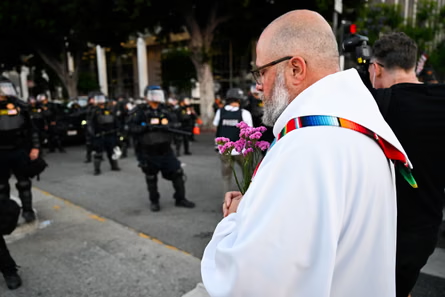
Two-thirds of Americans are either skeptical of or against Christian nationalism. And most of America’s millions of Christians, from various backgrounds and denominations, have never been all in on Trump: according to Pew Research polling from February, white Evangelicals “are the only large religious group in which a clear majority approve of Trump’s job performance”. Most Americans don’t see him as religious at all, according to recent Pew Research polling.
Even political candidates are seeking to reclaim the narrative that Christianity is not the property of Republicans or the right.
James Talarico, a Texas Democratic senate hopeful, has built his platform on a progressive vision of Christian faith, saying God is nonbinary on the Texas state house floor, where several anti-trans measures have passed over the past few years. The majority of Christians support LGBTQ+ rights and abortion access, both of which Talarico has also used Christian rhetoric to support. More clergy are also running as pro-social justice candidates while citing their faith – a sign people are calling for an alternative within the political sphere.
In response to Trump’s and Hegseth’s Christian nationalist rhetoric, Pope Leo XIV wrote this month, “God does not bless any conflict. Anyone who is a disciple of Christ, the Prince of Peace, is never on the side of those who once wielded the sword and today drop bombs.”
Of Hegseth’s call for “no mercy” for Iran, Kirchhoefer said: “That is a radically different orientation that is so counter to the message of Jesus – of nonviolence, turning the other cheek.”