
惯性聚合 高效追踪和阅读你感兴趣的博客、新闻、科技资讯
阅读原文 在惯性聚合中打开

推荐订阅源

Recent Announcements
博客园 - Franky
博客园 - 三生石上(FineUI控件)
H
Hackread – Cybersecurity News, Data Breaches, AI and More
Apple Machine Learning Research
云风的 BLOG
云风的 BLOG
人人都是产品经理
人人都是产品经理
博客园 - 【当耐特】
L
LangChain Blog
Stack Overflow Blog
Stack Overflow Blog
H
Help Net Security
爱范儿
爱范儿
罗磊的独立博客
博客园_首页
美团技术团队
让小产品的独立变现更简单 - ezindie.com
月光博客
月光博客
freeCodeCamp Programming Tutorials: Python, JavaScript, Git & More
量子位
OSCHINA 社区最新新闻
OSCHINA 社区最新新闻
钛媒体:引领未来商业与生活新知
钛媒体:引领未来商业与生活新知
博客园 - 叶小钗
V
Visual Studio Blog
T
Tailwind CSS Blog

The Guardian

New Zealand’s North Island braces for Cyclone Vaianu with thousands ordered to evacuate Artemis II splashdown – in pictures Swalwell denies allegations of sexual assault as calls grow for him to withdraw from California governor race Trump news at a glance: Epstein survivors have words for Melania Trump after surprise statement Multiple people face charges, including murder, in California fireworks blast Rory McIlroy surges into six-shot Masters lead with stunning second-round flourish Roberto De Zerbi targets ‘Ange-ball’ revival to save Spurs from relegation Bath hit back to reach semi-final after stunning Northampton in 11-try epic Australia crash out of BJK Cup after Britain secure upset with doubles win Zebras, wealth and power: Hungary’s election tests Orbán’s grip on power ‘TikTok effect’ brings sellout crowds and younger fans to Grand National meeting King signs up David Beckham to his Chelsea flower show team The war over Omagh’s gold: the £21bn mine plan tearing a community apart Britain’s shadow workforce is paid as little as 65p an hour. Who cares for the carers? Tim Dowling: my wife is on a quest to restore my thinning hair SUVs are making Britain’s potholes worse, say scientists Blind date: ‘She claimed she was usually shy. I wouldn’t have guessed’ I’m a sauna person now: the Becky Barnicoat cartoon ‘I got everything I dreamed of – when I had no ability to handle it’: Lena Dunham on toxic fame, broken friendships and her ‘lost decade’ Six great reads: the man who let snakes bite him, masked heavy metal and the brutal reality for foreign students in the UK Meera Sodha’s recipe for noodles with rose beancurd, spring greens and egg Cuba’s doctors were a lifeline for the world. Now the Caribbean is shamefully complicit in the US drive to expel them An environmental disaster in Moldova has Russia’s fingerprints all over it ‘This is as important as your teeth’: are you skipping this key part of mouth hygiene? Man arrested after four die trying to cross Channel in small boat Ukraine war briefing: doubts linger in Kyiv over Moscow’s promise to uphold Orthodox Easter ceasefire Ichiro Suzuki statue unveiling goes awry as bronze bat snaps during ceremony Arrest of national war hero Ben Roberts-Smith cuts deeply to core of Australian psyche European football: Real Madrid held at home by Girona to extend winless run ‘You come back different’: how rugby players change after motherhood
‘Magical’ objects from iron age hoard found in UK go on d...
Mark Brown N · 2026-05-14 · via The Guardian

Iron age objects that tell a dramatic story of female power and which dispel the myth that northern Britain was a left-behind backwater have gone on display for the first time.

The objects exhibited in York are from the Melsonby hoard, the largest trove of iron age metalwork ever found in the UK, which experts say could alter our understanding of life in Britain 2,000 years ago.

The hoard, which comprises more than 800 items, is almost certainly associated with a tribe called the Brigantes, who controlled most of what is now northern England and whose most famous leader was Queen Cartimandua.

There are fragments of chariots, bridle bits, weapons, a cauldron, a mysterious mirror and much more – all of them deliberately dismantled and burned before they were buried. It was a “crazy amount of effort and work”, said Yorkshire Museum’s senior curator, Glynn Davis.
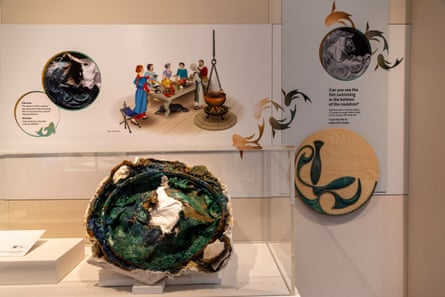
The cauldron in a display case at the museum
The cauldron found in the hoard, which comprises more than 800 objects. Photograph: Gary Calton/The Guardian

The hoard was acquired by the museum after it raised more than £265,000, including £192,000 from the National Heritage Memorial Fund.

It is, everyone associated with the hoard believes, an unprecedented, once-in-a-generation find. Five years after its initial discovery by a metal detectorist, the public will now be able to see what all the fuss is about.

The big question is why the objects were buried: was it to mark an important feast or festival? Did the Brigantes capture treasures after a fight? Was it for the funeral of one of their most important people?

The exhibition asks the questions rather than answering them, although its lead curator, Emily North, points to one rare object going on display – a large, heavily corroded iron mirror.

“The mirror is my absolute favourite object,” North said. “It is spectacular and that’s not because of how it looks, because it doesn’t look like an awful lot at the moment.

“It is the clue that could solve the puzzle of why people buried this hoard.”
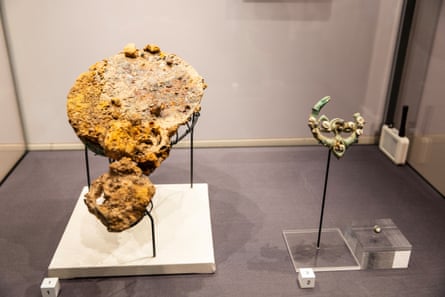
A rusted and corroded mirror on display at the museum
The mirror, left, could have belonged to Cartimandua’s mother or grandmother, said the exhibition’s lead curator, Emily North. Photograph: Gary Calton/The Guardian

Iron age mirrors are exclusively associated with powerful women and have not been found in the graves of men or children.

North said the timing was not quite right for it to have belonged to Cartimandua but that it could have belonged to her mother or grandmother.

“It is a magical object associated with female power,” she said. “This mirror would have given quite a distorted view of the person who was looking into it.”

North said the mirror was less likely to have been an object of vanity and more seen as a “bridge to a past life”. It suggests a story of a powerful older woman “and her connection to a mystical world”.

Just under a fifth of the hoard has gone on display, with more to come in future years.

At the centre of the show is a climate-controlled case containing what has become known as “the block” – a 150kg corroded tangle of objects.

Early on it became clear that to dismantle the block would permanently damage objects in it, curators said.
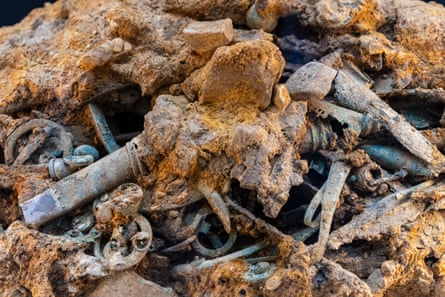
Closeup of 'the block'
Among the objects in ‘the block’ are a ‘stylised boar’s head that’s part of an object and also a man’s face’, North said. Photograph: Gary Calton/The Guardian

“It is an incredibly tantalising object,” said North. “You can peek through the surface at some of the things that are hidden inside. There’s a stylised boar’s head that’s part of an object and also a man’s face … To see the face of an iron age Briton as they depicted themselves is something very, very special.”

From Roman times onwards, iron age life in northern Britain has been seen as less developed and less connected than in the south, but experts say the Melsonby hoard means we need to rethink that.

“The sheer wealth, artistry, skill and international connections that are revealed by the objects in the hoard really show that the iron age north of Britain was a vibrant place to be,” said North. “It was not left behind in any sense of the word.”