


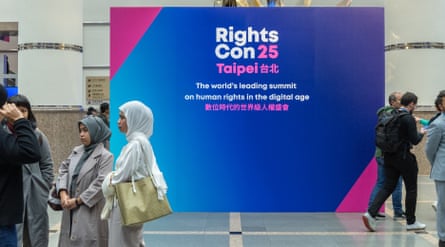
The world’s largest conference on human rights and technology has been cancelled just days before it was due to start after the Zambian government told organisers it did not align with “national values”.
Zambia’s government had originally welcomed the RightsCon 2026 summit on “human rights in the digital age”, due to be held in the capital, Lusaka, on 5-8 May, but Thabo Kawana, permanent secretary for the Ministry of Information & Media, said last week that the conference would not go ahead to allow time to ensure the gathering “aligns with Zambia’s national values, policy priorities, and broader public interest considerations”.
More than 2,600 activists, technologists, academics and policymakers were expected to begin arriving in Lusaka over the weekend. The event was to address issues of human rights in the digital age, including online hate, internet shutdowns, AI, surveillance, the militarisation of tech and disinformation at a time when democratic, women’s and LGBTQ+ rights are under intense assault.

Rights campaigners have called the decision a blatant act of censorship and part of a broader pattern of suppression of legitimate debate.
Zambian news reports have suggested pressure from China could be behind the surprise move – several Taiwanese delegates had been due to attend and the conference was being held in a venue donated by China. The conference, now in its 14th year, was held in Taipei last year.
Linda Kasonde, a prominent Zambian lawyer and civil society activist who founded the LCK Freedom Foundation, said the decision showed a disregard for human rights. “When the current administration came into power, they were a government of rule of law and democracy. What we are seeing is a slow degradation of rights – of freedom of expression and the right to assemble.”
Kasonde suggested the move was linked to the forthcoming general election. “We go to the polls in August 2026,” she said “In the run-up, the government has steadily been putting in place laws that make it easier to win and entrench power post-election. Political parties and civil society have been denied the opportunity to meet in public.”
It was a blow for Zambia’s reputation, she added. “This was the first time RightsCon was being held in southern Africa and it was a showcase for our region.
“It is highly unfortunate that it was cancelled at the very last minute for an extremely disingenuous reason, especially as the government had been involved in the planning process, which took over a year,” she said. “It really dents the image of our country.”
In a statement issued on Friday RightsCon organiser, the New York-based organisation Access Now, said it had spent months liaising with government relationships to ensure transparency and mutual understanding around the conference. “We see this unilateral decision, and the way it was taken, as evidence of the far reach of transnational repression targeting civil society, and effectively shrinking the spaces in which we operate. At a time when this sector is already under immense financial and political strain, what we and our community forcefully experienced is unprecedented and existential,” it said.
Most delegates had already booked and paid for their travel. Karna Kone, from Côte d’Ivoire, who was due to join a panel on digital censorship, had spent months organising his visa to Zambia. “Travelling from west Africa is very expensive and a lot of logistical work. It’s a loss in terms of money and of energy.”
It was also a loss of opportunity, added Kone, who works for the ODAS Centre, a coalition of reproductive health organisations.
“Security was the reason we were going. Our members face online harassment and physical threats because of their focus on [strengthening access to] safe abortion. RightsCon was one of very few global spaces we could connect and share our work. This was a chance to give voice to Francophone Africa. Now this conversation has been silenced.”
Chioma Agwuegbo, director of TechHer, a Nigerian organisation mentoring girls in technology, was also due to speak and said RightsCon was a rare opportunity for organisations to come up with solutions to pressing challenges.
“At a time when civic space across the continent is increasingly shrinking, this incident reflects a troubling pattern where compliance mechanisms are weaponised to restrict convening, dialogue and dissent,” she said.
“These constraints silence voices and weaken ecosystems working to protect fundamental human rights, including the safety and dignity of women and girls online.”
A significant number of speakers were lined up to address issues around the online censorship of sexual and reproductive health rights (SRHR).
“It is deeply ironic that a conference dedicated to strengthening rights and participation in digital spaces is being shut down in this way,” said Martha Dimitratou, director of Repro Uncensored, which has conducted research showing how tech companies regularly restrict or close SRHR-related online accounts.
Luca Stevenson, of the International Planned Parenthood Federation, said RightsCon was a “critical” space for communities already pushed to the margins, “including sex workers, LGBTQIA+ people, and those seeking sexual and reproductive healthcare”.
Sibongile Ndashe, a South African lawyer and human rights activist who founded the Initiative for Strategic Litigation in Africa, said the Zambian government’s move set a dangerous precedent. “If cancellation of conferences becomes normalised, it is human rights groups that will progressively find it hard to convene,” she said. “Restrictions on human rights harm those without power.”