






A surfboard split in the middle to create crab pincers. Another that looks like an exaggerated take on a stingray. A surfboard with a webbed bottom contour, like a duck’s foot. And a fire-engine red skateboard shaped like a cartoon-like flame on wheels.
All of Lucas Lecacheur’s surfboards and skateboards push the boundaries of accepted norms – and incredibly, they are all also functional. Beachgoers on the French holiday island Île de Ré, where Lecacheur grew up, have become accustomed to seeing his black leather-clad figure on the sand, holding the Brutalist – an enormous and sharply contoured board – under his arm.
Lecacheur is a French designer and has surfed since he was a child. He spent years as a rock musician, touring and travelling with his underground band Bad Pelicans. His experiments in surfboard design grew out of a lifelong desire to do things differently; to synthesise his two greatest passions – performance and surfing – and “reinterpret it”.
“In rock’n’roll, I was always looking for a new sound, a new energy,” he says. “I thought, how can I bring that to surfing? What if I made a cowboy boot surfboard? A guillotine surfboard? A brutalist one? A crab?”
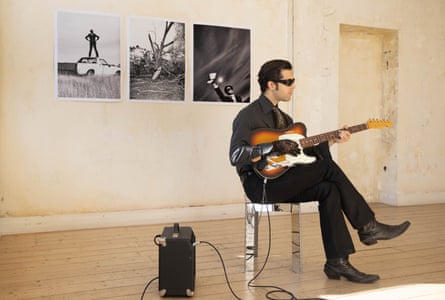
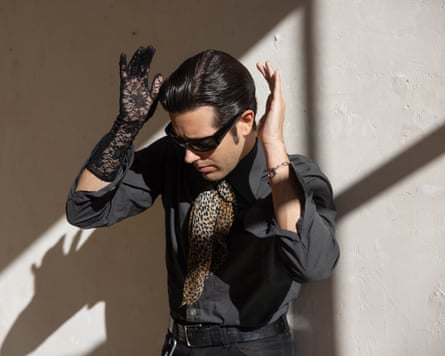
Lecacheur is in Australia as part of Melbourne Design Week, living and working out of At The Above gallery on Fitzroy’s Gertrude Street. When I go there to meet him, I ascend into a cavernous, light-filled space. No one else is there but Lecacheur. He is dressed entirely in black: leather jacket, cowboy boots, sunglasses. He is strumming a guitar, seated by the windows. With a jolt, I realise he has created this tableau in anticipation of my arrival. It’s like a scene from a movie; I can’t help but appreciate the dedication.
Lecacheur is spending his six-week residency ensconced in the gallery, sleeping on a double mattress on the floor. Nearby, old box televisions show flickering scenes from a documentary made about his previous work. There are two Scarpa lounge chairs flanking a turntable on the floor, alongside scattered vinyl records. Photos are tacked all over the walls, while part of the floor is covered in photos of his various surfboards.
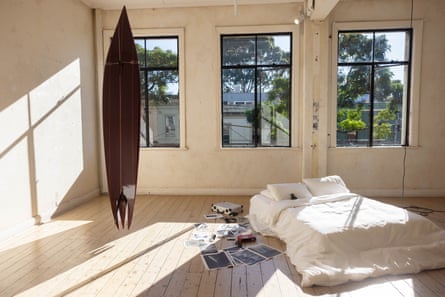
While his surfboards are outlandish, the designer has tried surfing with several of them, including the Brutalist and the sleek, pearlescent Medusa. “The Medusa is very challenging because it has a massive flex tail, it’s all made in epoxy and there is no leash loop, so you have to be very careful,” he says.
“But otherwise it’s a beautiful feeling, to try something that no one else has tried. It feels like being a beginner again, having the feeling of the first wave “
How do other surfers respond to his boards? “It’s always an event on the beach. I went to Bells Beach this week with the board I just made. We parked the car and within a minute we could hear, “Oh God, that’s so sick! What’s your Instagram? That board is so sick!”
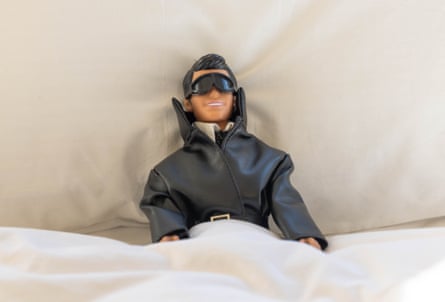
Lecacheur was born in Paris but was raised on Île de Ré, off of France’s west coast. His boards are made the traditional way, in surfboard factories, and use regular materials like fibreglass. On the days he goes into the factor to shape his boards, Lecacheur dresses in one of his many 80s and 90s suits by the likes of Yves Saint Laurent, Armani and Givenchy, some picked up in Paris vintage stores for as little as 1 euro.
“When you dress in a different way, you might end up with a different result,” he explains. “Style is a muscle.”
For Melbourne Design Week, Lecacheur has created two entirely new surfboards. One, called Château Rouge, is a 10-foot long surfboard with a cowboy boot nose and a forked tail. Lecacheur describes the other as being shaped by the land of Australia: “I attached a blank surfboard form to a chain, attached it to a ute in the Australian bush, and I drove the car, dragging it behind. You can see pieces of wood inside, grass, lots of dirt.” That board will be cast in resin to preserve all the collected debris of the bush.
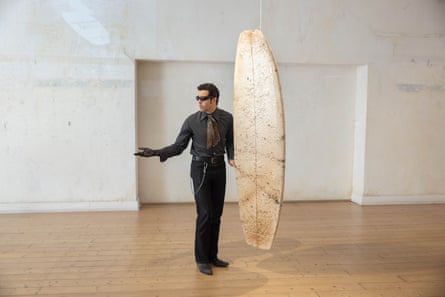
The exhibition also features drawings and examples of dozens of experimental fins designed by Lecacheur. These include a spiky metal fin named Total Mayhem, the terrifying Hook, and the aptly named Bat Fin no.6, which looks like a bat wing.
Lecacheur’s enormous and sharp-looking Guillotine board is now held in a gallery in Tokyo. He has built a solid following in Japan and the US, and spends large parts of each year in both countries, and six months of each year on the road. He is now on a world tour – he was in Japan and Indonesia before Australia – and, in an unguarded moment, admits it can be a lonely life. But such is his dedication to his craft.
“I believe if we go outside the box and explore, we could find something that could be an advancement, a progression,” he tells me. “But someone has to try, someone has to do it. Otherwise you’re not evolving.”
Aside from his out-there boards, Lecacheur is also behind a playful photography series called the White Fin Project: a tongue-in-cheek idea that sees him attach a white surfboard fin to various objects, such as a grandfather clock, a cutting board, a post box, an ATM, a bathroom mirror and even the Eiffel Tower. In his world anything can be a surfboard.
Before interviewing him, I watch an Instagram video where he flamboyantly attaches the fin to a chair leg, to the whoops and cheers of an assembled crowd. The video makes no sense to me, but after we meet it falls into place: for a brief moment an ordinary object is turned into “a vehicle of magic”, as Lecacheur puts it, “that helps people to dream a little more”. It is all part of his push against the boundaries of craft and design, injecting it with more individuality and flair.
“It’s a quest,” Lecacheur says, a little sheepishly, as if he knows that the earnestness of the comment rubs against his carefully curated image. “I do it to help other people dream more and accept their own ideas.”
-
Melbourne Design Week runs until 24 May