








Molière is to the French what Shakespeare is to the English: the last word in historical literature, drama, wit and satire.
Now, more than 350 years after his death, the 17th-century dramatist has been revived after scholars at the Sorbonne University in Paris used artificial intelligence to help write an experimental play in his style.
L’Astrologue ou les Faux Présages (The Astrologer, or False Omens), a three-act comedy, made its debut at the Royal Opera at the Château de Versailles last week.
The two-hour play tells the story of a wealthy bourgeois Parisian who, under the instruction of a charlatan astrologer called Pseudoramus, insists his daughter Lucile marry a debt-ridden and elderly wigmaker.
While the theme could well have been dreamed up by Molière, the dialogue, music, costumes and scenery were all created with the help of a French AI tool called Le Chat (The Cat).
A group of researchers at the Sorbonne worked on the project, called Molière Ex Machina, for two and a half years. The team included a three-person group of artists and researchers called Obvious.

The production involved what they described as “intellectual ping pong” of about 20,000 exchanges between researchers, classical literature scholars, linguists, historians and Le Chat. As the team fed more information into the AI assistant, each word and scene it came up with went through numerous rewrites as the researchers explained to the AI assistant why certain passages did not work and asked it to try again.
“The process was long and demanding,” said the play’s director, Mickaël Bouffard, the head of the Théâtre Molière Sorbonne. He added that Le Chat’s first draft ran to only eight pages that were “not very interesting” and as a result “scenes had to be revised multiple times”.
“AI has a superpower: the ability to store everything Molière wrote and everything Molière read,” Bouffard told France Info. “We human beings can’t do that.”
The theme of astrology, which featured in at least one original Molière play, and the play’s title were suggested by the AI and touched on current preoccupations regarding the use of the technology. “Astrology allows us to discuss manipulation, false beliefs and disinformation, which are particularly topical subjects,” said Pierre-Marie Chauvin, an associate professor at the Sorbonne.
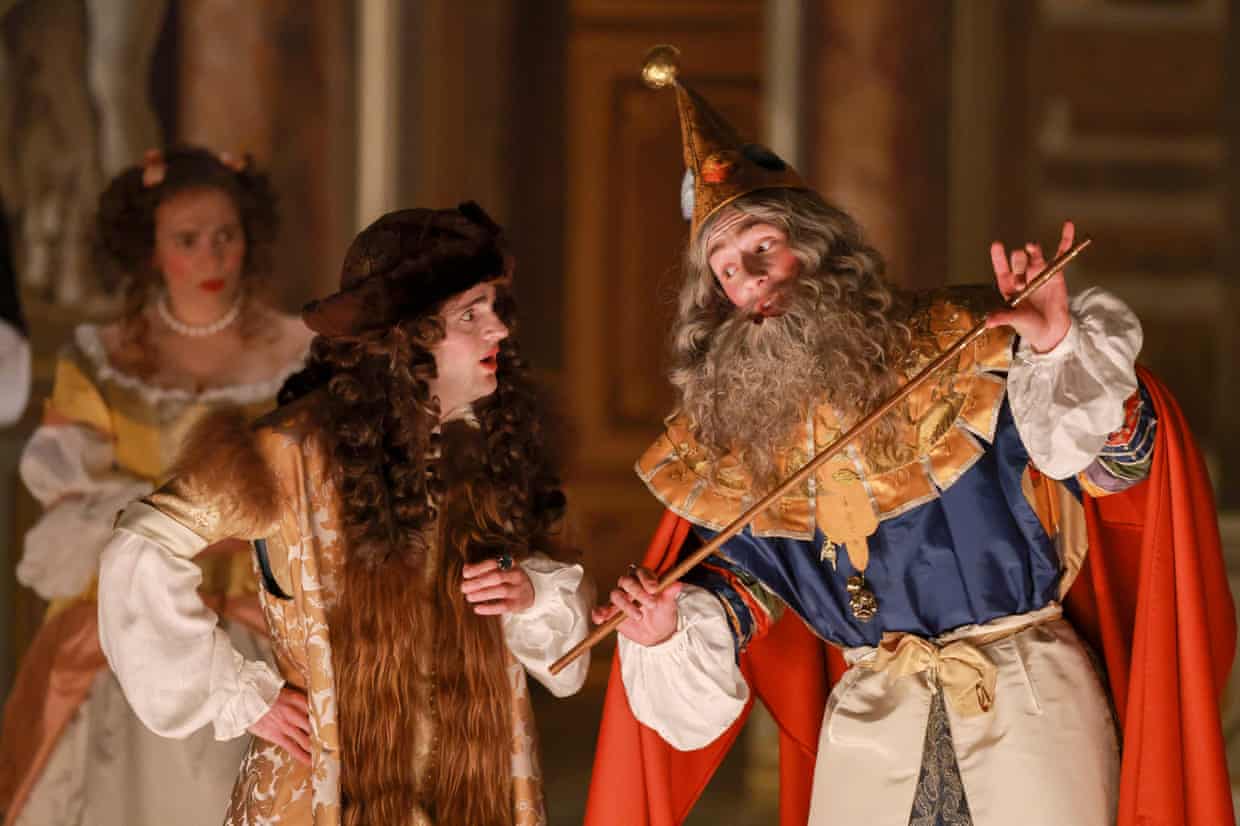
Molière, who died in 1673, was so influential that French is often referred to as “the language of Molière”.
AI remains one of the most sensitive issues in the entertainment industry and has generated intense debate. Using it to imitate Molière would have caused outrage in France were the project not being carried out by academic experts at the Théâtre Molière, which specialises in accurately reconstructing 17th-century productions.
A report submitted to the national assembly last year suggested generative AI was a “marvellous opportunity, a stimulating tool and a powerful driver of creativity”. But it also said AI “poses a threat to many professions in the cultural sector because it enables the production of content that may compete directly with human creations”, adding: “It is necessary to strike a balance between different forms of creation.”
Chauvin said L’Astrologue had struck that balance. “We are demonstrating in concrete terms something that can be achieved in a novel way with AI. Not a play written by AI, but a play co-written with it,” he said.
An audience of 100 people, including Catherine Pégard, the culture minister, saw the play during two performances last week. Afterwards, one audience member said: “I think it’s a success. The plot feels so real, the subject matter is so close to what we’re used to hearing in these [Molière] plays.”
Another theatregoer was less impressed. “A decent writer can do this without artificial intelligence,” he said. “I think we [humans] still have a bright future.”
Christophe Séfrin, the technology editor for the news website 20 Minutes, attended one of the two performances. He described the AI imitation as “striking, almost disconcerting” and said the dialogue was “entirely believable”.
The magazine Telerama described it as a “crazy venture” but said the play at times “seems like a pastiche of the playwright’s work”.
The Théâtre Molière Sorbonne and Obvious plan to perform the play across France and to take it abroad.